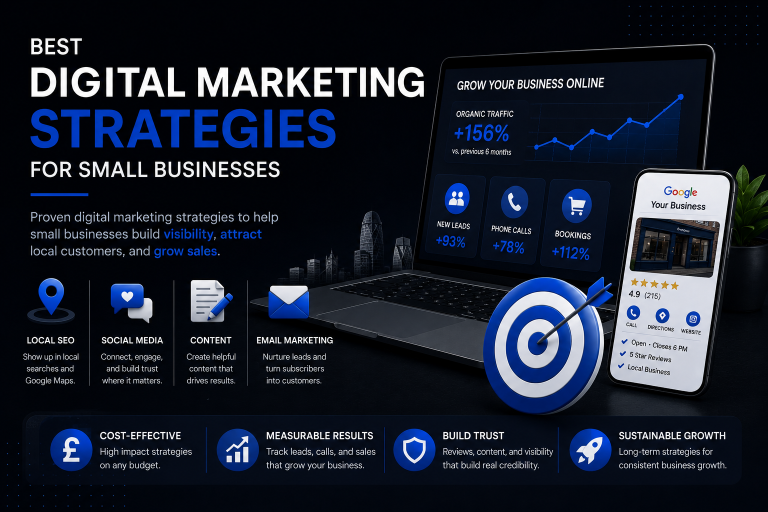
The best digital marketing strategies for small businesses are Local SEO and Google Business Profile optimization, targeted social media marketing, and content and email marketing. These high-impact tactics help smaller teams build authority, capture local intent, and drive sales on a lean budget.
In the UK alone, over 5.5 million small businesses compete for attention. The ones that win aren’t necessarily spending the most – they’re spending smartly. At Inteliware Growth, we’ve helped taxi companies, immigration law firms, app startups, cleaning businesses, and private clinics turn tight budgets into predictable revenue by applying exactly these strategies with consistency.
This guide breaks down the core digital marketing strategies you can implement today, even with a team of one. You won’t find vanity metrics here. What you will find are the same frameworks our performance agency uses to audit, strategise, execute, track, and scale campaigns for real clients across high-intent service industries.
Local search and visibility
When someone searches for a service “near me” on their phone, you have seconds to appear. Local search marketing ensures you show up in those moments of high intent and convert the click into a customer.
Claim and fully optimise your google business profile
Your Google Business Profile (GBP) is the most powerful free tool for small business marketing. A complete profile places your business on Google Search and Maps, displaying your address, phone number, hours, photos, and reviews at a glance. For step-by-step help, refer to Google’s official guide. Then, head to the claim page to set up yours.
Fill in every field with precision: primary category, a business description naturally including service keywords, high-quality images of your work, and regular posts. We’ve seen cleaning companies double their call volume simply by adding before-and-after photos and responding to every Q&A query. Google rewards completeness and freshness, so treat your GBP like a mini-website that never stops working.
Turn customer reviews into a local trust engine
Reviews influence local ranking and, more importantly, the split-second decision a potential client makes. Make asking for reviews a systematic, non-pushy part of your workflow. A simple follow-up email or SMS with a direct Google review link immediately after service works far better than waiting weeks.
Reply to every review thoughtfully and without jargon. Thank a taxi customer by mentioning the specific driver; address a concerned immigration client by acknowledging the feedback and offering to take the conversation offline. Google notices this engagement, and prospects see a business that genuinely cares. Building this trust engine is a cornerstone of our work with Doctors & Clinics.
Keep nap consistency across the web
NAP stands for Name, Address, and Phone number. These three details must match identically everywhere – your website footer, GBP, Yell, Thomson Local, industry directories, and social profiles. Even “St.” vs “Street” can fragment your local authority.
Audit major citation sources quarterly. For a small chain of clinics, we’ve uncovered outdated phone numbers on old listings that silently undermined their SEO. Fixing them is a quick win that often improves map pack rankings within weeks. Consistency tells search engines your business is legitimate and trustworthy.
Social media and content marketing that actually converts
Small businesses often spread themselves too thin. The antidote is focus: meet your audience where they already spend time, and offer value that pulls them toward your service.
Choose one or two platforms where your audience lives
Not all platforms fit every business model. A B2B immigration law firm finds far more qualified conversations on LinkedIn than on TikTok. A local cleaning company thrives in Facebook community groups. A taxi firm might see rapid engagement through local Instagram geotags and WhatsApp broadcast lists.
Pick one or two channels and own them completely. Consistency on the right platform beats sporadic posting everywhere. At Inteliware Growth, we help app startups identify whether their user acquisition is driven by Instagram Reels or Meta’s ad canvas – then we pour all creative energy there. The moment you narrow your focus, your messaging sharpens and engagement rises.
Create value-driven content that answers real questions
Stop selling and start solving. The most effective content addresses the exact questions customers type into Google. For a doctor’s clinic, a blog post on “How to book a private GP appointment in [city] without waiting weeks.” For a taxi company, a short video on “How to book a wheelchair-accessible cabin under 60 seconds.” This content does the pre-selling for you.
You don’t need a production studio. A 90-second phone video, a crisp FAQ page, or a simple checklist can outperform a polished but soulless corporate piece. Use your customers’ language, cover the topic completely, and embed a gentle call-to-action. When your content earns the click and holds attention, Google’s algorithms notice.
Speed up content creation with AI (without losing your voice)
Generative AI tools are essential for lean marketing teams. Use them to draft content calendars, social captions, blog outlines, or email newsletters. This frees you to focus on strategy and personalisation – the parts only a human can do well.
A smart workflow: prompt an AI tool with your customer persona, brand tone, and pain points; refine the output with your real-world expertise; add local details or client mini-stories; then schedule. You maintain authenticity while dramatically increasing your publishing cadence. We’ve implemented this process for immigration law firms needing regular, compliant content without a full-time writer – producing a steady stream of useful articles that rank and convert.
Lead nurturing and conversion tactics
Driving traffic is only half the battle. Converting that traffic into booked appointments, ride requests, or consultation calls separates businesses that grow from those that merely survive. These two tactics ensure no lead slips through.
Build an automated email engine (2-4 touchpoints a month)
Email marketing remains the highest-ROI digital channel for small businesses because it enables direct, personalised communication with people who have already shown interest. The mistake is either under-emailing or sending nothing but hard sells. In fact, the Data & Marketing Association reports that email marketing delivers an average return of £35 for every £1 spent, making it a non-negotiable for lean teams.
Set up a simple, automated newsletter that goes out two to four times a month. Mix valuable content with subtle promotion. For a cleaning company, one email might share “5 things to deep-clean before allergy season,” while the next offers a discount on first-time deep cleans. For an app startup, a drip sequence that educates trial users on underused features can lift paid conversions by over 15% – a metric we’ve tracked across multiple client dashboards. Use Mailchimp, Brevo, or HubSpot’s free tier, and always include one clear call-to-action per email.
Deploy low-cost retargeting to re-engage warm prospects
Most website visitors leave without taking action. A small retargeting campaign – via Google Display, Meta, or LinkedIn – puts your brand back in front of them as they browse elsewhere. This keeps your service top-of-mind at a lower cost than cold acquisition.
Start by boosting your highest-performing organic social post to a custom audience of website visitors from the last 30 days. For a taxi company, an ad reminding someone who checked a route but didn’t book: “Complete your ride in 2 taps.” For a clinic, a patient testimonial. Retargeting reconnects rather than interrupts. With proper conversion tracking and a dedicated landing page, you can measure exactly what each pound returns.
How Inteliware Growth helps small businesses win with these strategies
Knowing the strategies is step one. Executing them with a performance mindset – every click tracked, every pound accounted for, and campaigns optimised toward real revenue – transforms a small marketing effort into a growth engine. That’s our entire reason for existing.
We’ve built a 5-step framework for service businesses in high-intent niches, and you can see exactly how it works across our Case studies:
- Audit: We dig into competitor data, audience behaviour, and existing funnels to find leaks and quick wins.
- Strategy: We build a custom roadmap with realistic KPIs, channel forecasts, and a timeline tailored to your industry – whether patient acquisition for doctors or ride-request conversion for private hire fleets.
- Execution: We launch tightly managed Google Ads, paid social campaigns, and high-converting landing pages that speak your customers’ actual language.
- Tracking: Every lead gets attributed. We implement advanced tracking and real-time dashboards so you see the exact cost per booking, consultation, or app install – transparently.
- Scale: Once a channel proves profitable, we systematically increase budget based on data, not guesses. No scaling until the unit economics are proven.
If you run a taxi firm, an immigration law practice, a mobile app startup, a cleaning company, or a private clinic, we’ve already built growth playbooks specifically for your industry. Explore how we drive ride requests for private hire companies or compliant leads for immigration solicitors. You don’t get a generic agency plan; you get a partner who understands your customer’s intent and your compliance landscape.
Ready to turn these strategies into predictable revenue?
- 📞 Call us at +92 344 3503901
- 📧 Email sales@inteliwaregrowth.com
- 📍 Based in London, United Kingdom
Frequently Asked Questions
Which digital marketing strategy gives the fastest results for a small business?
Local SEO with a fully optimised Google Business Profile and active review generation often delivers the fastest local visibility boost. Adding a small, well-targeted Google Ads campaign can generate immediate leads while organic rankings build.
How much budget does a small business really need to start digital marketing?
A meaningful starting budget can be as low as £300–£500 per month. Start with one channel, measure meticulously, and reinvest only what proves profitable.
What social media platform is best for a local service business?
Facebook and Instagram work well for most local services due to community groups and visual storytelling. LinkedIn suits professional services like immigration solicitors. Focus only on where your customers already ask for recommendations.
Do small businesses really need a blog?
Yes, but as an answer engine. An FAQ-rich resource section that directly addresses specific search queries attracts highly relevant organic traffic that converts far better than cold social media followers.
How does Inteliware Growth measure success beyond just likes and clicks?
We track real business outcomes: cost per qualified lead, cost per booked appointment, cost per completed ride, cost per app install, and return on ad spend (ROAS). Clients see live dashboards that connect spend directly to revenue.
Can AI replace a marketing agency for a small business?
AI is a powerful assistant for drafting and segmentation, but it can’t replace strategic judgement, creative empathy, or compliance knowledge. The best results come from humans wielding AI tools effectively – exactly how our team operates.