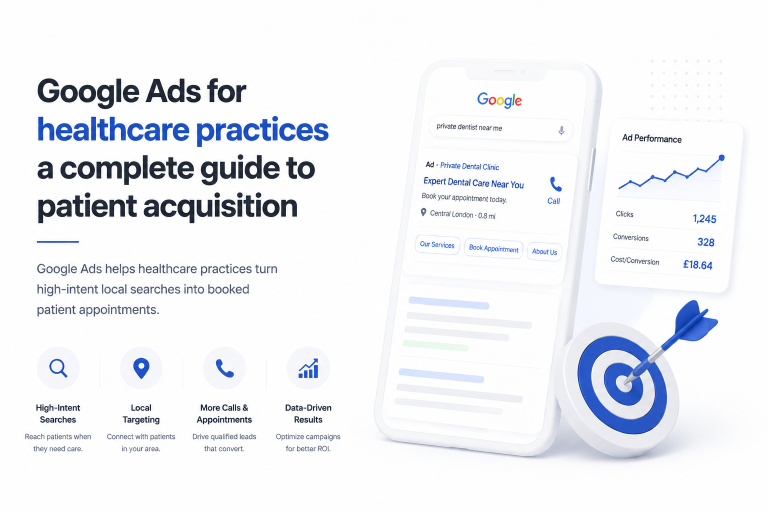
Google Ads helps healthcare practices turn high-intent local searches into booked patient appointments.
In the private healthcare sector, waiting for referrals is no longer a sustainable growth strategy. Patients are no longer flipping through phone books; they are grabbing their smartphones and searching for immediate solutions. At Inteliware Growth, we have spent over a decade analyzing the data behind these searches. We have found that the difference between a thriving practice and a stagnant one often comes down to visibility at the exact moment a patient decides to book.
Generic marketing doesn't work for medicine. You aren't selling a commodity; you are selling trust, health, and time-sensitive care. This guide breaks down our exact framework for using Google Ads to target high-intent patients, reduce wasted spend, and maintain strict compliance in the UK healthcare market.
Understanding the modern patient journey
The patient journey has fundamentally shifted. Before a potential patient ever calls your receptionist, they have already conducted significant research. They are comparing reviews, checking locations, and looking for specific symptoms or treatments.
If your practice does not appear during this micro-moment of intent, you lose the booking to a competitor who does. Google Ads allows you to bypass the slow burn of organic SEO and instantly place your practice at the top of the search results, but only if the strategy is built on data, not guesswork. According to recent data from Think with Google, over 77% of patients use search engines before booking a healthcare appointment.
Campaign strategy targeting high-value queries
A successful healthcare campaign starts long before you write the first ad. It starts with understanding the why behind the search. At Inteliware Growth, we structure campaigns to filter out researchers and attract bookers.
Search intent service and location
The highest converting traffic comes from users who know what they need and where they need it. We focus heavily on search queries that combine a specific service with a geographic qualifier.
- Example: Instead of targeting a broad term like doctor, we target same day GP appointment or physio near me.
- The data: These users have already made the decision to see a professional. They just need to find the right one quickly. Targeting these terms reduces cost-per-click (CPC) and increases conversion rates.
Query families structuring for success
We don't just dump keywords into a single list. We segment them into query families to align with specific landing pages and ad copy.
- Service-plus-location: Private dentist in city, dermatologist near postcode.
- Educational and treatment research: Treatment for acne scars, causes of lower back pain (used to capture users just before they book).
- Practical logistics: Clinic name opening hours, service cost, clinics with parking.
Ad extensions removing friction
Mobile users want to act immediately. We use every relevant asset available.
- Call assets: We add click-to-call buttons so mobile users can tap to dial your office instantly.
- Location assets: We attach your Google Business Profile address so users can get directions without copying and pasting.
- Sitelinks: We deep-link to services, meet the team, and book online pages. Learn more from Google support.
Landing page best practices
Driving traffic is only half the battle. If you send a user to a generic homepage, they will bounce. The landing page must act as a digital receptionist, answering questions before they are asked.
Direct match message consistency
If a user clicks an ad for Invisalign consultation, they should not land on a page about general dentistry.
- The rule: The headline of the landing page must mirror the headline of the ad. If the ad says private GP appointments, the landing page headline must say private GP appointments.
Above the fold content
You have less than three seconds to convince a user they are in the right place.
- Placement: We place a clear, tappable phone number and an appointment request button in the top right corner and central hero section of the page. The user should not need to scroll to find a way to contact you.
Simple forms reduce abandonment
We see practices asking for medical history, insurance numbers, and address details on the first form. This kills conversion rates.
- The strategy: Keep intake forms to three fields: name, phone number, and preferred time.
- The logic: The goal of the ad is to start a conversation, not to complete an intake. You can collect the rest of the data when your staff calls them back.
Compliance rules for healthcare ads
Advertising for healthcare is a minefield. Google's policies are strict, and violating them can result in account suspension. This is where experience matters. You can review the full Google policies for detailed requirements.
Platform policies keeping accounts safe
You must adhere strictly to Google Ads healthcare policies.
- Medical claims: Avoid making guarantees like we will cure your back pain.
- Restricted content: Be extremely cautious with terms related to prescription drugs, weight loss, and specific medical conditions. Google restricts remarketing for sensitive health data.
- Certification: Ensure your practice is registered with the appropriate UK bodies and that this is reflected on your landing page to build trust.
Diverse approaches among marketers
There is a debate in the marketing community regarding how specific medical ads should be.
- The conservative approach: Some marketers on platforms like Reddit suggest running broad service ads and qualifying conditions on the landing page to avoid triggering Google's sensitive category filters.
- The precision approach: Others advocate for condition-specific targeting to filter out low-intent clicks.
- Our stance: At Inteliware Growth, we use a hybrid model. We run broad umbrella ads for general practice growth, but we use exact-match negative keywords to block searches for conditions you do not treat. This keeps your account safe while maximizing qualified reach.
Common pitfalls draining your budget
Many healthcare practices waste thousands of pounds each month on Google Ads without realising it. Here are the most frequent mistakes we see and how to fix them. See how we helped clinics in our case studies.
Ignoring negative keywords
If you don't tell Google what you don't want, you will pay for clicks that can never convert. For example, a private GP clinic should add free, NHS, jobs, and salary as negative keywords. Otherwise, you attract job seekers or people looking for free services, not paying patients.
Sending traffic to the homepage
Your homepage is designed to showcase your practice, not to convert a specific search. When a user searches for private blood test London, they expect a page about blood tests. If they land on your homepage and have to search for that service, they leave. Always use dedicated landing pages for each service family.
Forgetting mobile users
Over 70% of healthcare searches happen on mobile devices. If your landing page takes more than three seconds to load or the phone number isn't clickable, you lose the lead. We design mobile-first pages with thumb-friendly buttons.
Not tracking phone calls
Many patients prefer to call rather than fill out a form. If you only track form submissions, you underestimate your ROI. Use call tracking numbers to attribute every phone call back to the exact keyword and ad that generated it. The team at Search Engine Land regularly publishes useful insights on call tracking best practices.
The Inteliware Growth framework
We don't believe in set it and forget it. We apply our 5-step growth framework specifically to the medical sector to ensure scalability.
- Audit: We analyze your current patient volume, competitor ad spend, and existing funnel. We look at what keywords competitors are bidding on and where the gaps are.
- Strategy: We build a custom roadmap, forecasting lead volume and cost per acquisition (CPA) based on your average patient value.
- Execution: We build the landing pages and ad creatives. We write copy that speaks to patient anxieties and solutions, not just medical jargon.
- Tracking: We implement call tracking and conversion tracking. We need to know which keyword generated the phone call, not just the click.
- Scale: Once we find a winning combination (keyword + landing page + ad), we shift budget aggressively toward it to maximize market share.
Niche agency vs generic agency
A general marketing agency doesn't understand the nuances of patient confidentiality, medical compliance, or local trust signals. We work exclusively with high-intent service industries, including doctors and clinics. Learn more about services for doctors and clinics.
We understand that a conversion for a cleaning company is different from a conversion for a dental practice. We build funnels that respect the sensitivity of health data while driving aggressive growth. We treat your marketing budget with the same care a surgeon treats an instrument, precisely and with purpose.
Conclusion
The healthcare industry is competitive, but it is also predictable. Patients are searching for you right now. By implementing a rigorous Google Ads strategy that focuses on high-intent keywords, frictionless landing pages, and strict compliance, you can dominate your local market.
Stop relying on word-of-mouth alone. It is time to turn your website into your highest-performing staff member, one that books patients while you sleep.
Ready to scale your practice?
If you are ready to stop guessing and start growing, we are here to help.
Contact Us
📞 +92 344 3503901
📧 sales@inteliwaregrowth.com
📍 London, United Kingdom
Frequently asked questions
1. How much should a healthcare practice spend on Google Ads?
Start with enough budget for 10 to 20 clicks per day to gather data. For most UK clinics, this is £1,500 to £5,000 monthly.
2. Why are my Google Ads getting clicks but no bookings?
Usually a landing page mismatch or a complex form. Ensure your ad promise matches the page and your phone number is clickable.
3. Can I target specific postcodes with Google Ads?
Yes. Use radius targeting and location insertion to show ads only to users in your service areas.
4. What is a good conversion rate for a healthcare landing page?
For high-intent private healthcare, 10 to 15 percent is strong. Below 5 percent indicates targeting or page speed issues.
5. How does Inteliware Growth handle medical privacy in advertising?
We strictly follow GDPR and Google policies. We do not use remarketing based on health conditions and treat all lead data securely.