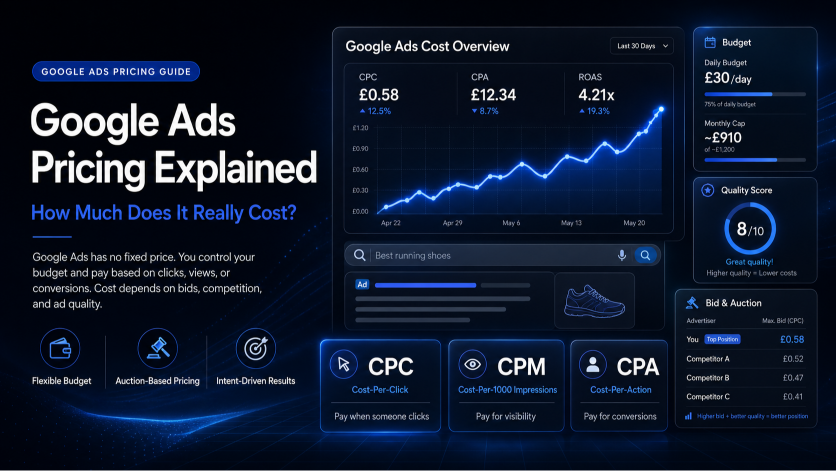
Google Ads does not have a fixed price. It uses a flexible auction system where you control your own budget. You only pay when someone interacts with your ad, such as clicking it (Cost-Per-Click) or viewing a video. Costs depend on your bid, industry competition, and ad quality.
If you are running a taxi company in London, an immigration law firm, or a private clinic, you have likely asked the same question: How much should I actually be spending on Google Ads?
Many business owners expect a flat monthly rate, similar to a newspaper ad or a billboard. Google does not work that way. Instead of paying for space, you are paying for intent. At Inteliware Growth, we specialize in turning that intent into revenue, particularly for high-stakes service industries. Here is a breakdown of how the pricing engine works and how you can master it.
Core pricing models
Google Ads operates on an auction, but the method in which you are charged depends on your campaign goal.
Cost-per-click (CPC)
CPC is the most common model for search campaigns. You pay only when a user clicks your ad. This is standard for search networks. If a user searches for a cleaning company near me and sees your ad but calls a competitor, you pay nothing. This makes it highly efficient for lead generation in sectors like taxi services or legal firms.
Cost-per-thousand impressions (CPM)
CPM is centered on visibility. You pay per 1,000 times your ad is shown on screens. This is used for brand awareness. While it does not drive immediate clicks, it is effective for keeping your brand top-of-mind. For example, an app startup launching a new feature might use CPM to flood the market with awareness before switching to conversion-focused models.
Cost-per-action (CPA)
CPA is the gold standard for ROI-focused marketers. You pay only when a user takes a specific action like a purchase or sign-up. If your goal is to get a patient to book an appointment or a client to request a consultation, Google optimizes your spend to hit that specific target cost. It removes the guesswork, ensuring your budget is only spent on actual business results.
Main cost factors
Why do some clicks cost £1 while others cost £50? The answer lies in three primary variables: the auction, your quality, and the vertical you operate in.
Ad auction and bids
When a user searches, an auction occurs in milliseconds. You set a maximum bid for what you want to pay. The highest bidder does not always win the best spot. Google balances money with relevance. If your ad is highly relevant to the searcher, Google may favor you over a competitor bidding higher but with poorer quality.
Quality Score
This is the great equalizer in Google Ads. Google scores your ad from 1 to 10 based on relevance and landing page experience. A higher Quality Score lowers your actual cost per click. At Inteliware Growth, our Conversion Rate Optimisation (CRO) strategy focuses heavily here. If your landing page speaks directly to the immigration lawyer search term, you will pay significantly less for that click than a generic legal firm page.
Industry competition
According to industry benchmarks, high-value sectors like legal or finance often see high click costs, while local services cost less. To provide context:
- Immigration lawyers: Click costs can range from £5 to £20+ due to the high lifetime value of a client.
- Taxi companies: Costs are often lower, but the volume and location targeting (e.g., airport transfers) are critical.
- Doctors & clinics: Competitive, especially for private procedures or urgent care keywords.
Controlling your budget
One of the biggest myths is that you need a massive budget to succeed. Google allows surgical control over your finances.
Daily budget
You pick an average daily limit for spending. You can set this as low as £10 per day or as high as thousands. You can adjust this at any time based on demand. For example, a taxi company might increase their daily budget on Friday and Saturday nights when demand spikes.
Monthly limit
You will never be surprised by a massive bill. Google caps your monthly spend at your daily budget multiplied by the average days in a month. If your daily budget is £30, your maximum monthly charge is roughly £910, though some days Google might overspend slightly to capture clicks, it will never exceed that monthly cap.
No minimums
There is no strict minimum fee to start an account, though small businesses typically spend hundreds to thousands of dollars monthly to see steady traffic. However, spending £100 poorly is a waste of money. We often advise clients to view their budget not as a cost, but as a test budget for data. You need enough data to let the algorithm learn.
Industry-specific pricing benchmarks
Understanding averages helps you set realistic expectations. Here is how pricing typically breaks down for the niches we serve at Inteliware Growth.
Taxi & private hire
In local transport, the goal is often ride requests. Average CPCs are moderate, but the conversion rate depends heavily on how fast your booking page loads. Focus on mobile traffic. A monthly budget of £1,500–£3,000 is often enough to dominate a specific city zone.
Immigration law firms
This is a high-stakes vertical. Because a single client can be worth thousands, the cost per lead is high. You might pay £10 per click, but if only 1 in 10 clicks convert into a lead, your lead cost is £100. Success here requires a strong funnel that builds trust through content before asking for the consultation. Immigration law marketing requires a tailored approach.
Cleaning companies
This is volume-driven. You need many leads because job values are moderate. You must focus on local search terms. A budget of £1,000–£2,000 per month can generate a healthy pipeline of domestic and commercial cleaning jobs if your ad copy is sharp and you offer instant quotes. Cleaning lead generation is all about speed and local relevance.
5 common mistakes that skyrocket costs
In our audit process, we see these errors inflating costs for businesses almost daily.
- Ignoring negative keywords: Paying for clicks from people looking for free legal advice or taxi driver jobs when you want passengers or clients. You must exclude these.
- Sending traffic to homepages: Sending a click to a generic homepage is the fastest way to burn cash. The user wants a specific service. Your page must mirror that intent.
- Using broad match without signals: Broad match allows Google to be creative, but it can show your ad for irrelevant synonyms if you do not feed it audience signals.
- No call tracking: If you do not know which keyword generated the phone call, you do not know where to allocate budget.
- Set and forget mentality: Google Ads is not a set-it-and-forget-it platform. Algorithms need feedback. Markets shift.
How Inteliware Growth optimizes your spend
We are a UK-based performance marketing agency focused on high-intent services. We do not do brand awareness fluff; we do measurable growth.
Our approach to pricing is simple: Reduce the waste, scale the winners.
- Audit: We analyze your current search terms report. We often find 20–30% of client budgets are wasted on irrelevant clicks.
- CRO integration: We fix the landing pages before spending money on traffic. Increasing your Quality Score from 5 to 8 can reduce your CPC by up to 30%.
- Real-time dashboards: You see everything. If a click costs too much, you will know immediately. We provide transparent reporting so you know your exact Cost Per Acquisition.
Conclusion
Google Ads pricing is not a mystery; it is a formula. It requires balancing the auction, respecting the Quality Score, and understanding the economics of your specific industry.
Whether you are an app startup looking to scale installs or a doctor’s clinic aiming to fill appointment slots, the principle remains the same: do not focus on the cost of the click; focus on the value of the customer. With the right strategy, budget caps, and conversion rate optimisation, Google Ads remains the most profitable channel for high-intent services.
Ready to find out exactly what you should be spending? Our experts at Inteliware Growth can provide a full audit and forecast for your specific niche.
Contact Us
📞 +92 344 3503901
📧 sales@inteliwaregrowth.com
📍 London, United Kingdom
FAQ
How much does Google Ads cost for a small business?
There’s no minimum. Most UK small businesses spend £1,000–£3,000 per month to get enough data and steady leads.
Why is my Cost Per Click higher than my competitors?
Usually because of a low Quality Score. If your ad or landing page doesn’t match the search intent, Google charges you more per click.
Can I run Google Ads for free?
No. It’s pay-to-play. You may occasionally get promotional credits from Google, but there is no free version.
What is a good Cost Per Acquisition (CPA)?
It depends on your margins. A taxi booking might be profitable at £15 CPA, while an immigration lawyer could happily pay £300+ per client.
Does Google Ads pricing change during the holidays?
Yes. Competition spikes in certain industries, driving up auction prices. A solid bidding strategy helps manage seasonal changes.