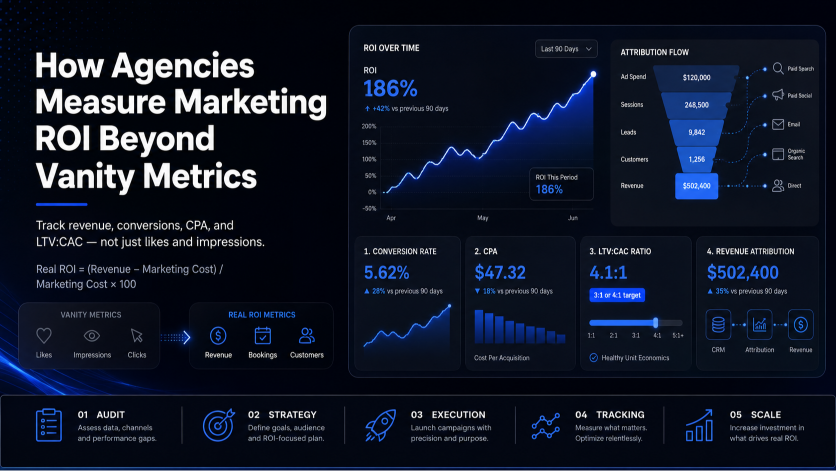
Agencies measure marketing ROI by subtracting total marketing costs from revenue generated, dividing by the cost, and multiplying by 100. They track key metrics like conversion rate, cost per acquisition (CPA), and customer lifetime value (CLV) using platforms like Google Analytics and Salesforce.
However, in a landscape saturated with likes and impressions, true return on investment is about one thing: Revenue generated vs. money spent.
At Inteliware Growth, we operate in the trenches of high-intent, performance-based marketing. We don’t measure success by how many people saw an ad; we measure it by how many taxi bookings were completed, how many immigration consultations were booked, or how many app installs turned into paying users.
In this guide, I’ll break down exactly how professional agencies track, analyze, and scale marketing ROI without the fluff.
Core ROI formula
Before diving into complex dashboards, you must understand the fundamental equation that drives every budget decision.
Calculation: (Revenue – Marketing Cost) / Marketing Cost × 100
For example, if you spend $1,000 on Google Ads and it generates $5,000 in legal fees, your ROI is 400%.
Inclusions: What counts as cost?
A common mistake is only tracking ad spend. To get a true picture, agencies must calculate Total Spend. This includes:
- Ad placement: The direct cost paid to Google or Meta.
- Agency retainer fees: The cost of hiring the experts to manage the campaigns.
- Creative & content: Costs for video production, copywriting, and graphic design.
- Software tools: Your tech stack including CRM, analytics tools, and landing page builders.
Many businesses forget to include overheads like software subscriptions or the time their internal team spends coordinating with the agency. If you omit these, your ROI calculation becomes inflated and misleading.
Why revenue, not profit?
ROI formulas typically use revenue, but for a true picture of business health, agencies should also look at profit margin. A campaign generating $100,000 in revenue with a 10% profit margin is less impressive than one generating $50,000 with a 50% margin. Smart agencies align ROI targets with actual profit goals.
Why financial ROI matters
Search intent for this topic is clear: Readers want to know if their marketing dollars are working.
Agencies exist to make money for their clients. If a campaign drives high engagement but zero conversions, it is a liability. We focus on bottom-of-the-funnel metrics that directly impact a company's bank balance.
Consider a taxi company that runs a viral social media post. It gets 10,000 likes but only 5 ride bookings. The engagement looks great on a report, but the revenue is negligible. A professional agency would rather run a boring Google Search ad that generates 50 high-intent bookings. The latter has a measurable ROI. As Neil Patel explains, many businesses get distracted by vanity metrics, but the only metric that truly matters is revenue.
This is why Inteliware Growth prioritizes high-intent channels like Google Ads for service industries. We know that someone searching for an immigration lawyer near me is far more likely to convert than someone passively scrolling Facebook.
Tracking attribution
The hardest part of measurement isn’t the math; it’s connecting the data. How do we know a specific click led to a specific sale?
Attribution: Connecting touchpoints from initial click to closed deal using CRM integrations.
A user might click a Facebook ad on Monday, read an email on Wednesday, and book a service on Friday. Which channel gets the credit?
Advanced agencies use attribution modeling to solve this. At Inteliware Growth, we integrate your ad accounts directly with your CRM like Salesforce or HubSpot. This allows us to track the lead back to the exact keyword or creative asset that generated it.
Common attribution models:
- First-click attribution: Gives all credit to the first touchpoint.
- Last-click attribution: Gives all credit to the final touchpoint before conversion. This is the default in many tools.
- Linear attribution: Splits credit equally across all touchpoints.
- Data-driven attribution: Uses machine learning to assign credit based on actual impact.
Most businesses still rely on last-click, which undervalues top-of-funnel awareness campaigns. A proper agency will help you understand the entire customer journey.
Key performance indicators
Once the tracking is set up, we monitor specific KPIs that tell us the health of the funnel. Here are the three pillars of performance measurement:
1. Conversion rate (CVR)
Percentage of users completing a target action.
This action varies by industry:
- Taxi companies: Booking a ride or downloading the app.
- Immigration lawyers: Submitting a consultation request form.
- Cleaning companies: Requesting a quote.
If your traffic is high but your conversion rate is low, the problem is usually a mismatch between the ad promise and the landing page experience. For example, if an ad says Book a Taxi in 30 Seconds but the landing page forces users to fill a long form, conversions will drop. Agencies often run A/B tests to fix this.
2. Cost per acquisition (CPA)
Total spend divided by total new customers gained.
This is the cost you pay to buy a customer. If you spend $2,000 and get 20 new patients, your CPA is $100.
Knowing this number is critical for scaling. If a clinic makes $500 profit per patient, a $100 CPA is excellent. If they only make $80 profit, the agency must optimize the campaign to lower the CPA or stop spending.
3. LTV:CAC ratio
Comparing customer lifetime value to acquisition cost, targeting a healthy 3:1 or 4:1 return.
This is a forward-looking metric. Customer Lifetime Value (LTV) is how much revenue a customer brings over their entire relationship with your business.
- Ratio of 1:1: You are losing money.
- Ratio of 3:1: You are doing well.
- Ratio of 4:1: You are highly profitable and should scale aggressively.
For app startups and subscription-based services, this metric is the holy grail. A ride-hailing app might have a low initial profit per user, but if the user takes 10 rides per month for a year, the LTV is high. Agencies must calculate LTV accurately to avoid scaling unprofitable campaigns.
ROI benchmarks by industry
While every business is unique, certain patterns emerge across the niches Inteliware Growth serves. Understanding these benchmarks helps set realistic expectations.
Taxi & private hire companies
Local search intent is high. ROI depends on getting users to book immediately. Agencies focus on click-to-call campaigns and Google Maps ads. A good CPA might range from $5 to $15 per booking, with an average trip value of $15 to $30. The key is repeat usage, so LTV is heavily tied to app retention. Learn more about our taxi marketing.
Immigration law firms
Lead quality matters more than volume. A single client can be worth $2,000 to $10,000. CPA can be $100 to $500, but a single closed case covers that easily. The challenge is long sales cycles, often 30 to 90 days. Agencies must track lead-to-client conversion rates over time.
App-based startups
User acquisition costs vary wildly. For utility or service apps, CAC might be $3 to $10, but for fintech or gaming, it can exceed $50. ROI is often measured by Day-30 retention and LTV. Agencies optimize for quality installs rather than just volume.
Cleaning companies
This is a lead-generation heavy industry. CPAs for a booked cleaning can range from $20 to $50, with job values from $100 to $500. ROI is usually positive on the first job, but agencies also focus on repeat bookings to boost LTV.
Doctors & clinics
Patient acquisition costs vary by specialty. A dermatology clinic might pay $50 to $150 per new patient, while a dental clinic might pay $30 to $80. Lifetime value is high for primary care but lower for one-off procedures. Agencies use call tracking and booking software to attribute ROI accurately.
Common measurement challenges
Even with the right formulas, measurement isn't always perfect. Here are challenges we see daily:
1. Long sales cycles
An immigration law firm rarely converts a client the same day they click an ad. There may be weeks of research, email exchanges, and phone calls. Agencies must use lead scoring and CRM tracking to measure the ROI of a campaign over months, not just hours.
2. The offline gap
For service industries like cleaning or taxi companies, the conversion often happens offline, such as a phone call or a physical ride. If you aren't using call tracking software or offline conversion imports, your data is blind. A clinic might receive 50 phone calls a day, but if none are tracked to a specific ad, you won't know which campaign is working.
3. Attribution bias
Google Ads often likes to take credit for the final click. However, the user might have discovered you through a Facebook video first. Agencies must use data-driven attribution models to fairly distribute credit across all touchpoints. Without this, you might cut a top-of-funnel campaign that was actually driving awareness.
4. Data silos
When marketing data lives in one platform, sales data in another, and finance data in a third, ROI becomes impossible to calculate. Agencies must break down silos by integrating tools like Google Analytics, Salesforce, and accounting software. At Inteliware Growth, we set up real-time dashboards that pull from multiple sources so clients see a single source of truth. See how we solved this in our case studies.
Essential tools
To measure ROI effectively, agencies rely on a stack of tools that communicate with each other:
- Google Analytics 4 (GA4): For understanding user behavior on the website.
- Google Tag Manager: For placing tracking pixels without breaking the site code.
- Salesforce or HubSpot: For storing client data and revenue values.
- CallRail: For tracking phone calls generated by specific ads. This is crucial for Doctors and Clinics.
- Looker Studio: For building visual dashboards that combine data from multiple sources.
A good agency will not only provide these tools but also configure them properly. Many businesses have GA4 installed but never set up conversion events, rendering the data useless.
Apply this to your business
If you are working with an agency or trying to measure this internally, follow this 5-step framework. This is the same one we use at Inteliware Growth:
- Audit: Look at your current data. Where are the gaps? Are you tracking sales or just leads?
- Strategy: Define what a good CPA is for your business model.
- Execution: Ensure your landing pages and ads are aligned to drive that specific CPA.
- Tracking: Set up the CRM integration. If you can't see it, you can't improve it.
- Scale: Increase budget only on the campaigns that prove a positive LTV:CAC ratio.
This framework prevents the common mistake of spending more money before the measurement infrastructure is in place. Without tracking, scaling is just gambling.
Conclusion
Measuring marketing ROI is not about pulling a report from Google Ads and looking at the Conversions column. It requires a granular look at your accounting, your CRM, and your customer behavior.
The most successful businesses treat their marketing agency as a revenue center, not a cost center. By focusing on the Core ROI Formula, tracking Conversion Rates, and optimizing for a 3:1 LTV:CAC ratio, you ensure that every penny of your budget is working to grow the company.
If you are struggling to connect the dots between your ad spend and your bank balance, you are not alone. It requires a specific infrastructure and expertise.
See your real ROI
Stop guessing where your money goes. We build transparent, real-time dashboards that show you exactly how much revenue your ads are generating. Get a free, no-obligation audit of your current campaigns to see where you are leaking cash.
View Our Services to learn how we tailor growth frameworks for high-intent industries. Or Book a Free Consultation.
Contact Us
📞 +92 344 3503901
📧 sales@inteliwaregrowth.com
📍 London, United Kingdom
FAQs
1. What is a good marketing ROI percentage?
A good ROI is typically above a 5:1 ratio, or 500%. A 3:1 ratio is often break-even for service businesses after overhead.
2. How do you calculate ROI for SEO?
Determine which leads or sales came from organic search in GA4, assign a monetary value, and divide by total SEO costs, including time, content, and tools.
3. Why is my Google Ads ROI negative?
Your CPA is higher than your profit margin, your landing page conversion rate is too low, or you're bidding on unprofitable keywords.
4. How often should I check your marketing ROI?
Check revenue-based ROI weekly or monthly. Daily checks can be misleading because leads often take time to convert.
5. What is the difference between ROI and ROAS?
ROI includes total business costs like overheads and salaries, while ROAS only looks at direct ad spend revenue. ROAS is usually much higher.
6. Can I measure ROI without a CRM?
You can, but it's extremely difficult. A CRM is essential for tracking leads to closed revenue, especially for businesses with long sales cycles.