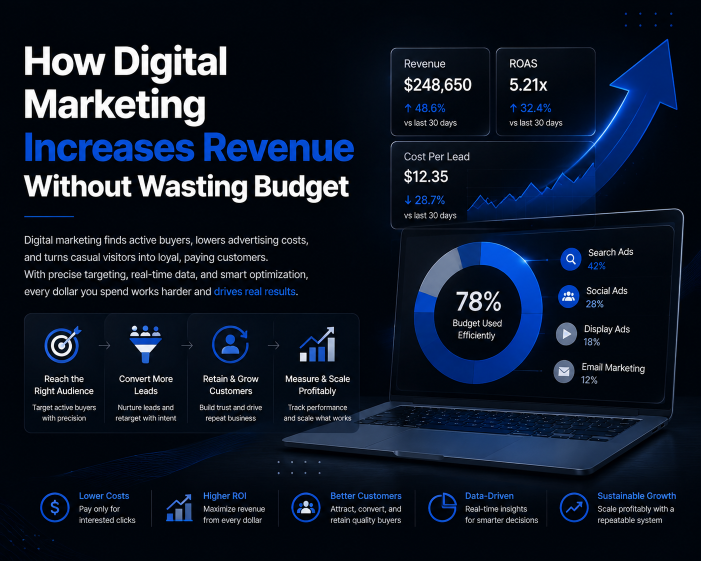
Digital marketing increases revenue by finding active buyers online, lowering advertising costs, and turning casual web visitors into loyal, paying customers. It uses precise targeting and data tracking to make every dollar spent work harder for the business.
For service businesses, this is not theory. At Inteliware Growth, our team has spent more than a decade running data-driven performance campaigns for taxi companies, immigration lawyers, app startups, cleaning companies, and doctors. The businesses that grow fastest treat digital marketing as a revenue system, not a branding expense. This guide breaks down exactly how digital marketing increases revenue, from reaching the right audience to converting leads and measuring profit.
Want a custom plan for your business? Book your free consultation and get a data-driven audit.
Direct revenue impact
Traditional advertising often pays for exposure and hopes for sales. Digital marketing flips that model. You can connect every click, lead, and sale back to a specific campaign, keyword, or ad. Economic Impact Report states that businesses make an average of $2 in revenue for every $1 spent on Google Ads. These numbers exist because digital channels let you target active buyers and optimize in real time.
- Search ads capture existing demand from people already looking for your service.
- Social ads create and retarget demand from people who fit your ideal customer profile.
- Analytics show which channel, ad, and keyword produce actual revenue.
Reaching the right audience
The first way digital marketing increases revenue is by eliminating guesswork. Instead of broadcasting to everyone, you can place your offer in front of the people most likely to buy.
Precise targeting
Ads focus only on people who want your items based on age, location, and past web habits. Google Ads and Meta Ads let you layer demographics, interests, search terms, and custom audiences. For example, an immigration law firm can target users searching for Skilled Worker visa solicitor in London while excluding students looking for study advice. That precision reduces wasted spend and increases the percentage of clicks that turn into consultations. Learn more about our Google Ads management.
Wider visibility
Local shops use search tools to sell globally or attract nearby buyers on Google Maps. A cleaning company can show Local Services Ads only within a 15-mile radius. An app startup can run Google App campaigns in multiple countries. This flexibility means you can dominate local search results or expand into new markets without opening a physical office. Explore our cleaning companies service.
Lower ad waste
Pay-per-click plans mean you only pay when an interested person clicks your link. Unlike TV, radio, or billboards, PPC charges on action. If no one clicks, you pay nothing. Set a daily budget, bid cap, and negative keywords to protect profit margins. This is one of the most direct ways digital marketing increases revenue: every dollar is tied to measurable engagement.
Converting and retaining buyers
Traffic alone does not equal revenue. The businesses that grow are the ones that convert visitors into leads and keep customers coming back.
Lead nurturing
Automated emails and special offers guide interested shoppers until they buy. Most visitors are not ready to act on the first click. A lead might download a guide, read a case study, or request pricing, but still need time. Nurturing sequences deliver relevant information, answer objections, and present time-sensitive offers. For example, an immigration law firm can send a client story after someone downloads a visa checklist. This keeps your business top-of-mind until they book a consultation.
Retargeting ads
Show items back to people who left your site without buying to finish the sale. Retargeting uses a tracking pixel to serve ads across Google Display Network, YouTube, Facebook, and Instagram. If a visitor checked your taxi booking page but did not complete the ride request, a retargeting ad can offer a first-ride discount. Because the visitor already expressed intent, retargeted users are significantly more likely to convert than first-time visitors. Retargeting often delivers the highest ROAS in a campaign.
Repeat sales
Regular updates and helpful content keep past buyers coming back for more. Email newsletters, SMS reminders, and loyalty offers turn one-time buyers into recurring revenue. For cleaning companies, a monthly maintenance reminder can schedule repeat visits. For doctors, appointment follow-ups and health tips can drive rebooking. Repeat customers cost less to acquire and increase customer lifetime value (LTV), which directly boosts revenue.
Measuring and improving results
Digital marketing is measurable. That means you can stop guessing and start scaling what works.
Real-time data
Analytics tools show exact sales numbers and profit returns for each campaign. You can track impressions, clicks, cost per lead, booking rate, and return on ad spend (ROAS) by channel. At Inteliware Growth, we build real-time dashboards so clients see every pound spent and the revenue it creates. This transparency makes budget decisions simple and fast.
Fast testing
Changing ad text or page layouts helps find the most profitable setup quickly. A/B testing headlines, calls to action, images, and form fields can lift conversion rates by double digits. Because results appear within days, you can stop guessing. For example, testing Book Free Consultation against Check Availability might increase leads for an immigration lawyer. This iterative process compounds revenue over time.
Supporting channels
Paid ads get quick results, but they work better with supporting channels. These channels reduce cost per acquisition and turn short-term wins into long-term revenue.
SEO and content marketing
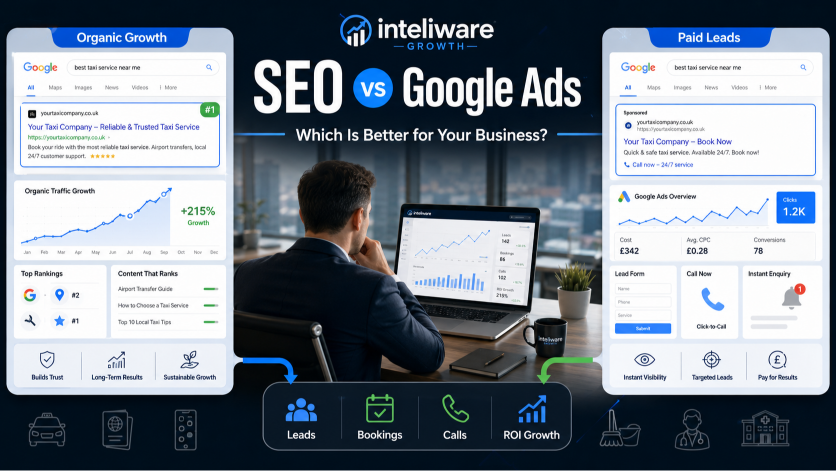
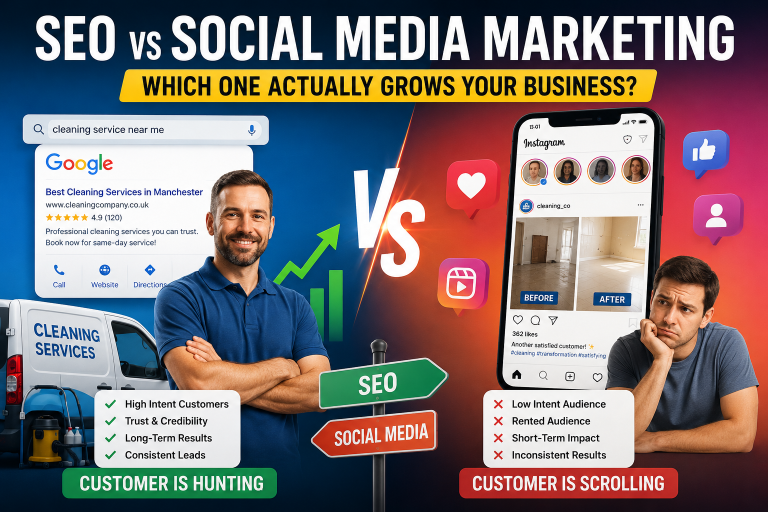
Search engine optimization attracts organic traffic from high-intent queries. A service page or blog post that ranks for immigration lawyer London can produce leads without ongoing ad spend. Content also feeds retargeting and email lists. This reduces overall customer acquisition cost.
Email marketing
Email remains one of the highest-ROI channels. Automated sequences nurture leads, win back abandoned enquiries, and promote repeat purchases. HubSpot cites email marketing returns of $36 for every $1 spent. For service businesses, a monthly newsletter keeps your brand top-of-mind.
Paid social advertising
Meta and LinkedIn ads build brand awareness and retarget visitors. They may not always convert on the first click, but they warm up audiences and feed your funnel. See our paid social advertising service.
Our revenue framework
At Inteliware Growth, we use a five-step roadmap to scale revenue. Each step is designed to find the fastest path to profitable growth, not vanity metrics.
- Audit: Deep dive into competitor data, audience intent, and existing funnels.
- Strategy: Build a custom roadmap with KPIs and channel forecasting.
- Execution: Launch custom ad creatives and high-converting landing pages.
- Tracking: Implement advanced attribution models and analytics.
- Scale: Expand budget based purely on winning, automated data.
This framework works because it treats revenue as the primary KPI. Whether you run a taxi company or an app startup, every step removes waste and increases conversion.
Industry-specific revenue strategies
Different industries need different levers. Here is how we apply the revenue system to our five core sectors.
Taxi and private hire companies
Local search intent is the fuel. We run Google Ads on keywords like taxi to airport and minicab near me with location extensions and click-to-call. Retargeting recaptures visitors who checked fares but didn’t book. Real-time dashboards show cost per ride and revenue per route, so you can shift budget to the most profitable areas.
Immigration law firms
Compliance and trust are crucial. We focus on high-intent legal searches, compliant ad copy, and landing pages that pre-qualify leads. Nurturing sequences handle long decision cycles. The result is lower cost per consultation and higher client conversion rates.
App-based startups
The goal is profitable user acquisition. We run app install campaigns on Meta and Google, optimize for events like signup or first purchase, and reduce customer acquisition cost (CAC) over time. Retargeting brings back users who installed but didn’t activate.
Cleaning companies
Lead generation is the priority. Local service ads, quote forms, and fast follow-up automation convert homeowners searching for cleaning services. Repeat booking campaigns build recurring monthly revenue.
Doctors and clinics
Patient acquisition and local appointment booking drive revenue. We use Google Business Profile optimization, call-only ads, and booking landing pages. Nurturing via email and SMS reduces no-shows and encourages rebooking.
7 actionable steps
Use these steps to start building your revenue system today.
- Define your revenue goal per channel. Set a target ROAS, not just a click count.
- Map buyer intent keywords. Use Google Keyword Planner to find high-intent queries like immigration lawyer near me or airport taxi booking.
- Build dedicated landing pages. Send ad clicks to pages designed to convert, not your homepage.
- Install tracking before spending. GA4, Google Tag Manager, call tracking, and CRM integration ensure accurate data.
- Launch a retargeting pool. Capture visitors from day one and show them tailored ads.
- Nurture leads automatically. Email and SMS sequences based on behavior move leads toward a sale.
- Review metrics weekly. Shift budget to top-performing campaigns and cut losers.
Common mistakes that kill revenue growth
Avoid these common errors if you want digital marketing to increase revenue:
- Optimizing for clicks instead of conversions.
- Sending all traffic to the homepage.
- Running no retargeting campaign.
- Ignoring mobile page speed.
- Not tracking calls and form submissions.
- Scaling budget before conversion rate is stable.
Each mistake causes wasted spend and missed revenue. A data-driven audit can fix them quickly.
The numbers that matter most
These metrics tell you whether digital marketing is actually increasing revenue.
| Metric | What it tells you | Revenue impact |
|---|---|---|
| Cost per acquisition (CAC) | How much you pay for a new customer | Lower CAC means higher margin |
| Conversion rate | Percentage of visitors who take action | More leads from same traffic |
| Return on ad spend (ROAS) | Revenue generated per dollar spent | Direct profit indicator |
| Customer lifetime value (LTV) | Total revenue from a customer over time | Justifies higher acquisition cost |
| Click-through rate (CTR) | Ad relevance | Lower CPC and better Quality Score |
Track these weekly. If you don’t have a real-time dashboard, set one up before scaling.
FAQs
How soon does it work?
Paid search can generate leads within days. Profitable scale usually takes 60–90 days.
Which channel is best?
Google Ads captures active demand fastest. Paid social and email then improve conversion and repeat sales.
How much budget do I need?
Start with a budget that generates enough data, then scale based on ROAS. A free consultation gives a custom number.
Does it work for local businesses?
Yes. Local search ads, Maps optimization, and retargeting work well for taxi, cleaning, and medical services.
What is a good ROAS?
3:1 is strong for services, but the target depends on margins. We use your unit economics to set it.
How do I track revenue?
Install conversion tracking, call tracking, and CRM integration. Real-time dashboards show which channel and keyword created each sale.
Conclusion
Digital marketing increases revenue because it aligns your budget with buyer behavior. You can reach the right audience, convert them with nurturing and retargeting, and measure every pound. At Inteliware Growth, we help service businesses build this system with data-driven advertising and conversion optimization. Ready to turn your marketing into a profit center? Book your free consultation today.
Book your free revenue growth consultation
Get a custom audit and roadmap for your business. Contact our team today.
Contact Us
📞 +92 344 3503901
📧 sales@inteliwaregrowth.com
📍 London, United Kingdom