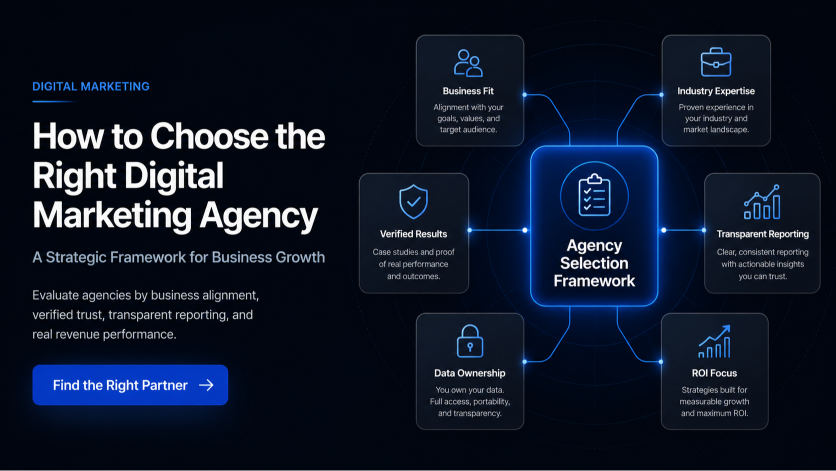
Choosing the right digital marketing agency requires shifting from a vendor-mindset to a strategic partnership framework that prioritizes business alignment, data clarity, and verified operational trust. Evaluating an agency purely on attractive pitches or the lowest price often results in superficial metrics rather than genuine revenue growth.
In a landscape flooded with freelancers, boutiques, and massive full-service firms, the barrier to entry for marketing experts is dangerously low. Anyone can claim to run ads. Few can prove they can scale your revenue profitably.
To protect your budget and secure a partner that actually understands your unit economics, you must treat the vetting process like a forensic audit. Here is the exact framework we recommend at Inteliware Growth for separating high-performance partners from expensive order-takers.
Phase 1: Internal Assessment & Strategy First
Before reaching out to any provider, outline your specific constraints and ultimate objectives. You cannot hire the right partner if you do not know what right looks like for your financial model.
Define Business Metrics
The era of brand awareness as a primary KPI is over for most SMBs and high-intent service providers. You need an agency that speaks the language of revenue.
- Document Clear Goals: Are you trying to lower your Customer Acquisition Cost (CAC)? Are you optimizing for a specific Lifetime Value (LTV) ratio? Or are you expanding into a new regional market?
- Tie to Revenue: If an agency asks about your target ROAS before asking about your gross margin, they are likely focused on vanity metrics rather than net profit.
A practical example. If your LTV is £2,000 and your gross margin is 40%, you can afford a CAC of up to £800. If an agency promises to deliver leads at £500 but ignores the close rate, they might be sending you unqualified traffic. The right partner will ask about your sales cycle and average deal size before suggesting any budget.
Match Agency Specialization to Growth Stage
Your business stage dictates whether you need a scalpel or a Swiss Army knife.
- Specialized Boutique: If you are a Taxi Company needing immediate ride bookings or an Immigration Law Firm needing compliant lead generation, a generalist agency is a liability. You need a partner who understands your specific compliance constraints and conversion triggers.
- Integrated Full-Service: If you are a scale-up requiring full-funnel management, app store optimization, and advanced CRO, you may need an ecosystem that handles everything under one roof.
At Inteliware Growth, we deliberately focus on five high-intent niches. Taxi & Private Hire, Immigration Law, App Startups, Cleaning Companies, and Doctors & Clinics. That focus means we already know the compliance rules, the search intent, and the conversion patterns for your industry before we run your first ad. You can view our services to see how we apply this specialization.
Establish Financial Parameters
Do not hide your budget hoping for a discount. Agencies either scale campaigns or they do not. They cannot scale a $1,000 budget into a $50,000 return without significant time and risk.
- Finalize a Transparent Range: Be honest about what you can spend. A good agency will tell you if your budget is too small to be effective and will advise you to wait or focus on a single channel first.
- Understand Pricing Models: Agencies typically charge a flat retainer, a percentage of ad spend, or a performance-based fee. Flat retainers are predictable. Percentage-of-spend scales with your investment. Performance models align incentives but often come with higher risk. Know which model fits your cash flow.
Phase 2: Evaluating Agency Competence & Trust
This is the discovery phase where you separate qualified agencies from those who simply outsource workflows or run boilerplate templates.
Analyze Technical Fluency & AI Use
The digital marketing landscape changed drastically with the introduction of advanced AI. Your agency should be using it to their advantage, not ignoring it or hiding behind it.
- Query Their Stack: Ask how the agency utilizes data analysis and artificial intelligence within content creation, coding, or audience personalization.
- Efficiency vs. Laziness: There is a difference between using AI to generate a dynamic ad copy test and using AI to write generic blog spam. Look for a nuanced answer that indicates they use AI for data crunching and scale, not as a replacement for human strategy.
For example, an agency that uses AI to analyze thousands of search term combinations for a Taxi Company's Google Ads campaign is adding value. One that uses AI to churn out repetitive blog posts without editing is cutting corners. According to Search Engine Journal, the agencies that thrive are those integrating AI into their workflows while maintaining human oversight.
Verify Case Studies and Real Traction
The proof is in the data, not the design of their pitch deck.
- Live Dashboards: Look for detailed performance data and verifiable achievements within your exact industry. If you are a Cleaning Company, ask to see their dashboard for a cleaning client. If they cannot show one, they do not have one.
- The Cobbler's Children Test: Be skeptical of agencies that lack steady organic web traffic on their own domain. If they cannot rank themselves, how will they rank you? If their own website traffic is invisible, they are likely buying leads or surviving on referrals only, which often indicates a stagnation in skills.
Audit External Client Reviews
Public reviews on Google are easy to fake or coax from a friend.
- Cross-Reference Identities: When you see a glowing review, find the author on LinkedIn. Do they actually work at the company they claim to? Does the review timeline make sense?
- B2B Verification: For B2B service firms, prioritize deeper verified listings on review ecosystems like Clutch or Sortlist. These platforms require proof of engagement, making it harder for agencies to game the system.
Phase 3: Crucial Vetting Questions
Before finalizing any service level agreements, directly interview potential account managers. Do not just talk to the salesperson who closes the deal. Talk to the person who will run your account.
Use this essential operational checklist:
| Evaluation Focus | Core Question to Ask | What to Look For |
|---|---|---|
| Operational Structure | Is the work executed completely in-house, or is it outsourced to white-label subcontractors? | Transparency about the specific specialists executing tasks daily on your account. |
| Asset & Data Ownership | Do I retain full legal ownership of all created ad accounts, landing pages, tracking pixels, and creative assets? | A firm Yes. Ensure your business maintains full admin access so your history is not locked if you transition away. |
| Performance Transparency | How are meetings structured, and do reports filter down to actual lead revenue and ROI rather than vanity clicks? | Clear, jargon-free reporting dashboards paired with a structured, regular meeting cadence. |
| Strategic Red Flags | Can you guarantee a number-one ranking or specific revenue figure within the first month? | A realistic, evidence-based roadmap. Avoid agencies making absolute guarantees or applying high-pressure, limited-time contract rules. |
Phase 4: Validating Cultural and Legal Fit
The final checkpoint involves verifying client references and legal boundaries to secure a smooth long-term collaboration. A great culture fit prevents friction when you need to pivot strategy.
Request Current Client References
Testimonials on a website are curated and often highlight the honeymoon phase. You need the unvarnished truth.
- Direct Contact: Move past generic website screenshots. Request direct contact info of active or former clients to speak with them firsthand.
- Specific Questions: Ask references how the agency handled a bad month. Did they communicate early? Did they adjust the strategy, or did they hide?
Review Legal Exit Horizons
Marketing is a marathon, not a sprint, but you should never feel like a hostage.
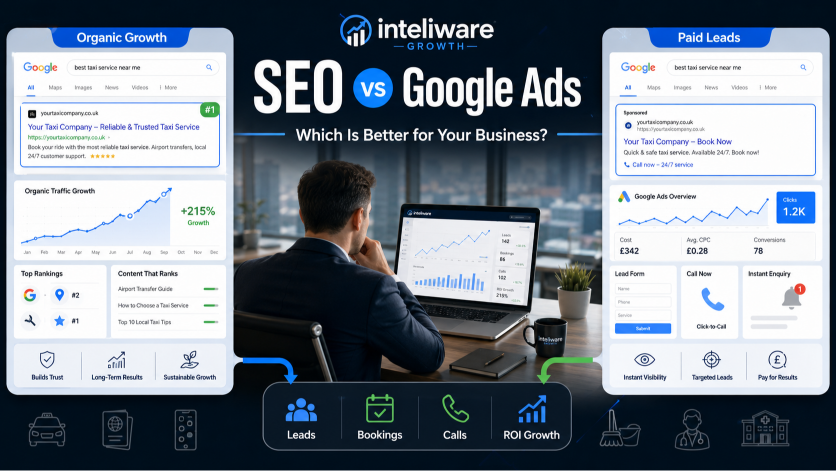
- SEO vs. PPC: Ensure contracts match work complexity. For example, SEO compounding takes 6 to 12 months, but Paid Ads (PPC) can be assessed in 30 to 90 days.
- Fair Off-Ramps: Confirm there are transparent, fair off-ramps and exit notice clauses if performance benchmarks are not met. If an agency requires a 12-month lock-in for Google Ads without a performance clause, walk away.
Red Flags Summary: When to Walk Away
Even with a solid vetting process, certain patterns should immediately disqualify an agency. Watch for these common traps:
- Guaranteed Number One Rankings: No one can control Google's algorithm. If they promise it, they are either lying or using black-hat tactics that will get you penalized.
- No Access to Analytics: If an agency will not give you admin access to your own ad accounts, analytics, or landing pages, they are hiding something.
- High-Pressure Sales Tactics: Sign today for a 50% discount is a classic red flag. A good agency does not need urgency to close a deal.
- No Industry Experience: While transferable skills exist, an agency that has never worked with an Immigration Lawyer or a Doctor's clinic will waste your budget learning compliance rules on your dime.
Why Businesses Choose Inteliware Growth
At Inteliware Growth, we operate on a performance-first framework designed for high-intent industries. Unlike generic agencies that treat a Taxi Company the same as a SaaS startup, we build custom growth frameworks for:
- Taxi & Private Hire Companies: Turning local search intent into immediate ride requests.
- Immigration Law Firms: Compliant lead generation that prioritizes client conversion.
- App-Based Startups: Reducing CAC while scaling profitable installs.
- Cleaning Companies: Booking calendars that fill up on autopilot.
- Doctors & Clinics: Localized patient acquisition funnels.
Our approach is simple. Audit, Strategy, Execute, Track, and Scale. We do not hide behind vanity metrics. We provide real-time dashboards so you see exactly which dollar turned into which lead. Whether you need Google Ads management, paid social advertising, conversion rate optimisation, or app install campaigns, our team of in-house specialists executes every campaign with full ownership transferred to you. Explore our Taxi & Private Hire Companies framework to see industry-specific results.
Frequently Asked Questions (FAQs)
1. What is the average cost of hiring a digital marketing agency?
Most competent agencies start in the low thousands per month. Anything under $1,000 per month usually means junior talent or white-labeling.
2. How long does it take to see results?
Paid ads show data within 2 weeks and optimized conversions by month 3. SEO takes 6 to 12 months for meaningful traction.
3. Should I hire a freelancer or an agency?
Freelancers work for single-skill tasks. Agencies provide strategy, redundancy, and full-funnel execution.
4. How do I know if my agency is performing?
Check your CRM and dashboards. Qualified leads should be converting to revenue with a clear line from spend to return.
5. What industries does Inteliware Growth specialize in?
We focus on Taxi & Private Hire, Immigration Law, App Startups, Cleaning Companies, and Doctors & Clinics.
Ready to Stop Guessing and Start Scaling?
Choosing the right digital marketing agency is the highest-stakes decision you will make for your company's growth trajectory. At Inteliware Growth, we do not just manage ads. We engineer profit.
We invite you to see the difference a data-obsessed partner can make. Book your free consultation today.
Contact Us
📞 +92 344 3503901
📧 sales@inteliwaregrowth.com
📍 London, United Kingdom