Launching an app is easy. Getting people to download it is the hard part. With over 5 million apps competing across the App Store and Google Play, the idea of build it and they will come is no longer a viable strategy. Marketing for app startups requires a mix of pre-launch buzz, store optimization, and user retention tactics to grow sustainably on a budget.
Unlike established brands, startups cannot afford to burn capital on blind brand awareness. Every dollar spent must be tracked, optimized, and attributed to a specific action. That action could be an install, a registration, or a purchase. The most successful app founders treat marketing as a product feature, not an afterthought.
At Inteliware Growth, we specialize in building high-converting funnels for app-based startups. In this guide, we will break down the exact marketing lifecycle you need to implement. We cover everything from the moment you write your first line of code to your first 10,000 users. And we show you how to do it without wasting your runway.
Pre-launch strategies
Your marketing strategy should begin long before your app hits the store. A pre-launch phase validates your idea and builds a waiting list of users ready to download on Day 1. This not only creates momentum but also gives you a test audience for messaging and pricing.
Build a landing page
Your app is a product, and like any product, it needs a storefront. Create a simple site with an email signup form to capture early interest and announce your release date. This serves two purposes. It validates demand, and it builds a seed list of users.
Use this page to run early paid ads or organic social traffic to measure click-through rates and user intent. If people will not give you their email for a free app, they probably will not download it either. Include a short demo video or animated GIF of the core feature to increase signup conversion. Tools like Carrd, Webflow, or Unbounce make this easy even if you do not have a developer.
Run beta tests
Before you spend money on mass acquisition, you need to ensure your app actually works and solves a problem. Gather early adopters using platforms like Product Hunt or BetaList to test your app and gather initial feedback.
This process is crucial for fixing bugs and understanding user behavior. Beta testers often become your most vocal advocates when you finally launch publicly. Ask them specifically what almost stopped them from using your app, and what feature would make them tell a friend. Use this qualitative data to refine your onboarding flow before scaling paid traffic.
Create social hype
In 2026, users want to see the process, not just the polished final product. Post short-form development updates and countdowns on channels like TikTok and Instagram.
Show the behind-the-scenes of coding, design changes, or team meetings. This builds a narrative and a community that feels invested in your success before you even open the doors. Even a simple series called Day 14 of building my app can accumulate thousands of followers who convert to users on launch day. Consistency matters more than production quality here.
ASO
Once you launch, your primary source of organic free traffic is the search bar within the App Store or Google Play. App Store Optimization, also known as ASO, is the SEO of the mobile world. It is often the difference between a slow trickle and a steady stream of installs.
Optimize metadata
Your app title and subtitle are your highest-ranking elements. Use clear titles, compelling subtitles, and target 6 to 10 high-value keywords in your App Store or Google Play listing.
Do not stuff keywords. Instead, weave them naturally into a description that explains the benefit to the user. Understand what your competitors are ranking for and find gaps where search volume is high but competition is low. Use tools like App Annie, Sensor Tower, or even free keyword research from Google Keyword Planner to identify terms. Remember that on iOS, the subtitle is indexed, so use it wisely. On Android, the short description carries weight.
Design visuals
Users often decide whether to download an app in the first three seconds based purely on the screenshot gallery. Use high-contrast screenshots and short preview videos that show your app's core value in seconds.
Do not just show the login screen. Show the money shot, which is the moment the user receives value. Overlay text on your screenshots to explain features, as many users never read the full description. A/B test different screenshot orders. Some apps see a 20 to 30 percent increase in conversion just by reordering screenshots to put the most compelling benefit first.
Localize content
The English-speaking market is saturated, but there is massive opportunity in secondary markets. Translate your store text and keywords for secondary regional markets to increase organic reach.
A user in Germany or Japan is far more likely to download an app that speaks their language natively. This is one of the fastest ways to scale organic downloads without increasing your ad budget. Start with languages where your app category is popular but competition is low. Often Spanish, Portuguese, or Indonesian work well. Localization goes beyond translation. Adapt cultural references and even app icon colors if needed.
Growth and retention
Acquiring a user is only half the battle. If your app has a high churn rate, your marketing engine will spin its wheels. Sustainable growth comes from balancing acquisition with retention. The algorithms that determine app store rankings reward apps that are opened frequently and uninstalled rarely.
Short-form video
Video is no longer optional. It is the primary discovery engine for Gen Z and Millennials. Post consistent, trend-based videos on TikTok and Instagram demonstrating how your app solves real problems.
You do not need a production crew. A screen recording with a voiceover explaining a hack or a use case often outperforms high-budget animation. Focus on the problem and solution format to hook viewers immediately. For example, a budgeting app might post a 15-second clip showing how someone saved $500 this month using a specific trick. Use trending audio but keep the visual content about your app. Post at least 3 to 4 times per week to feed the algorithm.
Gamify retention
Algorithms favor apps that users open repeatedly. Add streaks, badges, or shareable milestones to keep users coming back and signaling store algorithms to rank you higher.
Apps like Duolingo and Strava have mastered this. When a user maintains a streak, they create a habit. When they share a badge, they provide you with free word-of-mouth marketing. Design a simple reward loop with a daily check-in, progress tracking, or social leaderboards. Even a simple push notification that says you are on a 7-day streak can reduce churn by double digits.
Paid user acquisition
Paid ads are the fuel for the fire, but only if your funnel is ready. Test small budgets on Apple Search Ads or social media ads once your conversion rates and onboarding funnels are stable.
If you spend money on ads to a broken onboarding flow, you are effectively burning cash. At Inteliware Growth, we focus heavily on reducing your Customer Acquisition Cost (CAC). We do this by auditing your current funnel for leaks, retargeting users who installed but did not convert, and scaling budgets only when the data proves a positive Return on Ad Spend (ROAS).
Start with a daily budget of $20 to $50. Measure install rate and cost per install. Then kill anything that does not meet your threshold within 48 hours.
Key metrics to track
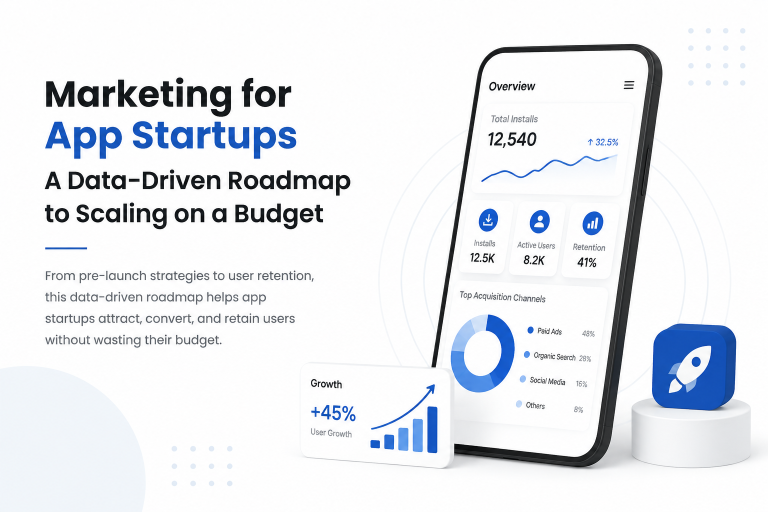
Without data, you are flying blind. Here are the four metrics that matter most in the first 12 months.
- Cost per install (CPI): How much you pay to get one user. This should decline over time as your ASO and organic social improve.
- Day 1 / Day 7 retention: The percentage of users who return on day 1 and day 7. If Day 1 retention is below 25 percent, fix onboarding before scaling ads.
- Lifetime value (LTV): Total revenue a user generates over their lifetime. Your LTV must be at least 3 times your CPI to be profitable.
- Store conversion rate: The percentage of store page visitors who install. If this is below 20 percent, your screenshots or metadata need work.
At Inteliware Growth, we build real-time dashboards for our app clients so every stakeholder can see these metrics without asking for a report. This transparency is key to making fast decisions.
Our growth framework
We do not believe in generic marketing plans. Our 5-step roadmap has helped app startups in the UK and beyond scale from zero to thousands of installs. You can learn more about our approach on our app startup services page.
- Audit: We dig into your competitor data, audience intent, and existing funnels to find low-hanging fruit.
- Strategy: We build a custom roadmap with KPIs and channel forecasting, so you know exactly what success looks like.
- Execution: We launch custom ad creatives and landing pages designed to convert.
- Tracking: We implement advanced attribution models so you know which channel actually drove the install.
- Scale: We expand budgets only on winning data, not hunches.
Whether you are a taxi booking app, a meditation app, or a productivity tool, this framework keeps you disciplined and profitable.
Conclusion
The era of spray and pray marketing is over. For app startups, success is not determined by who has the biggest budget, but by who has the smartest strategy.
By following the strategies outlined above, you can grow your user base without needing a venture capital war chest. Create hype before launch. Optimize your store presence. Focus on retention. And track the right metrics. The key is to start early, test small, and scale only what works.
If you are ready to stop guessing and start scaling, our team at Inteliware Growth builds custom roadmaps for app startups looking to lower their acquisition costs and increase lifetime value. Reach out to us today through our contact page and let us turn your app into a growth engine.
Contact Us
📞 Phone: +92 344 3503901
📧 Email: sales@inteliwaregrowth.com
📍 Address: London, United Kingdom
FAQs
When should I start marketing?
Start before launch. Build a landing page and collect emails during development.
How much does app marketing cost?
Organic is nearly free. Paid starts at $20 to $50 per day for testing. Then scale with positive ROAS.
ASO or social media? Which is better?
ASO captures high-intent searches. Social creates demand. Use both, but ASO gives more sustainable early traffic.
How do I lower CAC?
Improve store conversion and onboarding. Fix leaks before spending on ads. Retarget installs that do not convert.
Why is retention important?
High retention signals quality to app stores, boosting organic rankings and lowering long-term marketing costs.