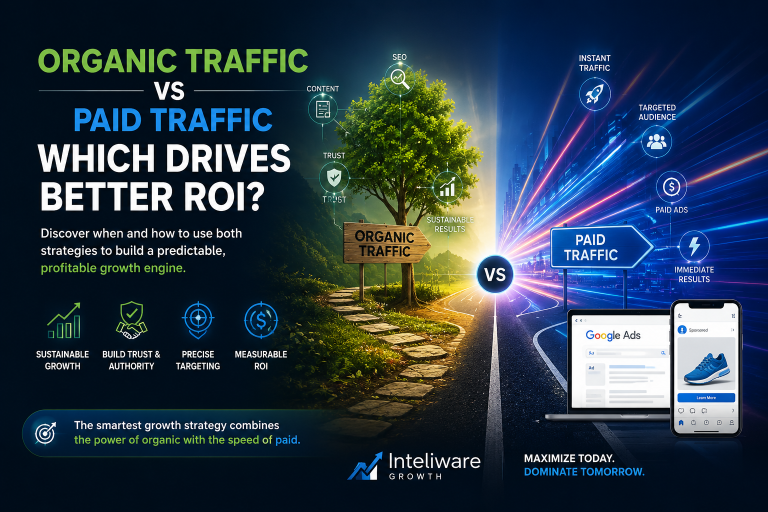
Every business owner wants more website visitors fast. You’ve probably asked yourself: should I focus on free, organic reach, or start paying for ads to get immediate results? The answer isn’t about picking one over the other; it’s about knowing when and how to use each to build a predictable, profitable growth engine.
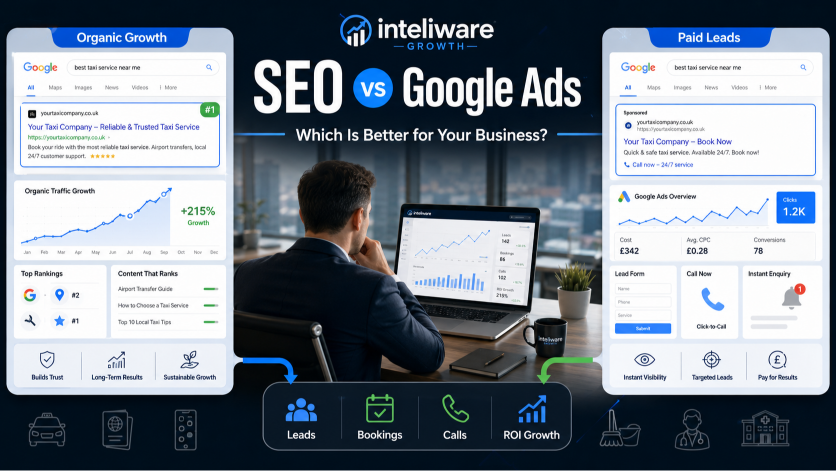
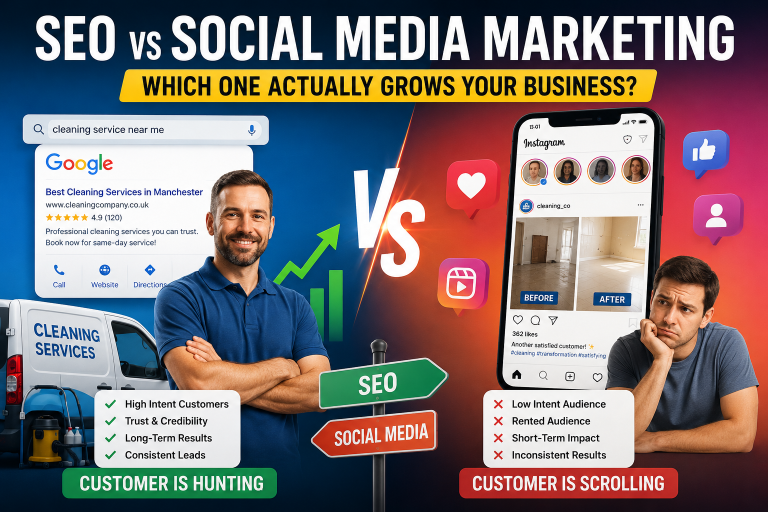
Organic traffic refers to visitors who find your website naturally through unpaid search engine results or social media. Paid traffic involves paying for sponsored placements, such as Google Ads or promoted social media posts, to drive immediate visitors. Organic is a long-term, cost-effective strategy, while paid provides instant, targeted results.
At Inteliware Growth, we specialise in turning ad spend into measurable revenue for high-intent service businesses. But we’ve also learned that the most sustainable growth comes from a smart balance. In this guide, we’ll break down the real differences between organic and paid traffic—and show you exactly how to use both to dominate your niche.
What is organic traffic?
Organic traffic includes all visitors who land on your site without you paying directly for the click. It’s driven by:
- Unpaid search engine results (SEO)
- Social media posts that reach audiences naturally
- Referrals from other websites
- Direct visits from people who already know your brand
Building organic traffic requires time, high-quality content, and technical website optimisation. The goal is to earn top positions on Google for keywords your ideal customers search for. Once you rank, every click is free.
However, organic doesn’t mean effortless. You invest in content creation, link building, site speed, and mobile optimisation. The payoff is a compounding asset—an article written today can bring customers for years.
What is paid traffic?
Paid traffic covers any visitor that arrives through an advertising channel where you pay per click (PPC), per thousand impressions (CPM), or per action. Common sources include:
- Google Ads (search, display, shopping)
- Social media ads (Meta, LinkedIn, TikTok)
- Native advertising and sponsored content
- Influencer partnerships and paid affiliate marketing
With paid traffic, you set a budget, choose your audience, write ad copy, and launch. Within hours, your site sees targeted visitors. You stop paying, the traffic stops. The speed and targeting precision make paid traffic the go-to for time-sensitive campaigns and immediate lead generation.
Key differences between organic and paid traffic
| Feature | Organic Traffic | Paid Traffic |
|---|---|---|
| Speed | Slow (takes 6–12 months to build rankings) | Instant—campaigns drive traffic within hours |
| Cost | Free per click, but requires time and resource investment | Pay-per-click or per impression; traffic stops when budget runs out |
| Trust & Authority | Higher trust—users view organic results as natural endorsements | Lower trust—users recognise ads immediately |
| Lifespan | Long-lasting; a well-optimised page can generate traffic for years | Temporary; visibility ceases the moment you pause campaigns |
These differences mean each traffic type plays a distinct role in your marketing funnel. Understanding them helps you stop comparing and start combining.
The pros and cons of organic traffic
Why organic traffic works:
- Sustainable growth : Once your page ranks, it acts like a 24/7 salesperson that doesn’t ask for a paycheck. The traffic keeps flowing without incremental ad spend.
- Brand credibility : People trust Google. Appearing at the top of organic search results signals authority. Comprehensive click-through rate studies show that up to 70% of searchers skip ads and click organic results, making organic visibility a powerful trust builder.
- Cost efficiency over time : While SEO requires upfront investment, the long-term cost per acquisition often drops far below paid channels.
Where organic falls short:
- Time to results : In competitive niches like immigration law or taxi services, it can take 8–12 months to rank for valuable keywords. That’s too slow if you need leads now.
- Algorithm dependency : A Google update can shake your rankings overnight. Recovery takes time and expertise.
- Difficult to target instantly : SEO attracts broad audiences. Fine-tuning which demographics see your content isn’t as precise as paid targeting.
Organic traffic is your long game. It builds a foundation of trust and consistent, low-cost leads but it won’t fill your sales pipeline tomorrow.
The pros and cons of paid traffic
Why paid traffic shines:
- Immediate visibility : Launch a Google Ads campaign this morning and leads can start arriving by lunchtime. For new businesses or product launches, this speed is priceless.
- Laser-focused targeting : Paid platforms let you target by location, age, interest, device, and even life events. You can show ads only to people searching for “emergency plumber near me” at 2 a.m.
- Data and testing : Every impression, click, and conversion is tracked. You can A/B test ad copy, landing pages, and audiences to quickly find what converts—and then scale. This data can even shape your organic content strategy.
The drawbacks of paid:
- Cost per click can be high : In competitive industries like legal services or app installs, CPCs can reach £20 or more. Without tight funnel optimisation, costs can eat your margin.
- Traffic stops when spend stops : Turn off ads, and the pipeline dries up. There’s no residual effect.
- Ad blindness : Many users subconsciously ignore ads or use ad blockers. You’re competing for attention in a crowded space.
Paid traffic is your growth accelerator. It puts you in front of the right people immediately—but only if you manage budgets and conversion rates effectively.
Which one should you choose?
The ideal digital marketing strategy balances both, because they serve different stages of your customer journey.
Why use organic traffic?
- Sustainable growth engine. Once you rank for “cleaning services London,” you’ll attract local leads daily without paying for each click.
- Builds brand authority. People trust organic listings. That trust increases conversion rates, especially for high-consideration services like immigration advice or medical treatments.
- Maximises long-term ROI. Over 12–24 months, the cumulative return from organic traffic often outstrips paid campaigns, giving you a lower blended cost per acquisition.
Why use paid traffic?
- Instant market entry. When you can’t wait months to rank, paid ads put you in front of high-intent searchers instantly. Perfect for new taxi firms, app launches, or seasonal promotions.
- Precision audience control. Want to target only smartphone users within 5 miles of your clinic who’ve shown interest in cosmetic procedures? Paid social and Google Ads can do that.
- Keyword and conversion insights. Use paid search data to identify high-converting keywords and messaging. Apply that learning to your SEO content to accelerate organic wins.
For the fastest, most predictable growth, we recommend a paid-first approach while you build your organic foundation. The immediate data from paid campaigns often pays for the organic investment itself.
For niche service industries why paid traffic delivers the fastest ROI
At Inteliware Growth, we work exclusively with high-intent service businesses. These niches—taxis, Immigration lawyers, cleaning companies, App Startups, and doctors—share one trait: when customers search, they’re ready to act.
- A person Googling “minicab near me” wants a ride now.
- Someone looking for “UK spouse visa solicitor” has an urgent legal need.
- A search for “end of tenancy cleaning quotes” signals immediate booking intent.
This intent is backed by real-world behaviour; Google’s own insights reveal that “near me” searches have skyrocketed, showing just how critical local immediacy has become. In these scenarios, organic rankings take too long to build, and every missed click is a missed booking. Paid search and social ads allow you to:
- Bid directly on high-intent, transactional keywords.
- Appear above organic results (and competitors) for local searches.
- Retarget visitors who didn’t convert on the first visit.
We’ve seen cleaning companies triple their lead volume in 30 days by combining Google Local Services Ads with Facebook retargeting. For Immigration law firms, precise Google Ads targeting delivers compliant, qualified leads at a predictable cost per consultation. App Startups use paid user acquisition to scale installs while keeping customer acquisition cost (CAC) in check. And Taxi Companies turn local search intent into immediate ride requests through smart PPC.
Organic still matters. A doctor’s clinic should invest in local SEO and health content. But the fastest route to a full appointment book is a paid traffic strategy optimised for conversions. The two feed each other: paid data reveals which keywords convert; organic captures the long-term authority.
How Inteliware Growth turns paid traffic into measurable growth
We don’t just run ads. We build systematic growth frameworks tailored to your industry. Our approach follows a proven 5-step roadmap:
- Audit. We deep-dive into your current traffic, competitors’ ads, audience intent, and conversion funnels. We identify the leaks costing you money.
- Strategy. We map out KPIs, channel mix, and a custom forecast. You’ll know exactly what budget to allocate and what return to expect.
- Execution.* Our team builds high-converting ad creatives and landing pages. We launch and monitor campaigns across Google, Meta, and programmatic platforms.
- Tracking. We implement advanced attribution models so you see every pound’s journey. Real-time dashboards give you full transparency.
- Scale. Once we identify winning audiences and ad sets, we expand budget confidently—automating where possible to drive down cost per lead.
For our doctors and clinic clients, this process reduced cost per patient acquisition by 40% while increasing monthly bookings. For a taxi firm, we cut CPC by 25% while doubling ride requests. You can explore these results on our case studies page. We focus on conversion rate optimisation (CRO) just as much as traffic. Getting 10,000 visitors is useless if only two convert. Our CRO work ensures that every paid click has the highest chance of becoming a paying customer.
5 actionable steps to build your own traffic strategy
Ready to craft a traffic mix that grows your business? Start here:
- Audit your current traffic sources. Use Google Analytics to see how much traffic comes from organic vs. paid, and which channels convert best. This baseline tells you where to invest.
- Set clear goals by funnel stage. Use paid traffic for bottom-of-funnel offers (book a ride, book a consultation). Use organic content for top-of-funnel education to build trust and capture long-term search demand.
- Launch a small-scale paid campaign. Pick one high-intent keyword (e.g., “emergency locksmith” if that’s your niche) and run a tight Google Ads experiment. Track calls, form fills, or sales. Use the data to refine your ad copy and landing page.
- Build an SEO foundation while ads run. Publish one in-depth service page and one helpful blog post per month. Optimise title tags, meta descriptions, and local listings. The insights from your paid keywords will guide your content topics.
- Connect your tracking and iterate. Install conversion tracking, use UTM parameters, and review performance weekly. Double down on what works; cut what doesn’t. Gradually increase budget for winning campaigns and scale.
Remember, the best traffic strategy isn’t organic or paid—it’s a system where each amplifies the other.
Conclusion
Organic traffic builds long-term authority and cost efficiency. Paid traffic delivers speed, precision, and measurable scale. For high-intent service industries—from taxi firms to legal practices—the question isn’t which to choose, but how to use both in sync.
At Inteliware Growth, we believe paid search and social should drive your immediate revenue while you lay the groundwork for lasting organic growth. The data from your ads feeds your SEO, and your SEO dominance eventually lowers your reliance on ads. That’s the flywheel effect every performance-focused business needs.
If you’re ready to turn ad clicks into real customers without wasting budget, we’re here to help.
Book Your Free Consultation
📞 +92 344 3503901
📧 sales@inteliwaregrowth.com
📍 London, United Kingdom
Frequently Asked Questions
Is organic traffic really better than paid traffic? Neither is universally better. Organic builds trust and long-term efficiency, while paid delivers speed and precise targeting. A mix of both usually yields the strongest ROI.
How much should a small business budget for paid traffic? Start with a modest test budget—around £500 to £1,500 per month—to collect conversion data. Scale up once you identify what works profitably.
Does paid traffic help my SEO? Paid ads don't directly boost rankings, but they provide keyword and conversion insights that strengthen your organic strategy. They also increase brand visibility, which can lead to more branded searches.
How long does it take to see results from organic traffic? Typically 6 to 12 months to rank for competitive terms. Results depend on content quality, domain authority, and competition level.
Can I rely solely on organic traffic? It’s possible, but growth will be slow and vulnerable to algorithm updates. Without paid, you lack the agility to capture immediate opportunities or test new offers quickly.
What’s the biggest mistake businesses make with paid traffic? Directing ad traffic to poorly optimised pages without proper tracking. Always invest in conversion rate optimisation alongside your campaigns to turn clicks into customers.
Is paid traffic suitable for local businesses like clinics or cleaning services? Yes, especially via Google Local Services Ads and geo-targeted social campaigns. These place you in front of high-intent local customers exactly when they’re ready to book.