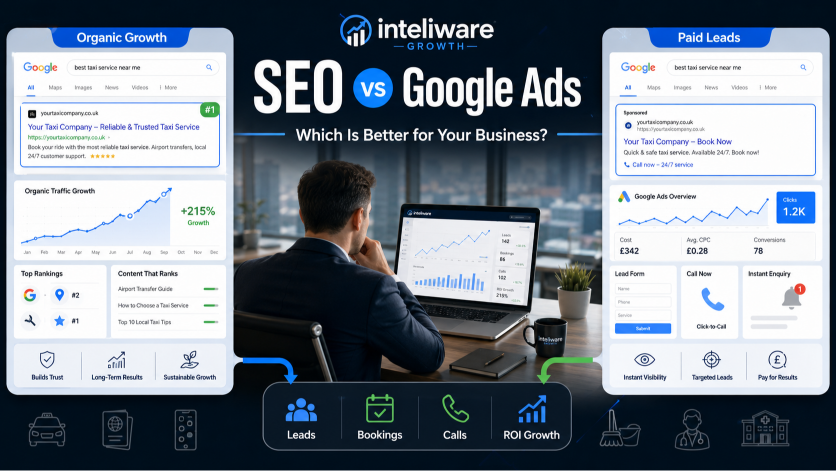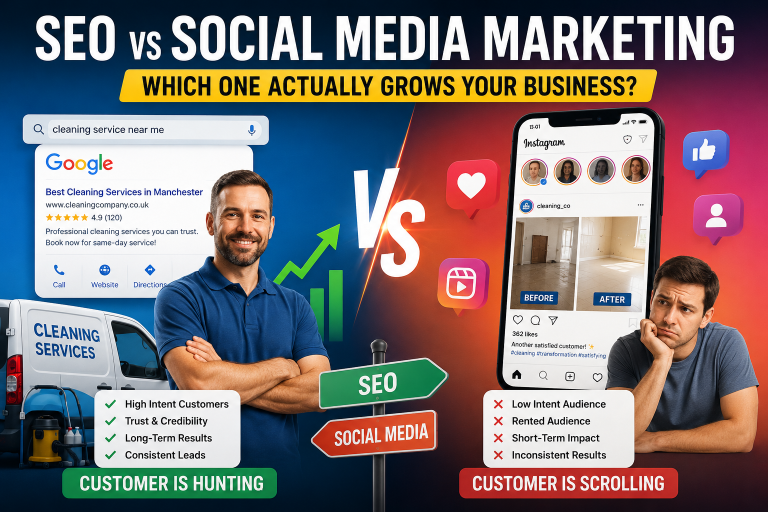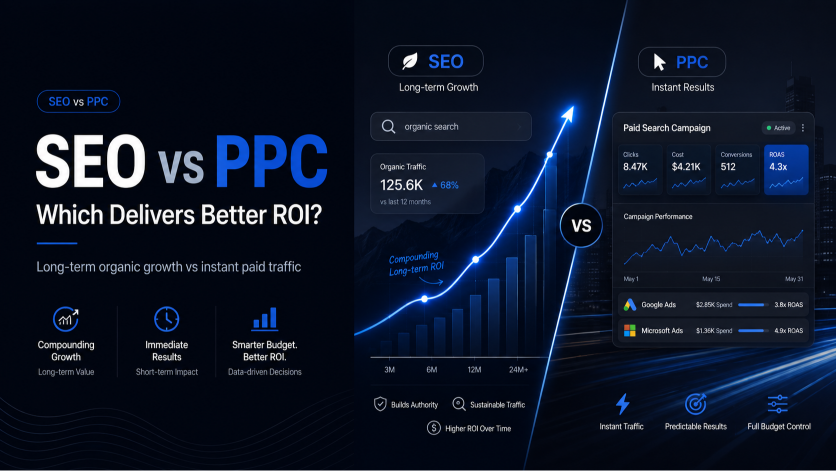
SEO delivers a significantly higher long-term return on investment (ROI), often averaging over 500% to 700% once established, because organic traffic is free per click. Conversely, PPC (Pay-Per-Click) delivers immediate visibility and predictable short-term revenue, but its ROI remains linear and stops the moment you pause your ad spend.
Every business owner facing this question wrestles with the same tension: invest time and patience into a channel that builds lasting value, or spend money on instant traffic that vanishes the moment the budget stops. The truth is that neither SEO nor PPC is universally better. The answer depends entirely on your timeline, cash position, and business model. A well-funded app startup needs different fuel than a local cleaning company trying to fill next week’s schedule.
Below, I’ll walk you through how each channel generates ROI, where they shine, and exactly how to blend them so you stop choosing between speed and sustainability. I’ll also show you how Inteliware Growth applies this hybrid approach for high-intent niche service businesses — precisely the industries we serve every day.
Understanding marketing ROI
ROI isn’t just about the revenue a channel produces today. It’s about the total value created over time relative to what you spend. To compare SEO and PPC fairly, you need to look at three dimensions:
- Customer acquisition cost (CAC) – what it costs to land a lead or sale.
- Customer lifetime value (LTV) – how much that customer is worth over the relationship.
- Time to value – how quickly the channel starts paying you back.
SEO front-loads investment but drives down CAC over time. PPC keeps CAC predictable yet perpetually recurring. Both have a place; the trick is knowing when each belongs in your growth engine.
SEO as a long-term powerhouse
Search engine optimisation is often reduced to “writing blog posts.” In reality, it’s a systematic process of making your site the most relevant, authoritative answer to a user’s query. The ROI story of SEO is one of patience rewarded with compounding returns.
High compounding returns
Organic traffic doesn’t charge you per click. Once you rank in the top three positions for a high-value keyword, that stream of visitors becomes near-free – your only ongoing cost is periodic content refreshes and technical maintenance. This is how SEO routinely delivers 500%+ ROI over 12 to 24 months.
Consider an immigration lawyer ranking for “UK spouse visa solicitor.” That single organic position can send dozens of qualified leads every month, month after month, with zero per-click cost. The cost per lead falls steadily the longer you hold the rank, while the PPC equivalent grows more expensive as competitors bid harder.
Builds trust and click dominance
Users trust organic results more than ads. Research consistently shows that over 70% of all clicks go to organic listings. That trust premium translates directly into higher conversion rates; a prospect who discovers you through a thorough, helpful guide arrives warmer than someone who clicked an ad out of fleeting curiosity.
For service businesses like law firms, medical clinics, or private hire operators, this credibility edge is priceless. Somebody searching “emergency dentist near me” is far more likely to call the practice that appears organically as a recommended local provider than the one that simply paid for the top ad spot.
Slow ramp-up over 3 to 6 months (or longer)
The catch? SEO demands consistent technical and content work for at least three to six months before major results surface. Google needs time to crawl, index, and trust a new site or freshly optimised pages. In competitive sectors – immigration law, taxi services in big cities – establishing authority can take a year or more.
That doesn’t mean you’ll see nothing for half a year. Early quick wins like fixing broken links, claiming your Google Business Profile, and optimising title tags can bring small traffic boosts within weeks. But the compound curve that eventually makes your phone ring without ad spend requires discipline.
PPC as the speed engine
Pay-per-click advertising, whether through Google Ads or paid social, is the polar opposite of SEO in terms of immediacy and control. It’s a tap you can turn on or off instantly, giving you complete say over when, where, and to whom your message appears.
Instant traffic within 24 hours
Launch a Google Ads campaign today, and targeted traffic can land on your site tomorrow. For a taxi firm expanding into a new city or an app startup that needs immediate downloads to impress investors, that speed is non-negotiable.
PPC also functions as the ultimate testing lab. You can quickly validate which keywords actually convert before you invest months optimising for them organically. That intelligence is pure gold when you eventually build your SEO content strategy.
Precise control over budget and targeting
With PPC, you decide exactly how much a click, lead, or app install is worth to you. You can target people by location, device, time of day, and even their past behaviour on your site through remarketing. Want to show ads only to people in London searching for “cleaning company” between 8 a.m. and 10 a.m.? Done.
This precision is exactly how Inteliware Growth’s Google Ads Management slashes customer acquisition costs for immigration law firms and private hire operators. We build campaigns where every pound is accountable and tied to revenue.
Linear costs mean traffic stops when you pause
Here’s the hard truth: PPC ROI is linear and fragile. If you spend £1,000 and make £2,000, that’s a 100% return. But if you stop spending tomorrow, your traffic – and therefore revenue – goes to zero. There’s no residual asset, nothing you own.
To make matters worse, cost-per-click rises steadily in competitive markets. A keyword that cost £3 last year might cost £5 this year, eating into your margins. Industry benchmarks confirm that average CPCs have been climbing year on year across most sectors. Over a multi-year horizon, ROI will decline unless you continuously optimise conversion rates. That’s why Conversion Rate Optimisation (CRO) isn’t a nice-to-have. It’s the lever that keeps PPC profitable.
SEO vs PPC ROI comparison
| Factor | SEO | PPC |
|---|---|---|
| Time to first result | 3–6+ months | 24–48 hours |
| Cost structure | Upfront investment, then low ongoing cost | Pay per click, continuous spend |
| Typical 12-month ROI | 500%–700%+ (once established) | 100%–300% (highly variable) |
| Traffic longevity | Lasts months/years after work stops | Stops immediately when ads pause |
| Click trust level | High (70%+ of clicks are organic) | Moderate (users know it’s an ad) |
| Scalability | Virtually unlimited, but slow | Instantly scalable with budget |
| Risk | Algorithm changes can impact rankings | Ad costs and competition can spike overnight |
Neither column wins across the board. The table simply confirms that these two channels serve fundamentally different strategic purposes.
Integrating SEO and PPC for maximum ROI
The businesses with the strongest unit economics don’t pick one channel – they sequence them. This is the core philosophy behind every growth framework we build at Inteliware Growth.
Use PPC first to fast-track market entry
When launching a new service or entering fresh territory, PPC provides immediate cash flow and irreplaceable market intelligence. Within weeks, you’ll learn which ad copy resonates, which landing pages convert, and exactly which keywords send high-intent traffic.
Treat PPC as your paid market research lab. After a few months of conversion data, pour those winning keywords directly into your SEO content plan – eliminating months of guesswork.
Use SEO in parallel to build long-term authority
While PPC funds today’s growth, SEO quietly constructs the asset that makes you less dependent on ad spend tomorrow. As organic rankings rise, you gradually reduce PPC spend on those same terms, lowering your blended cost per lead across the board.
For instance, a doctor’s clinic might run Google Ads for “private GP appointment London” while simultaneously building a comprehensive, SEO-optimised health library and local service pages. After 12 months, organic traffic might cover 60% of total leads, allowing the clinic to cut ad spend or redeploy it into higher-margin services.
This dual approach also protects your brand from inevitable ad cost inflation. When click prices climb, your organic visibility acts as a hedge – you maintain volume without paying the premium.
How Inteliware Growth maximises niche service ROI
Generic marketing advice fails for businesses where one wrong click costs hundreds of pounds and a client’s lifetime value runs into thousands. That’s why we built our entire agency around performance-driven strategies for five high-intent sectors.
- Taxi & private hire companies: We turn “taxi near me” searches into instant bookings through hyper-local Google Ads, then build durable organic visibility with location-specific landing pages that rank for the long haul.
- Immigration law firms: High-cost, high-conversion PPC phrases like “UK work visa solicitor” run alongside deep, authoritative SEO content that answers complex legal questions – content Google rewards and anxious clients trust.
- App-based startups: App Install Advertising drives initial downloads and reveals real CAC data, which then informs ASO (app store optimisation) content and organic social growth. Paid and organic form a flywheel rather than separate silos.
- Cleaning companies: Lead generation campaigns fill diaries today; local SEO ensures tomorrow’s calls come in without ad spend.
- Doctors & clinics: Patient acquisition through targeted paid search and social integrates with reputation-building organic content and local map optimisation.
Our 5-step framework – Audit, Strategy, Execution, Tracking, Scale – applies whether we’re running a pure PPC sprint or a full-funnel SEO+PPC integration. Every decision is driven by real-time dashboards that show exactly which keyword, ad, or page is putting money in your pocket. Explore our case studies to see these results in action.
Calculating your ROI with key metrics
Before committing budget, set up measurement that tells you what’s working.
For PPC:
- Cost per click (CPC)
- Click-through rate (CTR)
- Conversion rate
- Cost per acquisition (CPA)
- Return on ad spend (ROAS): Revenue ÷ Ad Spend
For SEO:
- Organic sessions and users
- Keyword rankings for target terms
- Organic conversion rate
- Assisted conversions (when organic touchpoints contribute to a final sale)
- Estimated cost per organic acquisition: (SEO investment) ÷ (Organic conversions)
A common mistake is comparing a raw PPC ROAS of 300% with an “SEO ROI” that ignores the time and resources you’ve invested. SEO’s upfront cost is real – content creation, technical fixes, link building. The magic is that once the curve tips, the incremental cost per lead approaches zero.
FAQ
Does SEO really work for small businesses?
Yes. A local cleaning company ranking in the Google 3-pack for “cleaners near me” can generate consistent calls without spending on ads. The key is targeting long-tail, hyper-local keywords with lower competition.
Why does PPC feel more expensive year after year?
Because it is. More advertisers enter the auction, and costs per click rise. Continuous conversion rate optimisation is the only sustainable way to protect margins as CPCs increase.
Can I just do PPC and ignore SEO?
You can for a while, but you’ll own no asset. If your ad account gets suspended or costs spike, your entire lead flow disappears. SEO serves as your long-term insurance policy.
How do I convince my boss to invest in SEO when PPC shows immediate results?
Compare trendlines. PPC cost per lead generally rises over time. Organic cost per lead falls. Project both over 18 months – the blended cost per lead from a combined strategy almost always wins.
When should I hire an agency instead of managing this in-house?
When the cost of a wrong move outweighs agency fees. Specialist agencies bring cross-industry pattern recognition and have already made the expensive mistakes, so you don’t have to.
Conclusion
SEO and PPC aren’t rivals. They’re two halves of a single growth machine. PPC buys you speed, data, and the revenue to fuel your business right now. SEO builds the asset, trust, and margin expansion that makes your business defensible.
The winners stop asking “SEO or PPC?” and start asking “How do we sequence PPC to fund and inform aggressive SEO, while continuously optimising conversion rates so every click, paid or organic, counts?”
At Inteliware Growth, that’s exactly what we do. Whether you need a laser-focused Google Ads campaign, a full-funnel patient acquisition system, or app install advertising that doesn’t burn through your runway, our framework turns advertising spend into measurable, scalable revenue.
Contact Us
📞 +92 344 3503901
📧 sales@inteliwaregrowth.com
📍 London, United Kingdom