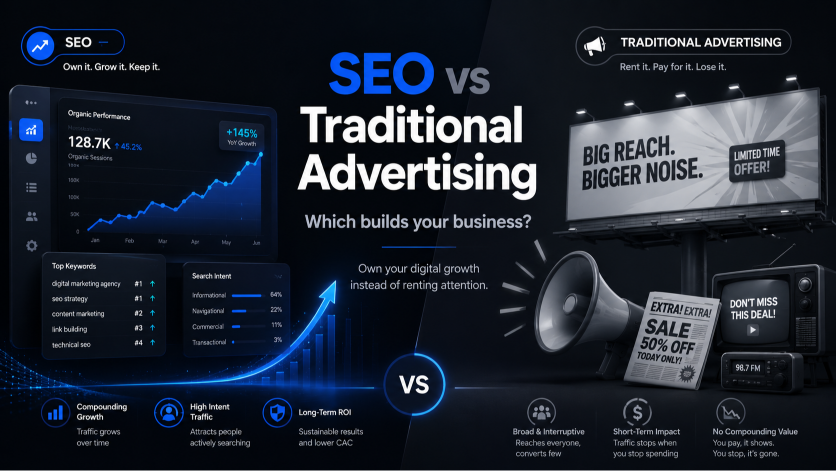
SEO focuses on organic search visibility by targeting specific user queries and building long-term digital assets. Traditional advertising uses offline channels like print, TV, and billboards to broadcast broad messages to mass audiences. SEO compounds over time, whereas traditional ads stop working when funding ends.
In the race to scale a business, the battle for budget between marketing channels is relentless. For years, the default setting for growth was to buy attention: billboards, radio spots, and direct mail. But the digital economy has introduced a fork in the road.
At Inteliware Growth, we analyze the data behind every pound spent. We have seen businesses burn cash on fleeting impressions and others build digital empires through organic search. The debate is not just SEO vs. Traditional Advertising. It is a fundamental question of whether you want to rent your audience or own your digital territory.
Core differences
Understanding the nuance between these two strategies is the first step to allocating your budget effectively. They operate on entirely different physics, and treating them as equals is a costly mistake.
Here is a quick comparison table to help you see the differences at a glance:
| Aspect | SEO | Traditional Advertising |
|---|---|---|
| Targeting | Active search intent | Broad, interruptive mass reach |
| Duration | Compounding, long-term returns | Temporary, short-term awareness |
| Measurement | Precise analytics and conversion tracking | Estimated impressions and reach |
| Cost structure | Owned media assets | Rented audiences with high upfront costs |
Targeting
SEO targets active search intent. Traditional advertising casts a wide, interruptive net. When a user types immigration lawyers or cleaning services in London into Google, they are raising their hand. They have a problem and are actively seeking a solution. SEO captures this demand precisely at the moment of need. In contrast, a billboard or a TV spot interrupts someone who is likely thinking about their commute or their favorite show, not your service. While interruption can build awareness, it rarely captures high-intent leads the way a top-ranking landing page does.
Duration
SEO provides compounding, long-term returns. Traditional marketing offers temporary, short-term awareness. This is the most significant financial distinction. A traditional ad campaign is a light switch: on when you pay, off when you stop. SEO is a compounding asset. The content you publish and the links you earn today continue to drive traffic tomorrow, next month, and next year. As your domain authority grows, the cost of acquiring a new customer through organic search often drops, whereas the cost of traditional media tends to rise.
Measurement
Digital SEO analytics track performance precisely. Traditional media struggle with exact ROI tracking. With SEO, we live in a world of data and analytics. We can see the exact keyword, the exact page, the time on site, and the conversion path. We know the lifetime value of a customer who came through organic search. Traditional advertising, by nature, relies on broad metrics like estimated impressions or reach. While brand lift surveys exist, they cannot tell you precisely which billboard convinced a high-value client to book a consultation. This lack of clarity leads to wasted spend.
Cost structure
SEO builds owned media assets. Traditional advertising relies on high upfront costs for rented audiences. When you invest in SEO, you are building a property on the internet: your website content, your backlinks, and your reputation. You own this space. When you invest in a magazine ad or a TV spot, the moment the campaign ends, you own nothing. You have paid rent for attention. If you stop paying rent, you are evicted from the customer's mind. If you stop paying for SEO after a period of maturation, your rankings often persist, continuing to generate revenue from the asset you built.
Rented Attention
As a performance marketing agency focused on high-intent niche services, Inteliware Growth has audited countless budgets. The pattern is always the same: businesses pump thousands into awareness campaigns without a mechanism to convert that awareness into revenue.
Traditional advertising relies on frequency. You need to hit the same consumer seven times before they remember you. That requires a massive budget. For a local taxi company or a medical clinic, that budget is unsustainable. It is a high-risk gamble with a low statistical probability of immediate return.
SEO, on the other hand, is a filter. It does not try to convince someone they need a ride to the airport. It simply ensures that when they search for airport transfer London, your business is the first name they see. This is the pull methodology that high-growth sectors rely on.
High-Intent Assets
At Inteliware Growth, we apply this asset-building philosophy to five distinct verticals: Taxi Companies, Immigration Lawyers, App Startups, Cleaning Companies, and Doctors & Clinics. Here is why the SEO model works flawlessly for them but traditional methods often fail:
- Taxi & Private Hire: A radio ad asks everyone to remember us next time. An SEO-optimized page ranks for taxi to Heathrow exactly when a traveler is booking. The latter has a 90% higher chance of conversion.
- Immigration Law: Billboards are generic. SEO allows you to answer specific, complex queries like spouse visa financial requirements UK. By solving these problems, you establish immediate trust and authority.
- Doctors & Clinics: Traditional print ads are fading. Parents searching pediatrician near me open now are ready to book. If you are not there, you lost a patient to a competitor who is.
- App Startups: A startup app cannot afford a Super Bowl ad. SEO and App Store Optimization work together to capture users who are actively looking for a solution that your app provides. This leads to lower customer acquisition costs and higher retention rates.
- Cleaning Companies: Local SEO drives phone calls. When someone searches for end of tenancy cleaning near me, they want a quote today. Traditional flyers often end up in the bin, but a top organic listing earns immediate trust and action.
The Inteliware Framework
To truly leverage SEO against traditional advertising, you cannot just write a blog. You need a systematic approach. We utilize a 5-step roadmap, refined through real case studies, that treats organic search like the performance channel it is:
- Audit: We dive deep into competitor data and audience intent. We do not guess what you think people are searching for. We analyze the actual query data for your niche.
- Strategy: We build a custom roadmap based on KPIs and forecasted organic growth. We identify the money pages that will drive leads, not just traffic.
- Execution: We launch optimized landing pages and content that answers the user's query better than anyone else on the SERP.
- Tracking: We implement advanced attribution so you can see exactly which organic landing page generated the phone call or the form fill. No more we think it worked.
- Scale: We double down on winning content. If a page drives high-converting traffic, we feed it more resources: internal links, backlinks, and supporting content to dominate the niche.
When Ads Still Work
It would be misleading to say traditional advertising is dead. For certain scenarios, it still delivers value. Mega brands with huge budgets often use TV or billboards to maintain top-of-mind awareness. A national retail chain launching a new product line might benefit from a short burst of mass media exposure.
However, for niche service industries, traditional advertising often fails because the audience is too broad. A billboard in London reaches millions of people, but only a tiny fraction need an immigration lawyer or a taxi to the airport at that exact moment. The cost per relevant impression is enormous. Nielsen trust study shows that consumers consistently place more trust in organic search results than in interruptive ads.
The key is to understand your sales cycle. If your customers make high-consideration decisions, they will search for information before buying. That is where SEO wins. If your product is an impulse buy with universal appeal, traditional advertising might still work. But for the five verticals we serve, data shows that search intent consistently outperforms interruptive ads.
The Smart Play
While we are passionate about SEO, a smart marketer knows that channels can be complementary. However, the order of operations matters.
Traditional advertising is a megaphone. SEO is a magnet. The highest ROI strategy is usually to use a smaller, targeted paid campaign like Google Ads or Paid Social to generate immediate cash flow, while simultaneously building the organic foundation that will eventually replace that expensive paid dependency.
If you are spending £5,000 a month on a billboard for your cleaning company but your website does not rank for house cleaning services, you are burning money. You are driving people to a digital storefront that is closed.
Conclusion
The shift from traditional advertising to SEO is not a trend. It is a correction of market inefficiency. Traditional advertising still has a place for mega-brands with massive budgets looking for broad reach. But for niche service industries, such as the taxi firms, the law firms, and the clinics, survival depends on capturing demand, not creating it.
Search engines have become the new Yellow Pages, the new town square, and the new referral network. If you are ready to stop renting audiences and start owning your digital growth, it is time to look at the data.
Frequently asked questions
Can I use SEO and Traditional Advertising at the same time?
Yes, you can and often should. Traditional ads create demand. SEO captures it. Make sure your SEO foundation is solid before launching broad awareness campaigns.
How long does it take for SEO to beat Traditional Advertising ROI?
Typically 6 to 12 months in competitive niches. Once mature, SEO usually delivers a much lower cost per acquisition and lasts for years, unlike ads that stop when you stop paying.
Which is better for a startup: SEO or a Billboard?
SEO is almost always better for startups. It targets users actively searching for your solution, while a billboard targets everyone and no one.
Does Inteliware Growth handle both Paid Ads and SEO?
We are a data-driven performance agency focused on high-intent channels like Google Ads and CRO. Our strategies are built on sound analytics that benefit all digital channels, including SEO assets.
How do I measure the ROI of SEO compared to traditional advertising?
With SEO, you can track exact conversions, calls, and form submissions through analytics tools. Traditional advertising relies on surveys and estimates. The difference in data precision is night and day.
Ready to stop renting your audience and start owning your growth?
Contact Inteliware Growth today for a free consultation.
Contact Us
📞 +92 344 3503901
📧 sales@inteliwaregrowth.com
📍 London, United Kingdom