Introduction
People search Google more than 8.5 billion times every day, making search engines one of the most valuable sources of qualified traffic for businesses. Whether someone is looking for a local taxi company, an immigration lawyer, a healthcare clinic, or a new mobile app, their journey often starts with a search.
But simply having a website is no longer enough. In 2026, Google's search ecosystem is powered by artificial intelligence, semantic understanding, user experience signals, and helpful content. Businesses that understand modern Search Engine Optimization (SEO) can earn consistent organic traffic, qualified leads, and long-term growth without relying entirely on paid advertising.
In this guide, you'll learn:
- What is SEO
- How search engines work
- Why SEO matters in 2026
- The different types of SEO
- How AI is changing search
- Common SEO mistakes
- How businesses can build a sustainable SEO strategy
What Is SEO?
Search Engine Optimization (SEO) is the process of improving a website so it appears higher in search engine results when users search for relevant products or services. The goal is to increase visibility, attract qualified visitors, and convert that traffic into leads or customers.
Unlike paid advertising, SEO focuses on earning organic visibility by providing helpful, authoritative, and technically sound content that satisfies user intent.
Why SEO Matters More Than Ever in 2026
The search landscape has evolved significantly. Modern SEO is no longer about keyword research, meta data, heading tags —it is about delivering value.
Today's search engines evaluate:
- User intent
- Content quality
- Experience and expertise
- Website speed
- Mobile usability
- Structured data
- Trust signals
- AI relevance
- Topical authority
Businesses that invest in SEO build a stronger long-term digital presence while reducing dependence on paid acquisition channels.
How Search Engines Work
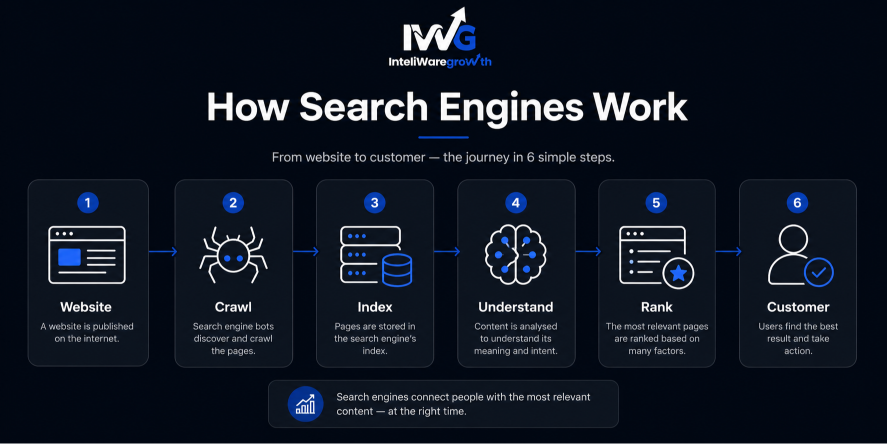
Search engines operate through four key stages:
-
Crawling
Search engine bots discover new and updated pages by following links across the web. -
Indexing
Relevant pages are analyzed, categorized, and stored in Google's index. -
Understanding
AI systems evaluate content, context, search intent, semantic relevance, and authority. -
Ranking
When someone searches, Google ranks pages based on hundreds of signals to deliver the most useful results.
The Three Core Pillars of SEO
Technical SEO
Ensures your website is easy for search engines to crawl and provides a strong user experience.
Key elements include:
- Core Web Vitals
- Mobile responsiveness
- Secure HTTPS
- XML sitemaps
- Structured data
- Clean site architecture
On-Page SEO
Optimizes individual pages to align with user intent.
Best practices include:
- Well-structured headings
- Keyword optimization
- Internal linking
- Optimized images
- Helpful, comprehensive content
- Meta titles and descriptions
Off-Page SEO
Builds authority through external trust signals.
Examples include:
- Quality backlinks
- Digital PR
- Brand mentions
- Reviews
- Local citations
How AI Has Changed SEO in 2026
Artificial intelligence has transformed how search engines interpret and present information.
Instead of matching keywords alone, AI understands:
- Context
- Entities
- Relationships
- Search intent
- User behavior
This means businesses should focus on creating genuinely helpful content that answers real questions comprehensively rather than chasing keyword density.
SEO vs Google Ads
| Aspect | SEO | Google Ads |
|---|---|---|
| Time Horizon | Long-term investment | Immediate visibility |
| Traffic Type | Organic traffic | Paid traffic |
| Authority Building | Builds authority | Stops when budget ends |
| Cost Model | Sustainable growth | Ongoing ad spend |
| Results | Lower long-term acquisition costs | Fast results for campaigns |
For many businesses, the strongest strategy combines both SEO and paid advertising.
SEO for Local Businesses
Local SEO is essential for service-based businesses targeting customers in specific locations.
Examples include:
- Taxi Companies
- Immigration law firms
- Medical clinics
- Cleaning services
- Local startups
Optimizing Google Business Profiles, location-specific pages, and local citations helps businesses appear in map results and local searches.
Common SEO Mistakes
Avoid these pitfalls:
- Publishing thin content
- Ignoring mobile users
- Slow page speed
- Duplicate content
- Poor internal linking
- Missing structured data
- Buying low-quality backlinks
- Neglecting user experience
The Future of SEO
SEO in 2026 is increasingly shaped by AI-generated search experiences, conversational queries, and user-centric content. Businesses that prioritize expertise, trust, and valuable information will continue to earn visibility as search technology evolves.
How Inteliware Growth Helps Businesses Grow
At Inteliware Growth, we believe that growth shouldn’t be guesswork. Our approach combines data, strategy, and performance to build predictable growth engines rather than chasing vanity metrics.
Our proven five-step framework includes:
- Audit – Analyze competitors, audience intent, and existing performance.
- Strategy – Build a tailored growth roadmap with measurable KPIs.
- Execution – Launch optimized campaigns, landing pages, and SEO initiatives.
- Tracking – Measure every click, lead, and conversion with transparent reporting.
- Scale – Expand investment into the channels that consistently deliver results.
We specialize in helping Taxi & Private Hire Companies, Immigration law firms, App-Based Startups, cleaning companies, and Doctors & Clinics through SEO, Google Ads, paid social campaigns, conversion rate optimization, and data-driven lead generation.
Frequently Asked Questions (FAQs)
1. What is SEO in simple terms?
SEO is the process of improving your website so it appears higher in Google when people search for products or services related to your business.
2. How does SEO work in 2026?
SEO combines high-quality content, technical optimization, user experience, and authority signals. Search engines use AI to understand intent and rank helpful content.
3. How long does SEO take to show results?
Most businesses see noticeable improvements in 3–6 months, while competitive industries may take 6–12 months.
4. Is SEO better than Google Ads?
Both serve different purposes. The best approach is usually a combination of both.
5. Why is SEO important for small businesses? SEO helps small businesses compete with larger companies by increasing online visibility, attracting local customers, building trust, and generating high-quality leads without relying solely on paid advertising.
6. What are the main types of SEO? The three primary types of SEO are:
- Technical SEO
- On-Page SEO
- Off-Page SEO Together, these improve website performance, content relevance, and online authority.
7. Does AI replace SEO in 2026? No. AI enhances how search engines understand content, but businesses still need expert-written content, technically optimized websites, and authoritative backlinks to rank well. SEO is evolving alongside AI rather than being replaced by it.
8. What are Google's ranking factors in 2026? Google evaluates many ranking signals, including:
- Helpful, high-quality content
- Search intent
- Website speed
- Mobile friendliness
- Core Web Vitals
- Backlinks
- User experience
- Structured data
- Website authority
9. Can I do SEO myself? Yes. Business owners can learn basic SEO practices such as keyword research, writing helpful content, optimizing page titles, and improving website structure. However, achieving competitive rankings often requires the expertise of an experienced SEO agency.
10. Why is local SEO important? Local SEO helps businesses appear in Google Search and Google Maps when nearby customers search for services. It is especially valuable for service-based businesses such as Taxi Companies, law firms, clinics, and cleaning companies looking to attract local clients.
11. What mistakes should I avoid in SEO? Common SEO mistakes include:
- Publishing thin or duplicate content
- Ignoring mobile optimization
- Slow-loading websites
- Poor internal linking
- Keyword stuffing
- Buying low-quality backlinks
- Neglecting technical SEO Avoiding these issues helps improve search rankings and user experience.
12. Why choose Inteliware Growth for SEO? Inteliware Growth delivers data-driven SEO strategies designed to generate measurable business results. Through comprehensive audits, customized strategies, technical optimization, content marketing, and continuous performance tracking, we help businesses achieve sustainable growth and higher search visibility across competitive industries.
Ready to Grow Your Business?
Whether you're looking to improve your search rankings, generate qualified leads, or build a scalable digital marketing strategy, Inteliware Growth can help.
Contact Us
📞 Phone: +92 344 3503901
📧 Email: sales@inteliwaregrowth.com
📍 Location: London, United Kingdom