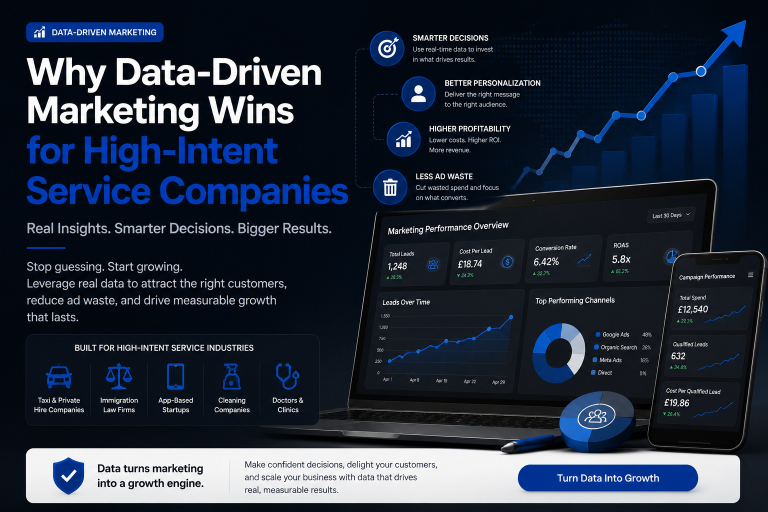
Data-driven marketing wins because it replaces guesswork with real consumer insights, making campaigns six times more profitable, cutting ad waste by up to 30%, and delivering five to eight times higher return on investment through precise personalization.
For UK service businesses such as taxi companies, immigration law firms, app startups, cleaning companies, and doctors or clinics, that sentence is the difference between paying for clicks and paying for customers.
This guide explains what data-driven marketing is, why it outperforms guesswork, the benefits it delivers, and the core strategies Inteliware Growth uses to help high-intent service brands scale profitably.
What is data-driven marketing?
Data-driven marketing is the practice of collecting, analysing, and acting on customer, campaign, and market data to make better marketing decisions. Instead of asking what you think will work, you look at what the data shows worked last week, for which audience, and at what cost. The data comes from website analytics, Google Ads search terms, Meta pixel events, CRM records, call tracking, and booking forms.
Why guesswork fails
High-intent niches are expensive. A click for “immigration lawyer London” or “taxi near me” can cost several pounds, and the window to convert is small. If you rely on intuition, you risk bidding on broad keywords, showing the wrong creative, or spending all day on a channel that never leads to a booked appointment. Data-driven marketing wins because it aligns every pound with a measurable outcome.
Key benefits
Below are the four benefits we see most often when service brands move from guesswork to data.
Smarter decisions
Data removes the loudest voice in the room. Instead of debating whether Facebook or Google Ads feels right, you look at cost per lead, conversion rate, and return on ad spend. Real-time metrics allow you to shift budget to the channel, campaign, or keyword that actually drives revenue.
Better personalization
Personalization is not just using a first name in an email. It means showing a taxi offer to someone who searched for airport transfers at 6 a.m., or a consultation ad to a user who already visited your immigration services page. When offers match exact buyer needs, engagement increases and conversion costs fall.
Higher profitability
Reaching the right audience with the right message at the right time has a compounding effect. You spend less to acquire each customer, retain more of them, and increase lifetime value. The data consistently shows profitability rises when budgets follow performance signals.
Less ad waste
Every click that does not turn into a meaningful action is waste. Data-driven marketing identifies the channels, times, placements, and audiences that do not convert and automatically reduces or stops that spend. The result is a cleaner pipeline and more budget available for winning campaigns.
Core strategies for success
You do not need a massive data science team to see results. You need three core strategies applied consistently.
Run tests
A/B testing is the fastest way to challenge assumptions. Test one variable at a time, such as headline, image, call to action, landing page, or audience. Use statistically significant results to keep the winner and test the next idea. At Inteliware Growth, we never launch a high-budget campaign without a testing roadmap.
Track results
Live dashboards turn raw data into decisions. Tools like Google Looker Studio pull data from Google Ads, Meta, call tracking, and CRM platforms into one view. This means you can see cost per lead, conversion rate, and ROI in real time, not in a PDF sent two weeks later.
Segment audiences
Not all customers are the same. Group users by past purchases, site behaviour, location, device, or stage in the funnel. Then create tailored ads, offers, and landing pages for each segment. Segmentation increases relevance, which lowers cost per acquisition.
Industry applications
Each high-intent service industry has different conversion events. Data-driven marketing respects those differences.
Taxi & private hire companies
Taxi and private hire companies live on local search intent. Data from ride requests, peak booking times, and geographic zones tells you exactly when and where to bid. We use this data to turn “taxi near me” searches into confirmed ride requests instead of wasted clicks. Learn more about our taxi company marketing approach.
Immigration law firms
Immigration law is high-consideration and compliance-sensitive. Data-driven campaigns focus on consultation bookings, call length, and lead quality. By tracking which keywords and ad angles produce qualified enquiries, firms can scale without inflating cost per lead.
App-based startups
For app startups, success is measured in installs that actually register, subscribe, or make a first purchase. Data-driven marketing links ad spend to in-app events, allowing you to optimise for return on ad spend rather than vanity installs.
Cleaning companies
Cleaning companies rely on local lead volume and booking conversion. Data shows which service pages, offers, and postcodes generate actual jobs. That insight helps you dominate your service area without overspending on broad, low-intent clicks.
Doctors & clinics
Doctors and clinics need patient acquisition but also appointment attendance. Data-driven campaigns track call bookings, form completions, and no-show rates. This allows clinics to focus on the campaigns that fill appointment slots with the right patients.
Our 5-step framework
We use a 5-step roadmap to scale clients with predictable, data-backed growth.
Audit
We dive deep into competitor data, audience intent, and existing funnels. The audit reveals where money is leaking and where the next growth opportunity sits.
Strategy
We build a custom roadmap with clear KPIs and channel forecasting. This removes guesswork before a single pound is spent.
Execution
We launch custom ad creatives and landing pages built for conversion. Every asset is designed around the data from the audit and strategy phases.
Tracking
We implement advanced attribution models and analytics, including call tracking and offline conversion imports, so every lead is attributed correctly.
Scale
We expand budget based purely on winning, automated data. If a campaign beats target KPIs for a set period, we scale it. If not, we cut or fix it.
Essential tools
Google Analytics 4 helps us understand user behaviour across your website and app. Google Looker Studio is our default reporting layer because it gives clients a live, filterable dashboard. Google Ads and Microsoft Ads capture high-intent demand, while Meta Ads use pixel data and custom audiences for advanced targeting. Call tracking and CRM data close the loop by importing offline conversions back into ad platforms.
Common mistakes
Avoid tracking vanity metrics. Impressions and clicks feel good but do not pay salaries. Focus on cost per qualified lead, conversion rate, and return on ad spend.
Do not ignore offline conversions. If most of your business comes from phone calls, and you are not tracking calls, your data is incomplete. You will kill good campaigns and scale bad ones.
Do not change too many variables at once. A/B tests lose meaning when you change headline, image, and audience simultaneously. Isolate one variable to know what caused the lift.
Do not scale before tracking. More budget does not fix a broken funnel. It amplifies it. Make sure conversion tracking and attribution are working before you increase spend.
Respect privacy. Data-driven marketing must respect GDPR and platform policies. Use consent-based first-party data and keep customer trust intact.
Getting started
Start by auditing your current tracking. Check Google Ads conversion tags, GA4 events, phone call tracking, and CRM connection. Set KPIs that reflect revenue, such as cost per booked appointment, cost per qualified lead, or return on ad spend. Build a live dashboard in Looker Studio so the whole team sees the same numbers. Run one meaningful test on a high-impact page or ad. Review weekly and make small budget shifts based on performance, not monthly reports. Scale what wins by gradually increasing budget once a campaign beats target KPIs for two to four weeks.
Why Inteliware Growth
Inteliware Growth is a UK-based performance marketing agency built for high-intent service industries. We do not offer generic marketing. We build growth frameworks specifically for taxi companies, immigration lawyers, app startups, cleaning companies, and doctors or clinics. Our campaigns are anchored in Google Ads management, paid social advertising, conversion rate optimisation, app install advertising, and lead generation with real-time dashboards. Every recommendation is backed by data, every budget decision is tied to a KPI, and every client sees exactly where their money goes.
Conclusion
Data-driven marketing wins because it turns marketing from a cost centre into a revenue engine. It replaces guesswork with real consumer insights, makes campaigns up to six times more profitable, cuts ad waste by up to 30%, and delivers five to eight times higher ROI through precise personalisation. For high-intent service brands, the choice is no longer whether to use data. It is how quickly you can implement it before competitors do. Contact Inteliware Growth at +92 344 3503901 or sales@inteliwaregrowth.com to build your data-driven growth engine.
Frequently asked questions
What is data-driven marketing?
It is the practice of using customer, campaign, and market data to make marketing decisions instead of relying on guesswork.
Why does data-driven marketing win?
It uses real-time behavioural and performance data to improve personalisation, reduce waste, and increase ROI.
How much can it improve ROI?
Businesses can see five to eight times higher ROI through precise personalisation, with campaigns up to six times more profitable and ad waste cut by up to 30%.
Which industries benefit most?
High-intent service industries benefit most, including taxi companies, immigration law firms, app startups, cleaning companies, and doctors or clinics.
What tools do I need to start?
You can start with Google Analytics 4, Google Ads conversion tracking, Meta pixel, and Google Looker Studio. Call tracking and CRM integration are also essential.
How quickly can I see results?
Many campaigns show meaningful data within two to four weeks, provided tracking is set up correctly before scaling.
Contact Us
📞 +92 344 3503901
📧 sales@inteliwaregrowth.com
📍 London, United Kingdom