Automotive SEO is the practice of optimizing a car dealership, repair shop, or parts website so it ranks higher in search engines for local queries like "used cars for sale" or "auto repair near me". It drives organic traffic by targeting buyer intent, improving inventory pages, and managing local map listings.
But simply ranking isn’t enough. You need a system that turns browsers into buyers: scheduled test drives, booked service appointments, and phone calls that become revenue. That’s exactly what a mature automotive SEO framework does. In this guide, we’ll break down the five core pillars that make it happen, and show you how to layer on performance marketing tactics to squeeze every possible lead from your organic presence.
Why automotive SEO is non-negotiable right now
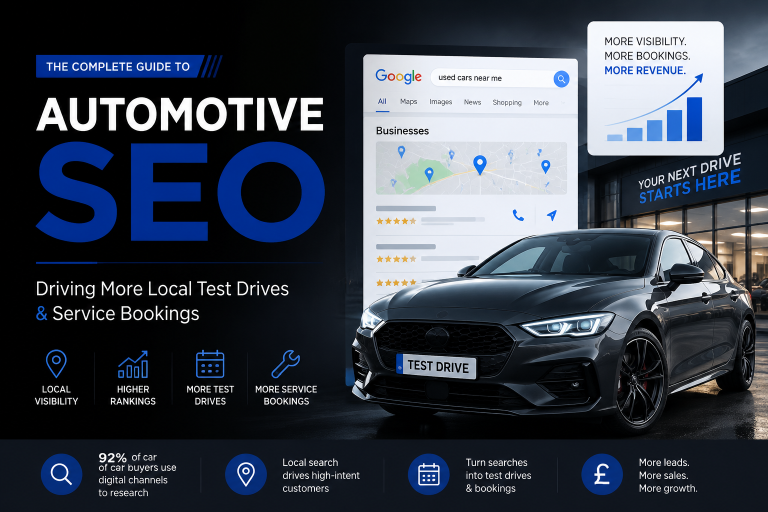
Car buyers have changed. 92% of vehicle shoppers use digital channels to research their next purchase, and a huge slice of those searches carry local intent—think “Honda CR-V near me” or “wheel alignment Manchester.” If your dealership or shop doesn’t appear in the Google Local Pack and organic top three, you’re handing ready-to-buy customers to competitors.
Beyond buyers, high-value service work, like brake jobs, diagnostics, and MOT prep, starts with a local query. Every missed impression is a missed key in the ignition. A strategic SEO approach ensures your business is there at the exact moment of need.
Core pillars of automotive SEO
We see many auto businesses stumble because they try to do a little of everything and master nothing. Instead, double down on these five pillars. They form a repeatable, high-ROI framework we use at Inteliware Growth for high-intent service niches (and they work brilliantly for automotive, too).
1. Local search optimization – claim, verify & power up your Google Business Profile
Your Google Business Profile (GBP) is the single most powerful piece of automotive SEO real estate you own. It controls how you appear in the local map pack, which often sits above organic results on mobile. Get this right and you can generate phone calls and direction requests without a click to your website.
Actionable steps:
- Claim and verify your profile immediately. Ensure your business name, address, and phone number (NAP) are identical everywhere they appear—website, directories, and social profiles.
- Select the right primary category: “Car Dealer,” “Auto Repair Shop,” “Used Car Dealer,” “Tyre Shop” etc. Add secondary categories that match your services.
- Populate every field: business hours (including holiday hours), attributes like “women-led” or “wheelchair accessible,” a robust description with primary keywords, and a steady stream of geotagged photos of your showroom, team, and stock.
- Actively manage Q&A and reviews. Respond to every review—good or bad. Use the Q&A section to pre-answer common questions like “Do you offer financing?” or “Do you service electric vehicles?”
- Publish weekly Google Posts about new inventory, service specials, or seasonal tips. Posts signal freshness and give you another slot in the knowledge panel.
Pro tip: pair your GBP with a dedicated local landing page on your site and link the two. This reinforces local relevance and often lifts your map pack ranking within weeks. The same local intensity that works for taxi companies relying on nearby ride requests applies here: proximity and prominence decide who gets the click.
2. Inventory & VDPs (vehicle description pages) that sell
Every vehicle in your inventory is a landing page. Yet most dealers upload the same manufacturer description and call it a day. Duplicate content doesn’t just bore Google—it flat-out won’t rank.
Your VDPs need to be unique, helpful, and conversion-focused. That means:
- Write original descriptions that highlight the actual car on the lot. Mention unique features, recent service work, optional extras, and even minor imperfections (this builds trust).
- Structure data clearly: price, mileage, fuel type, transmission, VIN, and vehicle condition upfront.
- Use high-quality media: 20+ photos (exterior, interior, engine bay, boot), a walkaround video, and a 360-degree spin if possible. Google increasingly serves video-rich results.
- Embed strong calls to action (CTAs) above the fold: “Reserve this car for £99,” “Book a test drive,” or “Apply for financing pre-approval.” A CTA that asks for an email or phone number immediately starts a lead.
- Speed matters. Compress images, use lazy loading, and minimise JavaScript. A VDP that loads in under 2.5 seconds keeps bounce rates low and conversion rates high.
At Inteliware Growth, we often layer conversion rate optimisation (CRO) on top of VDPs, tweaking button colours, form lengths, and trust badges. Even a 0.5% lift in conversion rate can mean a dozen extra test-drive bookings a month.
3. Targeting long-tail keywords for buyer intent
Competing for “used cars” is a money pit. You’ll fight national aggregators with million-dollar content budgets. The smart money is on long-tail, hyper-specific phrases that mirror how real people search: “2024 Toyota RAV4 hybrid for sale in Birmingham” or “certified pre-owned BMW 3 series under £20k London.”
These queries have lower search volume individually, but collectively they make up the majority of converting traffic. They also show crystal-clear purchase intent. A keyword research process for automotive looks like this:
- Start with seed terms: “used [make] [model] [city],” “[service] near me,” “cheap tyre replacement [area].”
- Use tools like Semrush or Ahrefs to pull related questions and auto-suggestions. Filter by low keyword difficulty and meaningful volume.
- Group keywords by intent: transactional (ready to buy/repair now), commercial investigation (comparing models or garages), and informational (maintenance tips). Map each group to the right type of page.
- Create dedicated category pages for popular long-tail groups, e.g., “Used hybrid SUVs in Manchester.”
4. Service & location pages to capture regional demand
If you run a multi-location dealership or offer a range of services, like MOTs, air con regas, and bodywork, you’re sitting on a goldmine of untapped traffic. The trick is to build dedicated, indexable pages for each specific service and each geographic area you serve.
For example, instead of a single “Services” page, create:
- /mot-testing/
- /mot-testing-leeds/
- /air-conditioning-service/
- /air-conditioning-service-wakefield/
Each page should contain:
- Unique service description and pricing (where possible).
- Local signals: the area name in the title tag, H1, and body copy, an embedded Google Map, testimonials from customers in that town.
- A clear CTA: “Book an MOT in Leeds – choose your slot now.”
- A fast-loading booking widget (or a phone number tap-to-call on mobile).
Don’t just copy and paste the same block of text across 20 city pages. Google is smart enough to catch that. Write genuinely distinct content, mention landmarks or local sponsorships, and include unique photos of your actual mechanics or vans in that locale. This geo-specific content strategy mirrors how we structure campaigns for cleaning companies, where “house cleaning in [suburb]” pages drive the bulk of leads. Internal linking is your glue: link each service page to its corresponding location pages, and vice versa.
5. Technical SEO & automotive schema markup
You can have the best VDPs on the internet, but if search engines can’t parse them, you’ll stay invisible. Automotive schema markup is structured data that explicitly tells Google, “This is a car. Here’s the price, mileage, colour, and availability.”
Key schema types to implement:
- Vehicle schema for every VDP. Mark up vehicleModelDate, offers (with price and currency), mileageFromOdometer, fuelType, and vehicleConfiguration.
- LocalBusiness schema on your homepage and contact page, matching your GBP NAP exactly.
- Service schema on service pages to describe what you do and the areas covered.
- FAQ schema where it makes sense—like a financing FAQ that can win an accordion snippet in search results.
- Review schema to pull star ratings from your own site (not third-party reviews, unless aggregated properly).
Other technical non-negotiables:
- Mobile-first indexing: Google indexes the mobile version of your site. Make sure all VDPs and forms work perfectly on a phone.
- Clean URL structure: /inventory/2022-ford-focus-st-3 not ?ID=49283.
- XML sitemaps that auto-update when inventory changes, and are submitted in Google Search Console.
- HTTPS everywhere, especially on pages that capture leads.
When we audit automotive sites at Inteliware Growth, schema errors are the most common quick win we find. Fixing them can lead to rich results—complete with pricing, stock status, and review stars—that push your click-through rate well beyond the organic average. It’s the same technical precision we apply when building patient acquisition funnels for doctors & clinics: clean markup feeds the machine.
How Inteliware Growth amplifies automotive SEO with performance marketing
SEO builds the foundation, but it’s a long game. The fastest-growing auto businesses we work with blend organic search with paid media and conversion optimisation, creating a flywheel where each channel feeds the other.
Here’s how our 5-step framework applies to automotive:
- Audit: We deep-dive your current traffic, competitors’ organic and paid strategies, and your lead-to-sale funnel to find the exact leaks.
- Strategy: A custom roadmap combining SEO, Google Ads (capturing high-intent local searches instantly), and landing page CRO tailored to vehicle sales or service bookings.
- Execution: Our team builds ad creatives, writes unique VDP copy, implements schema, and optimises your Google Business Profile.
- Tracking: We implement advanced attribution so you know which organic keyword—or which paid campaign—drove the test drive or the brake job. Real-time dashboards give you complete transparency.
- Scale: Once we identify winning channels and keywords, we increase investment intelligently. No guesswork, just data.
We’ve built a track record of delivering exactly this kind of ROI across multiple high-intent industries. You can see the results in our case studies. The goal is always the same: turn a local search into a paying customer.
Frequently Asked Questions about automotive SEO
1. How is automotive SEO different from regular SEO?
It focuses heavily on local map pack visibility, frequently changing vehicle inventory pages, and specialised car schema markup. The customer’s long research cycle also demands content that nurtures across multiple weeks.
2. Can I do automotive SEO on my own?
Yes, for basics like GBP setup and unique VDP descriptions. But managing large inventories, technical schema, and integrating paid campaigns typically needs experienced specialists.
3. How long until I see results?
GBP tweaks can lift map pack views within weeks. Competitive organic terms often take 6–12 months. Running Google Ads alongside SEO (which we handle) gets you on page one immediately.
4. What’s the biggest SEO mistake auto sites make?
Duplicate content. Using manufacturer descriptions on every VDP or copying service pages across cities fails to rank and risks penalties. Every page must offer unique value.
5. Do parts retailers need the same approach?
Yes, with extra emphasis on long-tail product queries (e.g., “Bosch alternator for VW Golf MK7”) and detailed product schema. Local optimisation still applies if there’s a physical shop.
6. How important are reviews for SEO?
Crucial. Review volume, freshness, and owner responses are strong local ranking signals. A steady flow of positive reviews directly lifts your Google map pack position.
Start driving more organic traffic today
Automotive SEO isn’t about chasing algorithms; it’s about building a digital forecourt that works 24/7. Get the local basics right, treat every VDP as a unique landing page, target the exact phrases your buyers are typing, and wrap it all in clean technical markup. The result is a predictable, profitable stream of test drives, service bookings, and parts orders.
At Inteliware Growth, we’ve spent over a decade turning searches into sales for service businesses across the UK. If you’d like a partner who understands both the art of SEO and the science of conversion, we’re ready to map out a strategy tailored to your dealership, garage, or parts shop.
Contact Us
📞 +92 344 3503901
📧 sales@inteliwaregrowth.com
📍 London, United Kingdom