Introduction
Google Ads are one of the fastest ways to reach people who are already searching for your service. Whether you run a [taxi company](https://inteliwaregrowth.com/TaxiMarketing), [immigration law firm](https://inteliwaregrowth.com/ImmigrationLawyers), cleaning business, clinic, or [app startup](https://inteliwaregrowth.com/AppStartups), they can help you appear at the exact moment someone is ready to call, book, download, or enquire.
But beginners often make one mistake: they launch campaigns before setting goals, tracking, landing pages, and budget rules properly.
This guide explains everything in simple language, so you understand how it works, what to set up first, and how to avoid wasting money.
What is Google Ads?
It is an online advertising platform that allows businesses to show ads across Search, YouTube, Display Network, Maps, Gmail, and other placements.
For beginners, the most common starting point is Google Search Ads. These are text ads that appear when someone searches for keywords like:
- taxi company near me
- immigration lawyer in London
- cleaning service near me
- private clinic appointment
- download taxi booking app
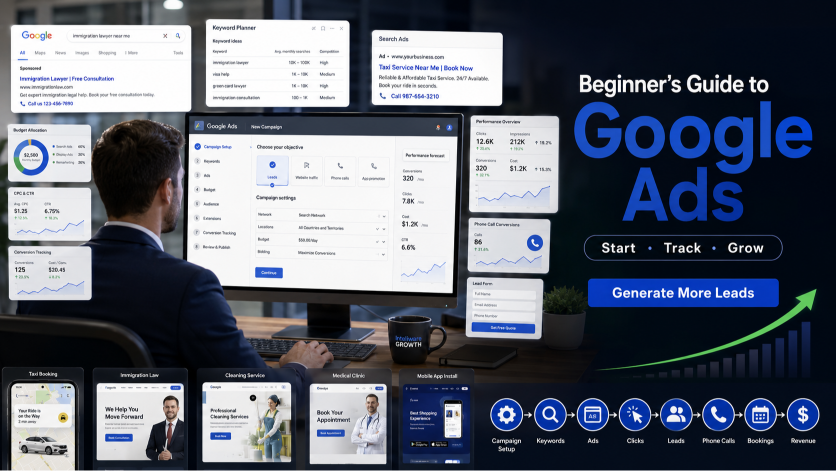
Google explains that a basic campaign setup includes adding business information, choosing a campaign goal, creating ads, selecting audience and budget, then launching the campaign.
How Google Ads Works
Your ad position is not based only on how much you pay. Google says Ad Rank depends on factors including bid amount, ad quality, landing page quality, auction competitiveness, search context, and expected impact of ad assets.
In simple words, Google looks at:
- How much you are willing to pay
- How relevant your ad is
- How useful your landing page is
- How likely the user is to take action
- Whether your ad assets improve the experience
That means a well-structured campaign can sometimes compete better than a campaign with a bigger budget.
Why Businesses Use Google Ads
This approach is powerful because it targets people with active intent.
For example:
- A taxi company can target people searching for airport transfers.
- An immigration lawyer can target people searching for visa consultation.
- A clinic can target patients searching for appointments.
- A cleaning company can target homeowners or offices needing urgent cleaning.
- An app startup can target users likely to install or convert.
At Inteliware Growth, we focus on performance marketing that connects ad spend with real outcomes: leads, enquiries, booked appointments, downloads, and revenue
Main Types of Google Ads Campaigns
- Search Ads Search Ads appear on Google when people type a keyword. These are best for high-intent services where people are already looking for help.
Best for:
- Taxi Companies
- Immigration lawyers
- Cleaning services
- Doctors and clinics
- Emergency or local services
- Performance Max Performance Max allows your ads to appear across multiple Google channels using automation and creative assets. Google describes Performance Max as a way to multiply conversions across Google channels.
Best for:
- Lead generation
- E-commerce
- Local services
- Multi-channel growth
- Display Ads Display Ads appear on websites, apps, and Google partner placements. These are usually better for awareness and remarketing.
Best for:
- Retargeting website visitors
- Brand awareness
- Visual offers
- YouTube Ads YouTube Ads help businesses reach users through video. They are useful for building trust, explaining services, and retargeting warm audiences.
Best for:
- Clinics
- App Startups
- Service brands
- Educational content
- App Campaigns App campaigns help promote mobile apps and drive installs or in-app actions.
Best for:
- App Startups
- Taxi booking apps
- Health apps
- Service booking apps
How to start your first google ads campaign
Step 1: Define Your Goal
Before creating ads, choose one clear goal.
Examples:
- Get phone calls
- Generate form leads
- Book appointments
- Increase app installs
- Sell products
- Drive store visits
Google Ads allows businesses to select goals such as leads, sales, calls, page views, and brand awareness during setup.
For beginners, avoid choosing too many goals at once. One campaign should have one primary objective.
Step 2: Choose Campaign Type
If your audience is already searching for your service, start with Search Ads. For broader reach or remarketing, consider Performance Max or Display campaigns depending on your goals.
Step 3: Keyword Research
Keywords decide when your ads appear.
Use keywords that show buying intent, such as:
- book taxi online
- immigration solicitor consultation
- clinic appointment near me
- office cleaning company
- app marketing agency
Avoid very broad keywords at the start because they can waste budget.
Step 4: Write Clear Ads
Your ad should answer three things quickly:
- What do you offer?
- Why should someone trust you?
- What should they do next?
Example:
Google Ads Management for Clinics Generate more patient appointments with data-driven campaigns. Book a free consultation today.
Step 5: Build a Strong Landing Page
Sending paid traffic to a weak page wastes money.
A good landing page should include:
- Clear headline
- Service benefits
- Trust signals
- Contact form
- Phone number
- Strong CTA
- Fast loading speed
- Mobile-friendly layout
For service businesses, the CTA should be simple: Call Now, Book Free Consultation, or Request a Quote.
Step 6: Set Up Conversion Tracking
Conversion tracking is one of the most important steps.
Google defines a conversion action as a valuable customer action, such as a purchase, phone call, app download, form submission, or in-app action.
Google also says conversion tracking helps businesses understand which ads drive value and optimise campaigns toward business goals.
Track actions like: Phone calls Contact form submissions WhatsApp clicks Appointment bookings
- App installs
- Lead form submissions
- Purchases
Without tracking, you are only guessing.
Step 7: Set Budget & Launch
Start with a budget you can test consistently.
Do not judge performance after one day. Google Ads needs enough data to understand which keywords, ads, and audiences perform best.
For lead generation, review:
- Cost per lead
- Lead quality
- Conversion rate
- Search terms
- Device performance
- Location performance
Step 8: Optimize
After launch, check the campaign regularly.
Look for:
- Irrelevant search terms
- High-cost keywords
- Low-quality clicks
- Poor landing page performance
- Weak ad copy
- Missing conversions
At Inteliware Growth, our approach is not “launch and leave.” We use audit, strategy, execution, tracking, and scaling to improve campaigns based on real data.
Common Mistakes Beginners Should Avoid
1. Running ads without conversion tracking This is the biggest mistake. If you are not tracking leads, calls, or bookings, you cannot know what is working.
2. Using broad keywords too early Broad keywords can bring irrelevant clicks. Start with focused keywords that show clear intent.
3. Sending traffic to the homepage A homepage is often too general. Use a dedicated landing page for each service.
4. Ignoring negative keywords Negative keywords stop your ads from showing for irrelevant searches. Example: A private clinic may want to exclude “free,” “jobs,” or “training.”
5. Not reviewing search terms Search term reports show what people actually searched before clicking your ad. This helps you improve keywords and reduce wasted spend.
6. Weak CTA Your ad and landing page must clearly tell users what to do next.
Google Ads for Different Industries
- Taxi Companies Taxi Companies should focus on local intent keywords like airport transfers, private hire, city taxi, and taxi near me. Campaigns should prioritise calls, booking forms, and location-based searches.
- Immigration Lawyers Immigration law firms need compliant and trust-focused campaigns. Ads should target specific services such as visa consultation, spouse visa, work permit, asylum advice, and immigration appeal support.
- Doctors & Clinics Clinics should focus on patient acquisition, appointment bookings, local targeting, call tracking, and service-specific landing pages.
- Cleaning Companies cleaning companies should target high-intent local searches such as end-of-tenancy cleaning, office cleaning, deep cleaning, and house cleaning services.
- App Startups App Startups should focus on install campaigns, conversion tracking, CAC, retention, and in-app events. The goal is not only downloads but profitable users.
How Inteliware Growth Manages Google Ads
Inteliware Growth is a UK-based performance marketing agency built for high-intent service industries.
Our framework includes:
- Audit — We review your current campaigns, competitors, search intent, landing pages, and tracking setup.
- Strategy — We build a custom roadmap based on KPIs, budget, audience intent, and channel forecasting.
- Execution — We launch targeted campaigns with strong ad copy, conversion-focused landing pages, and industry-specific messaging.
- Tracking — We set up advanced attribution, conversion tracking, call tracking, and dashboards so you can see where every penny goes.
- Scale — We increase budget only when the data shows what is working.
Beginner Checklist
Before launching, make sure you have:
- Clear campaign goal
- Focused keywords
- Negative keywords
- Strong ad copy
- Dedicated landing page
- Phone number and form tracking
- Conversion tracking set up
- Realistic daily budget
- Location targeting
- CTA buttons
- Performance dashboard
Conclusion
Google Ads can be one of the most profitable marketing channels when it is planned correctly. The key is not just launching ads. The key is targeting the right keywords, writing clear ads, building strong landing pages, tracking every conversion, and scaling based on real data.
For beginners, start simple. Choose one goal, one service, one audience, and one clear conversion action. Then improve step by step.
If you want expert help setting up or improving your Google Ads campaigns, Inteliware Growth can help you turn ad spend into measurable leads, enquiries, bookings, app installs, and revenue.
Frequently Asked Questions
What is Google Ads used for?
Google Ads is used to promote businesses across Google Search, YouTube, Display, Maps, and other Google channels. It helps businesses generate leads, calls, bookings, sales, and app installs.
Is Google Ads good for beginners?
Yes, Google Ads is beginner-friendly, but beginners should start with clear goals, focused keywords, conversion tracking, and a controlled budget.
How much should I spend on Google Ads as a beginner?
Start with a test budget you can run consistently. The right amount depends on your industry, location, competition, and cost per click.
What is conversion tracking in Google Ads?
Conversion tracking measures valuable actions users take after interacting with your ad, such as calls, form submissions, purchases, app downloads, or bookings.
Can Google Ads work for local businesses?
Yes. Google Ads works very well for local businesses such as Taxi Companies, cleaning companies, clinics, and law firms because it targets people searching for services nearby.
What is the best Google Ads campaign type for beginners?
Search Ads are usually the best starting point for service businesses because they target people actively searching for your service.
Why are my Google Ads not getting leads?
Common reasons include poor keywords, weak landing pages, no conversion tracking, broad targeting, irrelevant clicks, weak CTA, or no negative keywords.
Should I hire a Google Ads agency?
If you want better tracking, lower wasted spend, stronger strategy, and scalable lead generation, working with a performance marketing agency like Inteliware Growth can help.
Ready to Grow with Google Ads?
Google Ads can deliver fast results when done correctly. The key is strategy, tracking, and optimization.
At Inteliware Growth, we help businesses turn ad spend into measurable revenue.
Contact Us
📞 Phone: +92 344 3503901
📧 Email: sales@inteliwaregrowth.com
📍 Location: London, United Kingdom