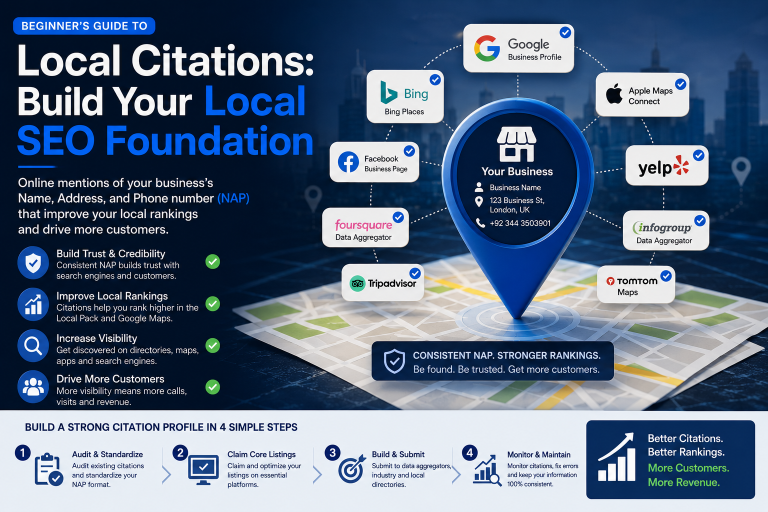
Local citations are online mentions of your business’s Name, Address, and Phone number (NAP). They help search engines like Google verify your business’s existence and improve your local search rankings. The most critical rule is ensuring your NAP data is 100% consistent across the web.
If you run a taxi firm, immigration law practice, cleaning company, clinic, or an app startup with a physical presence, citations are the quiet engine behind your local visibility. This guide walks you through exactly what local citations are, why they matter, and a proven step-by-step process to turn searches into customers.
What are local citations?
A local citation is any online reference to your business’s NAP. That reference can appear on business directories, social platforms, map apps, or blog posts. There are two main types.
- Structured citations live in the dedicated fields of a business listing. Think of your Yelp profile, Google Business Profile, or a listing on your local Chamber of Commerce website. The NAP appears in a predictable format that search engines crawl easily.
- Unstructured citations appear when your business is mentioned in a less formal way – a news article, a blog roundup, or a forum post. The data isn’t tucked into neat fields, but Google can still extract and associate it with your brand.
Both types send trust signals. A carefully built citation profile tells search algorithms, “This business is real, active, and relevant for local queries.”
Why local citations are crucial for your business
Search engines use citations to confirm the accuracy and legitimacy of your business information. They weigh citation consistency alongside proximity and relevance to decide which businesses appear in the coveted Local Pack – the top three map results.
Beyond rankings, citations directly impact trust. A BrightLocal survey found that 87% of consumers read online reviews for local businesses, and they often check directory listings for phone numbers and hours. If your address is outdated or your phone number is missing, you lose a lead in seconds. For high-consideration services like immigration law or dental care, that trust is everything.
And many directories are discovery platforms in their own right. A well-optimised Healthgrades listing can bring patient bookings directly, just as a detailed Checkatrade profile can fill a cleaning company’s pipeline.
The golden rule nap consistency
NAP consistency means your business name, address, and phone number appear exactly the same everywhere. Even tiny discrepancies hurt.
If you’re listed as “Inteliware Growth Ltd” on one site and “Inteliware Growth” on another, Google may see two different entities. Using “Suite 5” on Facebook but “#5” on Yelp erodes algorithmic confidence and ranking potential.
Before you build a single new citation, audit your existing NAP and settle on a master format. Write it down and keep it safe. Every future submission must match it perfectly.
How to build a strong citation profile
Follow this strategic sequence, from non-negotiable core platforms to ongoing monitoring.
1. Start with foundational platforms Claim and fully optimise your listings on the platforms that generate the most local visibility.
- Google Business Profile This is your most important citation. Create or Claim your profile on Google Business Profile. Verify your location, choose the right primary category, and fill every available field – hours, services, attributes, and a detailed description. Add high-quality photos. A complete GBP is your ticket to the Local Pack and Google Maps.
- Bing Places Register your business on Bing Places to power results on Bing search and maps. For some demographics, Bing holds a meaningful market share and shouldn’t be ignored.
- Apple Maps Connect Ensure your business is discoverable via Apple Maps Connect. Siri and Apple Maps rely on this data, and a listing here lets iPhone users find you, get directions, and call you with one tap.
- Facebook Business Page Complete your About section with a precise address and phone number. A fully filled Facebook page doubles as a powerful, crawlable citation.
Only when these core profiles are 100% consistent should you move to the next level.
2. Leverage major data aggregators Data aggregators distribute your business information to dozens of smaller directories, apps, and navigation systems automatically. Getting listed with them builds rapid, widespread credibility.
The two you must target are:
- Data Axle feeds platforms like TripAdvisor, GPS devices, and many local search engines.
- Foursquare powers location data for millions of apps, including Uber, Twitter, and Samsung devices.
A clean submission to these aggregators triggers a cascade of consistent citations. For performance-focused businesses, this step dramatically improves the pace at which search engines trust your NAP.
3. Target geo and industry-specific directories A citation on a niche directory or local business association site sends stronger relevance signals than a generic mega-directory listing.
- Industry-specific directories Submit to directories trusted in your trade. For Inteliware Growth’s core sectors – such as our cleaning company clients, doctors, and Immigration lawyers – here are some prime targets:
- Doctors & Clinics: Healthgrades, RateMDs, Doctify
- Immigration Lawyers: Avvo, Justia, Law Society directories
- Cleaning Companies: Checkatrade, Rated People, TrustATrader
- Taxi & Private Hire Companies: local transport authority registers, minicab directories
- App Startups: while not always citation-reliant, a consistent Google Business Profile and listings on product discovery platforms (Product Hunt, G2) reinforce local trust if you have a physical office
Lean hard into these niche directories. They often outrank general platforms for specific local searches like “immigration solicitor near me.”
- Geo-specific directories Register with chambers of commerce and local business groups. A listing on the London Chamber of Commerce or the Islamabad Chamber of Commerce & Industry tells Google you’re a legitimate player in your geographic market. For hyper-local areas like Ghauri Town, use neighbour hood directories to build tightly-coupled location trust.
For our clients, we build custom geo-targeted citation maps. A cleaning company covering five London boroughs needs citations on each borough’s local directory, not just a single city-wide listing.
4. Monitor and audit Citations are not a “set and forget” task. Businesses move, phone numbers change, and aggregators sometimes auto-populate old data. Inconsistent NAP harms your ranking more than having fewer citations.
Conduct a quarterly audit. Use auditing tools like BrightLocal’s Citation Tracker to monitor your existing citations and flag discrepancies. Platforms such as Moz Local then help push consistent data and surface duplicate listings. Whitespark’s citation finder is another excellent option for uncovering niche opportunities.
Search for all variations of your business name and address. Correct errors immediately and suppress duplicate listings. A clean, precise citation profile is a competitive advantage that compounds month after month.
Structured vs. Unstructured citations what’s the difference?
- Structured citations are machine-readable listings in directories. Google crawls them easily and uses them as factual confirmation.
- Unstructured citations are contextual mentions on blog, news sites, or forums. A local article about a new taxi fleet might include your NAP. While less predictable, these mentions boost authority because they appear on trusted, non-directory domains.
To earn unstructured citations, invest in PR, partnerships, and local sponsorships. At Inteliware Growth, we often combine high-quality paid campaigns with organic citation building. A lawyer’s ad triggers a visit, while an unstructured mention on a respected legal blog builds the long-term trust that lowers cost-per-click over time.
Common local citation mistakes to avoid
- Inconsistent abbreviations: “St.” vs. “Street” – pick one and stick with it.
- Missing suite numbers: If you’re in Office 3B, always include it.
- Using a tracking phone number on directories: Google prefers the same primary number across all citations. Use dynamic number insertion on your website instead.
- Duplicate Google Business Profiles: Multiple profiles for the same location confuse Google and risk suspension.
- Ignoring closed or duplicate listings: Get old locations marked as permanently closed or removed.
How local citations fit into your broader local SEO strategy
Citations don’t work in isolation. To turn a top map ranking into revenue, you also need:
- A fast, mobile-optimised website with local schema markup
- An active Google Business Profile with regular posts and review responses
- A deliberate review generation strategy
- Paid search campaigns that capture high-intent local traffic while organic rankings climb
This is exactly how Inteliware Growth structures client engagements. We start with a deep Audit of your citation health, competitor data, and existing funnels. Then we build a Strategy that aligns citations with Google Ads and Conversion Rate Optimisation – because a click from a local listing only becomes a client if the landing page converts.
We move to Execution, updating directories and launching targeted ads, all tracked in real-time dashboards that reveal which citations and channels drive phone calls and form fills. Finally, we Scale based on data, expanding the campaigns and citations that show clear ROI.
Conclusion
Local citations are an ongoing asset that protects your rankings and fuels consumer trust. Claim your foundational platforms, feed the aggregators, go deep on industry and geo-specific directories, and audit relentlessly. When citations work in sync with a fast website, a proactive review strategy, and smart paid campaigns, you create a round-the-clock lead generation machine.
If you’d rather focus on running your business while experts handle your complete local performance strategy, Inteliware Growth is ready to audit, build, and scale your presence.
How Inteliware Growth helps you build and leverage citations for ROI
As a UK-based performance marketing agency, Inteliware Growth doesn’t stop at citation building – we connect it directly to revenue. Our team specialises in high-intent service industries:
- Taxi & Private Hire Companies – turning “taxi near me” searches into ride requests
- Immigration Law Firms – generating compliant, low-cost leads through synchronised local SEO and paid ads
- App-Based Startups – building local trust as you scale user acquisition globally
- Cleaning Companies – filling your team’s schedule with local jobs
- Doctors & Clinics – driving patient bookings and appointment requests
Our 5-step roadmap ensures your citation profile isn’t just accurate – it’s a profit centre. We Audit your local footprint, spotting missing citations competitors overlook. Strategy integrates Google Ads, landing page CRO, and directory presence. Through continuous Tracking, we tie new patient bookings and call volume directly back to specific citation sources. Explore our case studies to see real results for businesses like yours.
Contact Us
📞 +92 344 3503901
📧 sales@inteliwaregrowth.com
📍 London, United Kingdom
Frequently Asked Questions
1. What is a local citation? A local citation is an online mention of your business’s Name, Address, and Phone number. It appears on directories, social media, apps, or news sites, helping search engines verify your business.
2. Why is NAP consistency so important? It ensures search engines see a single, unified business. Even “Road” vs. “Rd.” can weaken your ranking and confuse customers.
3. How many citations does my business need? Quality over quantity. Start with foundational platforms, add aggregators, then build industry and geo-specific listings at a steady, accurate pace.
4. Which citation sources matter most for a UK business? Google Business Profile is number one, followed by Bing Places, Apple Maps, Facebook, Data Axle, Foursquare, industry-trusted directories like Avvo or Healthgrades, and UK-specific platforms such as Yell.com.
5. How often should I audit my citations? At least quarterly, and immediately after any address, phone, or name change.
6. Can I build citations myself, or do I need an agency? You can handle the core platforms and a handful of directories. An agency like Inteliware Growth brings automation, auditing tools, and integration with paid campaigns that compress your timeline to measurable ROI.
7. Do citations still matter if most of my business comes from paid ads? Absolutely. Citations build the trust layer that makes ads more effective. When a user clicks an ad and then checks your Google Business Profile, consistent citations increase conversion rates and reduce long-term customer acquisition cost.