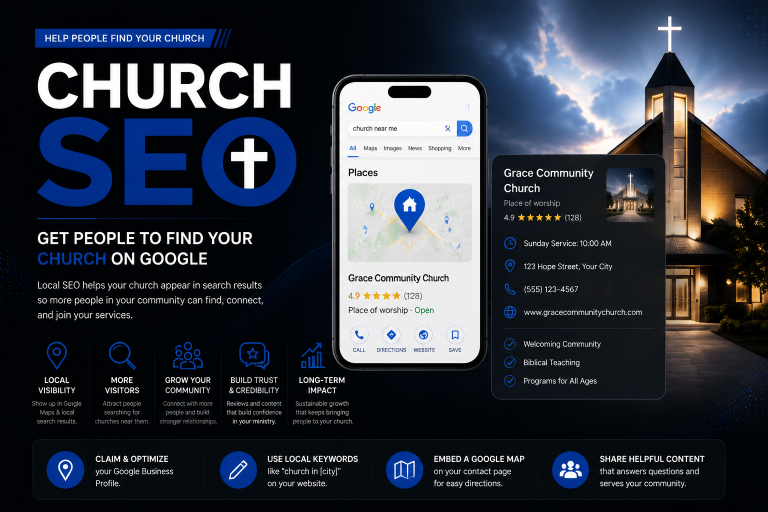
Search Engine Optimization (SEO) for churches helps local people find your place of worship when searching online. To succeed, claim your Google Business Profile with correct service times and address, use local keywords like “churches in [your city]” on your website, and embed a Google Map on your contact page.
The way people search for a church has changed. Before ever stepping through your doors, they pull out a phone and type “church near me” or “Sunday service times in [city]”. If your church doesn’t appear, you’re invisible to the very families who need you. At Inteliware Growth, we’ve seen that simple, consistent church SEO turns online curiosity into real-world attendance and it’s never too late to start.
Why church SEO matters more than ever
Word-of-mouth still works, but it’s no longer enough. Over 40% of all Google searches have local intent, and for spiritual communities, the journey often begins with questions like “welcoming church downtown” or “youth group near me”. If your website and online presence aren’t optimised, those searches will lead people to another congregation.
Church SEO isn’t about gimmicks. It’s about making sure your beliefs, service times, and community life are accurately reflected where people are looking. Done right, it reduces the friction between a seeker’s need and your welcome.
1. Claim and perfect your Google Business Profile
Your Google Business Profile is often the first impression. When someone searches for your church by name or a generic local term, the knowledge panel that appears must be accurate. Claiming it puts you in control.
Claim your listing and verify ownership
Head to Google Business Profile and claim your listing. Google will send a verification postcard. Once verified, you can manage information, respond to reviews, and appear in Google Maps searches.
Fill out every relevant detail
Churches often leave fields blank, but completeness signals trust. Add exact service times (regular and seasonal), your physical address formatted exactly as on your website, a phone number that reaches a person, and your website link. Select “Church” or “Place of worship” as your primary category.
Upload real photos regularly
Stock images won’t build connection. Upload genuine photos of your building, worship gatherings, community events, and welcome team. A fresh photo every few weeks signals to Google that your profile is active.
Encourage and respond to reviews
Gently invite members to share their experience on your Google profile. Reply thoughtfully to every review, positive or constructive. Active engagement boosts your local ranking.
2. Website keywords and content that speak to your community
A beautiful website means nothing if the right words are missing. Church SEO thrives on language that matches what real people type into search bars.
Use local phrases naturally
Don’t just say “join us for worship.” Say “join our Anglican worship service in Leeds” or “Catholic church with Saturday Vigil in Bristol.” Include your city, neighbourhood, and well-known landmarks. Terms like “churches in [city]”, “family-friendly church near me”, or “[denomination] service times” should appear naturally in headers, page content, and image alt text.
Structure your headers for clarity
Every page needs one H1 tag. Break up content with H2 and H3 tags that reflect common questions. For example:
- H2: Service times & location
- H3: Sunday worship schedule
- H3: Midweek Bible study
Search engines use headers to understand your page; people use them to scan.
Keep NAP consistency everywhere
Your Name, Address, and Phone number (NAP) must be identical across your website footer, contact page, social media profiles, and all directories. Even small variations like “St.” versus “Street” can confuse Google and weaken local rankings. We audit NAP consistency as part of our proven growth framework because uniformity builds trust.
3. Technical foundations that keep your site visible
A slow, clunky website repels visitors and search engines alike. Technical SEO ensures your content can be found and enjoyed.
Mobile-first design is non-negotiable
More than 60% of searches for local churches happen on mobile phones. Your site must load quickly, display legible text without pinching, and have tappable buttons. Test your site with Google’s Mobile-Friendly Test. A failing grade means a responsive redesign is essential.
Improve page speed
Compress images, enable browser caching, and use reliable hosting. A page that takes longer than three seconds to load risks losing visitors before they ever see your service times. Inteliware Growth’s technical audits frequently uncover easy-to-fix speed bottlenecks that drastically improve user experience and ranking.
Embed an interactive Google Map
Placing a live Google Map on your contact page or footer helps visitors find you instantly and reinforces location signals to Google. Embed the map using the place ID from your Google Business Profile, making sure the pin is exact.
Add structured data (schema markup)
Use schema.org/Church markup to help search engines understand your content at a deeper level. This can generate rich results like event times or location information directly in search listings, increasing click-through rates.
4. Content that serves and engages
Your website content can answer questions before they’re asked and build trust before a visit.
Create a sermon library
Record sermons and host them on your site with written summaries. Optimise each title and description with relevant keywords. For example, “Sermon: Finding Hope in Difficult Times – Pastor John, Cardiff Church” targets those searching for encouragement and your local area.
Build an events calendar
List potluck dinners, youth retreats, volunteer days, and holiday services. Each event page is fresh content that can rank for date-specific searches. Include start times, location details, and a short description.
Write about community involvement
Share stories about your food bank, clothing drives, or charity partnerships. These posts naturally incorporate local keywords and attract links from community organisations. For more ideas on content that converts, browse our case studies.
5. How Inteliware Growth’s framework elevates church SEO
Churches often lack a dedicated marketing team, which is where a data-driven partner makes all the difference. Our performance marketing framework applies directly to church growth.
- Audit – We deep-dive into your current online footprint, competitor churches, and local search volume for terms like “contemporary worship near me”. We check your Google Business Profile health, website technical state, and backlink profile.
- Strategy – We map out a custom SEO and content roadmap with keyword targets, on-page optimisations, and a review generation plan. KPIs are set against real attendance and contact form goals, not vanity metrics.
- Execution – Our team optimises your Google Business Profile, revamps page headers, embeds maps, implements structured data, and crafts locally-relevant content. Advanced conversion tracking is set up so every interaction is measurable, much like our Google Ads Management campaigns.
- Tracking – Through real-time dashboards, you see exactly how many people find your church online, which terms drive visits, and how often they request directions. Transparency ensures you never waste resources.
- Scale – Once the organic foundation delivers consistent growth, we can expand into paid campaigns for special services always based on data, never guesswork.
6. Local link building and citations
Trust flows through links. When other local websites link to your church, search engines see you as an established part of the community.
Get listed in relevant directories
Submit your church to local chamber of commerce websites, denominational finders, and community hubs. Ensure NAP consistency in every listing. Local parish directories can send valuable signals.
Partner with local organisations
Host a community cleanup and ask the neighbourhood association to link to the event page. Participate in interfaith initiatives and request a mention. Genuine, editorially-given links are far more powerful than spammy submissions.
Measuring success and what to track
- Google Business Profile insights – Track direction requests, phone calls, and website clicks. An uptick in direction requests directly correlates with foot traffic.
- Website conversions – Set up goal tracking for contact form submissions, newsletter sign-ups, or event registrations. We build dashboards tying digital actions to tangible outcomes.
- Keyword rankings – Monitor where you appear for “church in [city]” or “Sunday service near me”. Moving from page two to page one can double visibility.
- Review quantity and sentiment – More reviews and a high star rating improve click-through rates from the local pack.
Conclusion
Church SEO is a quiet, steady ministry that works while you sleep. It takes the sincerity you already offer and makes it discoverable. From a fully optimised Google Business Profile to a fast, welcoming website, every improvement reduces the distance between a searching heart and your open doors.
At Inteliware Growth, we’ve seen local SEO transform congregations filling empty seats, connecting families, and strengthening community presence. Our performance-marketing roots mean we care about real outcomes, not just rankings. If you’re ready to stop being the best-kept secret in your city, let’s talk.
Contact Inteliware Growth today
📞 +92 344 3503901
📧 sales@inteliwaregrowth.com
📍 London, United Kingdom
Frequently Asked Questions about church SEO
How long does it take to see results from church SEO?
Early gains often appear within 3–6 months after optimising your Google Business Profile and website. Competitive areas may take longer, but consistency builds lasting visibility.
Is SEO better than social media for churches?
They complement each other. SEO captures people actively searching for a church now, while social media nurtures community. Prioritise local SEO to be found at the moment of need.
Do we really need a Google Business Profile for a church?
Yes. It is often the first thing a visitor sees. A complete profile with photos, service times, and reviews can be the deciding factor between congregations.
Can we do church SEO ourselves, or should we hire an agency?
Basic steps can be done by a volunteer, but an agency like Inteliware Growth brings advanced tools and a proven framework that typically delivers faster, more measurable growth.
What if our church doesn’t have a dedicated website?
A website maximises SEO impact, but a well-optimised Google Business Profile and active social profiles still bring visitors. A simple mobile-friendly site is a strong next step.
How does Inteliware Growth help churches specifically?
We apply our performance-marketing framework (audit, strategy, execution, tracking, scale) treating your congregation’s goals with the same rigour we use for high-growth startups to drive real attendance.