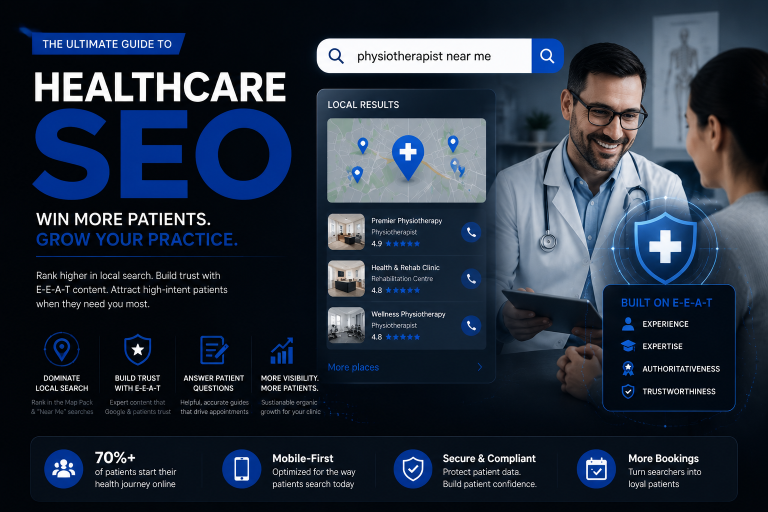
Healthcare SEO is the process of improving a medical website's visibility in search engine results, focusing on local optimization, E-E-A-T (Experience, Expertise, Authoritativeness, and Trustworthiness), and medical compliance to attract patients. For doctors, clinics, and private healthcare providers, appearing on page one of Google isn't just a vanity metric—it's the difference between a fully booked schedule and empty waiting rooms. At Inteliware Growth, we've built patient acquisition systems for high-intent service industries, and healthcare demands the strictest blend of technical precision, regulatory awareness, and human-first content.
This guide breaks down every layer of a modern healthcare SEO strategy, from dominating the local map pack to building content that Google's quality raters trust. Whether you run a single GP surgery or a multi-location private clinic, you'll walk away with a clear, actionable roadmap—and an understanding of where paid media can amplify your organic momentum.
Why healthcare SEO is different (and why it matters now)
Google treats medical websites as Your Money or Your Life (YMYL) pages. That means the search engine holds health content to a much higher standard. A blog about holiday recipes can afford a few casual opinions. A page about diabetes treatments absolutely cannot. Rankings hinge on demonstrable expertise, real clinical experience, and strict data security.
Patient behaviour has also shifted permanently. Over 70% of health journeys now start with a search engine, according to Pew Research. Someone with lower back pain doesn't open the Yellow Pages; they type physiotherapist near me open Saturday or how long does sciatica last. If your practice doesn't appear for those moments, you're invisible. SEO bridges the gap between patient intent and your appointment calendar—and when done right, it attracts patients who are ready to act.
Dominating near me searches with local SEO
For most clinics, the money lies within a 5–10 mile radius. Local SEO ensures you show up in the 3-pack map results, Google Business Profile listings, and voice search queries like find a dentist in London now.
Turn your Google Business Profile into your digital front door
Claim and verify your Google Business Profile (GBP) with an exact name, address, phone number, and opening hours. Inconsistencies across directories confuse both patients and Google. Upload high-quality photos of your premises, waiting areas, and team. Post regular updates about extended hours, flu vaccine availability, or new specialist services. A complete, active GBP signals relevance and freshness.
Optimising for intent-rich local pack searches
Near me and city-specific queries (e.g., private GP Liverpool or children's dentist near Victoria Station) trigger local packs. To rank, your website must include location-optimised pages. Each clinic address deserves its own page with a unique description, embedded Google Map, and local landmarks in the content. Embed schema markup for local business, including latitude/longitude, accepted insurance, and specialties. This structured data helps search engines understand exactly who you serve and where.
Building trust and rankings with patient reviews
Positive reviews act as both a local ranking factor and social proof. Encourage happy patients to leave reviews on your GBP profile—via follow-up emails, text reminders, or a simple QR code at reception. Always respond professionally to every review, thanking the patient and addressing any issues. A clinic with 40+ recent, authentic reviews will frequently outrank a competitor with a stronger website but zero feedback. Google sees engagement and trust.
Proving you deserve to rank with E-E-A-T content and authority
Experience, Expertise, Authoritativeness, and Trustworthiness form the backbone of healthcare content SEO. Without E-E-A-T signals, even technically perfect pages struggle to compete. Google's guidelines explicitly detail how these signals are evaluated for YMYL topics.
Letting real clinicians speak through medical reviewers
Content created or reviewed by licensed doctors, nurses, or board-certified specialists carries weight that generic copy never will. Each health article on your site should display the author's name, qualifications, and a short bio, linking to a verified professional profile. If you're a clinic director who writes about dermatology but you're a GP, bring in a consultant dermatologist as a reviewer and credit them visibly. Google's quality raters manually check for this—and so do increasingly savvy patients.
Targeting specific long-tail keywords driven by patient intent
Broad terms like heart specialist are near impossible to rank for and often lack clear intent. Someone searching cardiologist for chest pain near Manchester after COVID knows exactly what they need. Build your content around specific symptoms, treatments, demographics, and local procedures. A well-researched page targeting knee replacement recovery timeline over 60s will attract fewer but much higher-quality visitors who are likely to book a consultation. Use patient intake forms, call transcripts, and even Google's People Also Ask boxes to discover real-world questions.
Writing clear, helpful guides as accurate answers
Avoid medical jargon that confuses. Instead, write the guide you'd want a family member to read before an appointment. Break down a condition, its symptoms, diagnostic tests, and treatment options in plain language. Highlight when to see a doctor urgently. A clinic that answers questions thoroughly and compassionately earns longer dwell time, lower bounce rates, and the kind of organic backlinks that move the authority needle. Remember: Google's helpful content system rewards people-first content.
Keeping your site fast and secure with technical SEO
Even the best content fails if a site loads slowly, lacks encryption, or mishandles patient data. Healthcare websites sit at the intersection of UX performance and regulatory compliance.
Mobile speed can cost you patients in seconds
The majority of healthcare searches happen on smartphones—often in moments of worry or urgency. If your site takes more than three seconds to load, up to half of potential patients will abandon it. Compress large images, use a fast, medical-data-compliant hosting provider, and minimise unnecessary scripts. At Inteliware Growth, our real-time dashboards track site speed metrics and conversion behaviour so practices know exactly where visitors drop off.
HTTPS and privacy by design for secure data
An HTTPS connection is non-negotiable. Browsers flag non-secure sites, and patients are increasingly alert to security warnings—especially when they are about to submit personal health details. Beyond the padlock, ensure forms use encryption and that your site's privacy policy clearly outlines how patient data is collected, stored, and used. Google treats page experience signals, including security, as ranking factors.
Navigating HIPAA, GDPR, and local privacy laws
If you operate in the UK, EU, or treat international patients, GDPR compliance is mandatory. Any contact form, live chat, or appointment booking tool must safeguard personal data. For clinics interacting with US patients, HIPAA requirements add another layer. Your SEO strategy must account for cookie consent banners, secure analytics setups, and data processing agreements with third-party plugins. Non-compliance risks fines, loss of reputation, and removal from search results. Refer to the official GDPR text for a complete understanding of data protection obligations.
How Inteliware Growth amplifies your SEO with paid and CRO
Organic SEO builds long-term trust, but it takes time. In competitive healthcare markets like London, combining SEO with performance advertising creates a flywheel where each channel fuels the other.
Our 5-Step Scaling Framework is designed for high-intent service industries, including doctors and clinics:
- Audit – We deep dive into competitor gaps, patient search intent, and your existing funnel leaks.
- Strategy – A custom roadmap maps KPIs, channel mix (SEO, Google Ads, Paid Social), and realistic patient acquisition forecasts.
- Execution – We launch tightly targeted ad creatives, landing pages, and technical SEO fixes that match what patients actually search for.
- Tracking – Advanced attribution and real-time dashboards show you exactly which keyword, ad, or local listing generated a booked appointment—down to the penny.
- Scale – Once winners emerge, we shift budget aggressively toward what works, while continuing to strengthen your organic presence.
While your SEO gains traction, our Google Ads Management captures immediate high-intent search traffic—people typing private GP same-day appointment right now. Our Conversion Rate Optimisation (CRO) ensures that landing pages turn those visitors into real bookings, not bounces. Over time, the data from paid campaigns (search queries, top-converting locations, best-performing content themes) directly informs your SEO content plan. This is how we've helped immigration law firms reduce cost per client by 40% and taxi companies dominate hyper-local demand. Browse our case studies for detailed results, or explore our dedicated doctors & clinics industry page to see how we drive patient growth specifically.
A step-by-step checklist to build your healthcare SEO engine
To make this immediately useful, here's a condensed checklist for your clinic:
- Audit your Google Business Profile – update hours, add photos, and start a review collection habit.
- Create a dedicated location page for each clinic with unique local content and schema.
- Identify 15–20 long-tail keyword opportunities based on real patient questions.
- Assign a medical reviewer to every piece of clinical content and add author bios.
- Check mobile speed using PageSpeed Insights; target under 3 seconds.
- Ensure HTTPS and review cookie consent setup for GDPR compliance.
- Install call and form tracking to tie SEO visibility to actual patient bookings.
- Set up a simple dashboard (we do this for clients in real time) so you know what's working.
Conclusion
Healthcare SEO is a high-stakes balancing act of local visibility, clinical authority, and bulletproof compliance. When executed correctly, it consistently delivers patients who trust you before they ever walk through the door. Start with the fundamentals: a flawless Google Business Profile, clinician-authored content that genuinely helps, and a website that's fast and secure.
But don't wait months for organic traffic to mature in silence. The fastest-growing private practices layer paid search and CRO on top of their SEO foundation, capturing demand today while building the authority that wins tomorrow. Inteliware Growth specialises in exactly this intersection—where medical compliance meets performance marketing. If you're ready to see your practice's true growth potential, let's talk.
Frequently Asked Questions
How long does healthcare SEO take to show results?
Usually 3–6 months for local rankings, 6–12 months for competitive terms. Google Ads can bring immediate leads while SEO builds.
Do I need a separate page for each medical service?
Yes. Individual service pages help you rank for specific searches and provide focused, helpful content.
Is patient review management really part of SEO?
Yes. Reviews directly impact local pack rankings and boost click-through rates, which strengthens organic performance.
Can I do healthcare SEO myself?
Basics like updating your GBP and page speed can be done in-house. Technical SEO and E-E-A-T compliance usually need specialist support.
How does paid advertising complement healthcare SEO?
SEO grows long-term visibility. Paid ads capture instant demand. Data from ads also reveals which services to prioritise for SEO.
Ready to turn more searches into appointments?
Your patients are searching right now. The question is whether they'll find you—or your competitor. At Inteliware Growth, we combine healthcare SEO, paid search, and conversion optimisation into a single growth engine for doctors and clinics. Whether you're a private GP, a dental chain, or a specialist clinic, we'll build a data-driven plan that respects your compliance needs and fills your calendar.
Contact Us
📞 +92 344 3503901
📧 sales@inteliwaregrowth.com
📍 London, United Kingdom