Hotel SEO is an online marketing process that improves your property's visibility in organic search engine results. It helps travelers find your official website easily, driving more direct bookings and lowering high commissions paid to third-party booking sites.
Every time a guest books via an OTA, you hand over 15–30% of your revenue. A well-executed SEO strategy shifts that demand to your own booking engine, letting you keep the full profit, control the guest experience, and build a direct relationship long before check-in. This guide lays out the exact local-search playbook that powers high-growth service businesses, tailored specifically for hoteliers who want bookings, not just traffic.
Why hotel SEO matters more than ever
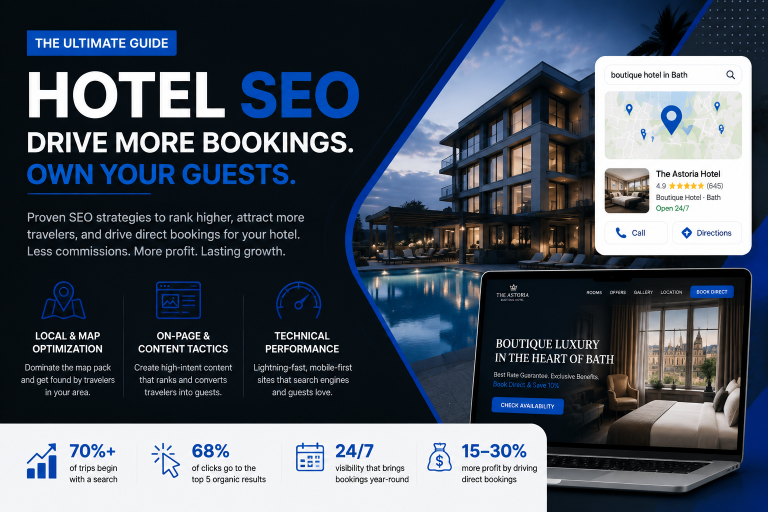
Google is the modern travel agent. More than 70% of trips begin with a search, and the first five organic results capture nearly 68% of all clicks. If your website doesn’t appear for “boutique hotel in Bath” or “family rooms near Hyde Park,” you are invisible to high-intent travellers ready to book.
Unlike paid ads that stop delivering the moment you stop spending, organic visibility compounds. A page that ranks well today can bring direct bookings for years. Strong SEO also strengthens every other channel: a guest who discovers you on Google Maps may later convert via a retargeting ad, and a travel blogger linking to your “hidden gems” city guide lifts your entire domain authority. When SEO sits at the foundation, your whole digital presence works harder.
Core hotel SEO strategies
We organise hotel SEO into three pillars that must work together: Local & Map Optimisation, On-Page & Content Tactics, and Technical Performance. These are not optional extras – they are the non-negotiable building blocks of a website that search engines trust and travellers love.
Local and map optimization
When someone searches “hotel near me” or “romantic getaway in [city],” Google returns a map pack with just three listings. Winning that compact space is often worth more than a full-page magazine advert.
Claim and perfect your Google Business Profile (GBP)
Your GBP is command central for local visibility. Ensure your hotel’s name, address, and phone number match your website and every citation across the web – NAP consistency is a direct ranking signal. Select the most accurate business category (Hotel, Resort, B&B), add high-resolution photos of rooms and views, list all amenities and payment methods, and update hours for seasonal changes. Respond to every review within 24 hours; it shows Google and guests that you are active and attentive.
Build a review-first culture
Guest reviews heavily influence local pack rankings and click-through rate. Set up an automated post-stay email gently asking for a Google review. Even a steady trickle of fresh five-star ratings can push you above a competitor with a higher overall score but fewer recent reviews. Tools like GatherUp or Birdeye integrate directly with your PMS and make asking for reviews effortless.
Weave local landmarks into headings
Google understands location through context, not just a pin. Replace generic page titles like “Our Rooms” with “Victorian Townhouse Steps from the Royal Mile.” Embedding neighbourhood names, train stations, and attraction terms into your H1 and H2 tags signals precise relevance to both search engines and guests, improving your chances of appearing for hyper-local searches.
On-page and content tactics
Once you are visible, your pages must convince the searcher before they ever click “check availability.”
Target intent-rich keywords
Group keywords into three buckets: informational (“things to do in Edinburgh in winter”), commercial (“best luxury hotel Edinburgh old town”), and transactional (“book boutique hotel Edinburgh”). Build dedicated pages for commercial and transactional terms, and use blog posts for informational queries. Use exact-match phrases naturally in title tags and headings, but don’t force them; Google understands synonyms, so a post about “hidden gems in London” will still rank for “off-the-beaten-path London attractions.”
Craft magnetic title tags and meta descriptions
Treat your search listing like a mini-ad. A strong title tag: “The Astoria – Boutique Hotel in Manchester City Centre | Book Direct & Save.” The meta description should reinforce unique value and include a clear call to action: “Stay steps from Piccadilly Gardens with free breakfast, late checkout, and rates 10% lower than OTAs. View rooms now.”
Publish hyper-local travel content
Guides to local events, seasonal itineraries, and “perfect weekend” posts attract top-of-funnel traffic and earn editorial backlinks. Update dates annually to keep content fresh. A guide titled “A Perfect Weekend in the Cotswolds” that links subtly to your rooms page turns curious browsers into future bookers. Over time, this builds topical authority around your destination.
Don’t ignore image alt text
Every photo of a suite, swimming pool, or restaurant dish needs descriptive alt text. Instead of “room1.jpg,” use “Four-poster bed with Egyptian cotton sheets overlooking the private garden.” This helps search engines understand the image, provides an extra opportunity to include location and amenity keywords, and improves accessibility – a core Google value.
Technical performance
Technical SEO is the silent engine. Without it, even brilliant content will struggle to rank.
Make speed a priority
Hotels rely on large, high-quality images, which can kill load times. Compress photos to WebP, lazy-load media below the fold, and serve everything through a CDN. Aim for a “Good” Core Web Vitals score on both mobile and desktop by testing your site with Google PageSpeed Insights. A one-second delay can cut mobile conversions by up to 20%; a traveller on patchy hotel WiFi will bounce straight back to the OTA if your page crawls.
Design mobile-first
Over 60% of travel searches now happen on a smartphone. Your booking calendar, room gallery, and contact form must work flawlessly on small screens. Regularly run your property’s site through Google’s Mobile-Friendly Test and fix any tap-target issues, tiny fonts, or intrusive pop-ups. For many guests, the mobile experience is the only one they will ever have.
Add hotel schema markup
Use JSON-LD structured data to tell search engines your star rating, price range, amenities, check-in times, and accepted payment methods. The Schema.org Hotel type outlines every property you can highlight. After implementation, validate your markup with Google’s Rich Results Test – this can trigger rich results, such as review stars in the SERP, dramatically lifting click-through rate.
Applying Inteliware Growth’s 5-step framework to hotels
At Inteliware Growth, a performance marketing agency built on data-driven results, we scale service businesses – from taxi fleets to medical clinics – with a repeatable framework. The same methodology drives exceptional hotel SEO results.
-
Audit
We map every competitor ranking for your target keywords, analyse their backlink profiles and content gaps, and audit your site for technical roadblocks. The output is a precise picture of the search landscape before any work begins. -
Strategy
We build a custom roadmap with measurable KPIs: organic sessions, map pack position, direct booking revenue. The plan includes keyword clusters, quarterly content themes, and a clear channel forecast so you know the expected return before committing budget. -
Execution
Our team creates search-optimised landing pages, local content assets, and technical fixes – from schema markup to speed improvements. We also manage Google Business Profile posts and review generation campaigns designed to dominate the local map pack. -
Tracking
We implement GA4, Google Search Console, and a custom real-time dashboard. You see bookings attributed to the exact landing page and keyword – never just a vague “organic traffic” line item. Transparency is non-negotiable. -
Scale
When a page proves it converts, we double down. We replicate the winning template across related topics, expand the keyword cluster, and only then increase spend on supporting channels like paid social retargeting. Growth is data-led, not guess-led.
Content that moves browsers to bookers
Exceptional content doesn’t just attract visitors; it builds trust and shortens the decision-making cycle.
Build city-guide pillar pages
Create a comprehensive area guide that links to your property and out to reputable local attractions. Google rewards hub-and-spoke structures where a pillar page connects to multiple, in-depth supporting posts. This signals topical authority and keeps visitors on your site longer.
Embed frequently asked questions
Mark up questions like “Is parking free?” or “What time is checkout?” with FAQ schema directly on the relevant page. This can earn you a spot in the “People also ask” accordion, giving you a valuable second organic listing for the same URL and pre-empting guest doubts before they need to call.
Measuring hotel SEO success
Moving the needle requires more than a gut feeling. Track these metrics monthly in a live dashboard to understand what’s working and where to double down.
- Organic visibility – Average position for core commercial keywords. Climbing from position 8 to 3 can triple your organic traffic.
- Organic sessions and users – Segment by landing page. Your rooms, offers, and local guide pages should show steady growth.
- Direct bookings from organic – Set up conversion tracking to see exactly how many reservations and how much revenue organic search delivers.
- Google Business Profile insights – Monitor direction requests, phone calls, and website clicks from your GBP to gauge local engagement.
- Core Web Vitals – A fast, stable site protects rankings and keeps potential guests on your booking engine.
Frequently Asked Questions
What is hotel SEO?
Hotel SEO improves your website’s visibility in organic search results so travellers find your official site directly, reducing OTA dependency and commission costs.
How long does hotel SEO take?
Local pack improvements often appear within 4–6 weeks with a well-optimised GBP. Meaningful organic ranking shifts for competitive terms typically take 4–6 months of consistent effort.
Why is local SEO critical for hotels?
Most travel searches carry location intent (“hotel near me”). The Google Map pack dominates mobile results. Without local SEO, your property is invisible to nearby, ready-to-book travellers.
What is hotel schema markup?
It’s structured data added to your site’s code that tells search engines your star rating, amenities, price range, and photos. It enables rich results like review stars, which increase click-through rate.
Can I do hotel SEO myself?
Basics like claiming your GBP, collecting reviews, and writing blog posts can be handled in-house. Technical audits, schema implementation, and competitive link building usually require professional support to avoid costly mistakes.
How is hotel SEO different from general SEO?
Hotel SEO places extra weight on local ranking signals, review velocity, image optimisation, and outranking OTAs. The conversion funnel is also unique, with guests often visiting multiple pages before booking.
Turn searches into stays
Hotel SEO is a systematic growth engine, not a one-off project. Be visible where travellers are looking, answer their questions better than anyone else, and make direct booking so seamless they forget the OTAs entirely.
At Inteliware Growth, we’ve helped service businesses across the UK – taxi companies, immigration law firms, medical clinics, and more – dominate their local search markets with data-driven, ROI-focused strategies. Explore our case studies to see real results. [View our full range of services](https://inteliwaregrowth.com/services/) to discover how we turn search intent into revenue.
Book a Free Consultation to audit your digital presence and build a custom SEO roadmap that delivers measurable direct revenue.
Contact Us
📞 +92 344 3503901
📧 sales@inteliwaregrowth.com
📍 London, United Kingdom