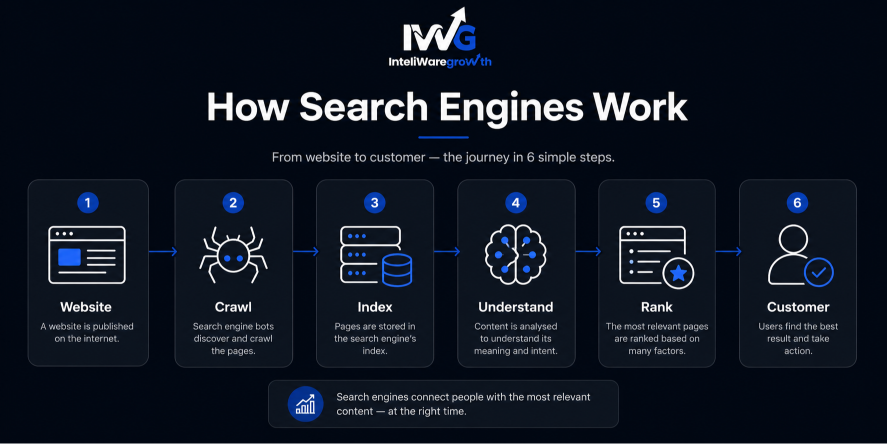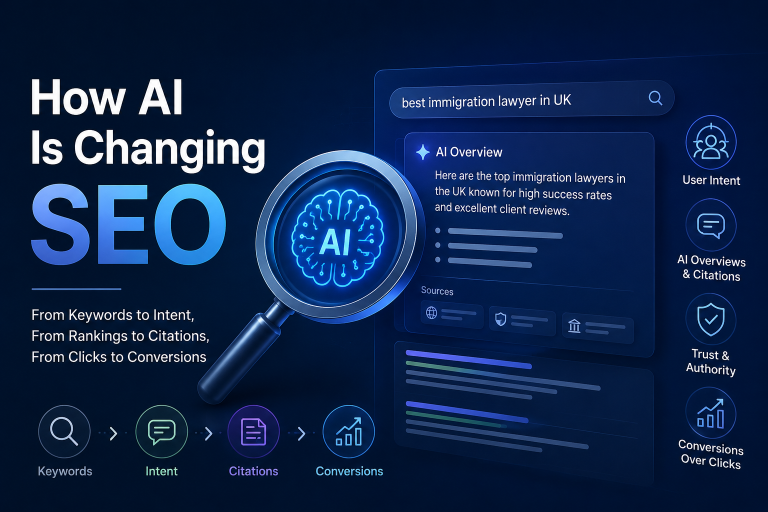
AI is shifting SEO from pure keyword optimization to AI-driven retrieval and conversational search. Instead of aiming only for traditional search rankings, the focus is now on being cited in AI overviews and adapting to search engines that synthesize information rather than just listing website links.
At Inteliware Growth, we live this shift every day. As a UK-based performance marketing agency that manages high-intent campaigns for Taxi Companies, Immigration lawyers, clinics, cleaning businesses, and App Startups, we see exactly how AI-generated answers are altering click-through rates, lead quality, and what it means to “rank” in 2026. This isn’t a theoretical change—it’s happening inside real campaigns with real revenue on the line.
If you depend on organic visibility to fill your pipeline, you need to understand what has changed, why it has changed, and the specific actions that will keep your business cited, clicked, and converting. Let’s break it down.
The shift from keywords to user intent
For years, SEO revolved around identifying a primary keyword and weaving it into title tags, headers, and body copy at the right density. That world is fading.
Search engines increasingly use Natural Language Processing (NLP) and machine learning to understand the exact context of what users are asking. They aren’t matching strings of text anymore—they’re interpreting meaning.
Two major shifts are driving this:
- Conversational Queries: Users are typing longer, more nuanced, and question-based queries instead of simple 2-3 word phrases. “Immigration lawyer London” might have been the old target. Now Google sees a flood of searches like “What documents do I need for a UK spouse visa if I work freelance?” Research from Ahrefs’ analysis of billions of keywords shows that 64% of all searches are four words or longer, a signal that simple keyword targeting is insufficient.
- Semantic Meaning: AI prioritises the actual meaning behind a search rather than keyword density. A page can rank for hundreds of long-tail variations it wasn’t explicitly optimised for—provided it comprehensively answers the user’s underlying need.
For service businesses, this means your content must stop acting like a billboard and start acting like a consultant. If a doctor’s clinic only writes “best GP in Manchester”, they will be invisible to the real question: “Should I see a GP or go to A&E for chest pain that comes and goes?” The AI wants to serve the answer, not the keyword. Your strategy must follow suit.
AI Overviews and citations: The new top of the SERP
The biggest visual change in search is the rise of AI-generated summaries—often called AI Overviews or Search Generative Experience (SGE)—that appear above the traditional blue links.
Instead of scanning ten results, users now read a synthesized answer that pulls data from multiple sources. The answer might include a bulleted list, a short how-to, or a direct comparison. And here’s the critical detail: clicking through to a website is optional.
This creates a new battleground for brands.
- Zero-Click Searches Are Climbing: Because AI summaries answer questions directly, click-through rates to traditional websites can drop—particularly for informational queries. A SparkToro zero-click search study revealed that 58.5% of US Google searches ended without a click in 2024, a trend that AI overviews only accelerate. A cleaning company might have once ranked first for “how to remove red wine from a wool carpet” and earned a visitor. Now, the AI overview gives the steps right there. The visitor never leaves Google.
- Visibility Metrics Are Shifting: Impressions and inclusion in AI-generated answers are becoming more important than basic traffic numbers. A taxi firm that gets cited inside an overview for “licensed airport transfer rules Heathrow” gains brand authority even without a click. That visibility builds future direct searches and branded clicks.
For Inteliware Growth’s clients, we’ve already adjusted how we measure organic success. We now track AI citation presence, branded search lift, and assisted conversions—not just raw organic sessions. The game is no longer only about getting the click today; it’s about becoming the reference that Google’s AI trusts.
How ai-generated summaries choose what to cite###
Understanding why certain brands get cited inside AI overviews is the key to modern SEO. While Google’s exact algorithm is opaque, patterns are emerging.
AI overviews favour sources that:
- Demonstrate clear topical authority: A website that covers an entire subject cluster in depth—not just one article—signals expertise.
- Use structured, digestible formatting: Tables, bulleted steps, clear definitions, and direct answers make extraction easy for the AI. Implementing proper schema markup helps search engines parse that structure automatically.
- Maintain strong E-E-A-T signals: Experience, Expertise, Authoritativeness, and Trustworthiness. The AI wants to pull from pages with real author credentials, transparent business information, and trust signals like reviews or industry recognition.
- Are already ranking in top organic positions: Many citations mirror the top 3-5 organic results, reinforcing that classic SEO fundamentals still underpin AI visibility.
If an Immigration law firms content is thin, outdated, and anonymous, it will never be the source an AI summary cites for “how long does a UK skilled worker visa take in 2026?” But a firm that publishes a detailed, regularly updated guide with genuine case processing timelines, written by a registered solicitor, stands a strong chance.
What this means for service-based businesses
The impact isn’t equal across all industries. High-intent local services—the exact niches Inteliware Growth specialises in—feel this shift acutely.
- Taxi & Private Hire: Informational searches like “pre-book vs. hail a taxi at Heathrow” might be answered by AI summaries, reducing blog traffic. But high-intent transactional searches (“book a reliable taxi from Heathrow to central London”) still convert heavily through paid ads and strong local listings. The strategy must bifurcate: play the citation game for broad visibility, and dominate paid search for immediate booking intent.
- Immigration Lawyers: Prospective clients research extensively before contacting a solicitor. AI overviews answering “what is the minimum income requirement for a spouse visa” could siphon away initial informational traffic. Law firms must ensure their content is the cited source, building trust that leads to a consultation when the user moves from research to hire mode.
- Doctors & Clinics: AI summaries for symptoms or treatment options can reduce clicks on clinical articles. But “GP accepting new patients near me” or “book a private GP appointment today” are still conversion-focused searches where strong Google Business Profiles and localized landing pages close the deal.
- Cleaning Companies: How-to queries face heavy zero-click risk. The countermove is building deep local service pages and running tightly targeted Google Ads for “end of tenancy cleaning services [city]” where the intent is to hire, not learn.
- App Startups: AI overviews pulling reviews or feature comparisons mean startups need to invest in third-party press mentions, app store optimization, and paid user acquisition campaigns that bypass organic search volatility entirely. We run dedicated app install advertising to ensure downloads aren’t left to chance.
Across all these verticals, one truth holds: you cannot control whether Google shows an AI overview, but you can control whether your brand is the one it uses.
Adapting your SEO strategy for AI search: Actionable steps
So how do you future-proof your organic presence? These are the exact moves we implement for clients inside their digital growth frameworks.
1. Create entity-rich, answer-first content Stop writing pages around a single keyword. Instead, map out every question, concern, and decision stage your customer navigates. Then create authoritative, long-form content that answers these clearly—with direct summaries an AI can lift. For an immigration solicitor, that means dedicated guides on visa types, cost breakdowns, timeline expectations, and document checklists, all interlinked.
2. Implement structured data and schema markup Help search engines parse your content. Use FAQ schema, HowTo schema, LocalBusiness schema, and Author schema so that machines can explicitly understand the parts of your page. This markup is the handshake between your content and the AI that might feature it.
3. Secure high-authority citations and mentions Get cited on trusted external platforms—legal directories, medical review sites, local chambers of commerce, accredited trade bodies. When Google’s AI cross-references sources, it looks for corroboration. Consistency in your name, address, phone number (NAP) and industry associations strengthens your entity’s trust score.
4. Own the ‘People Also Ask’ boxes These expandable question modules often feed directly into AI summaries. Identify the questions appearing in your niche, then create crisp, standalone answers on your site. A taxi company could answer 15 micro-questions about airport transfers, luggage policies, and pricing models, each engineered to be the snippet source.
**5. Balance AI-ready SEO with performance marketing ** AI overviews mostly impact informational searches. Transactional and commercial searches still deliver clicks—particularly through paid ads that occupy prime real estate above the AI summary. The strongest strategy pairs an organic citation engine with precision-paid search and social advertising.
At Inteliware Growth, we run Google Ads campaigns that capture high-intent users actively searching for services, while simultaneously building the organic authority that earns AI citations. Every campaign is paired with conversion rate optimisation to ensure clicks become customers. These channels feed each other: paid search converts today’s demand, and AI visibility creates tomorrow’s brand searches.
The role of paid search in an AI-driven world
Some business owners worry: “If AI is answering queries directly, will Google Ads become obsolete?” The data says no—in fact, paid search has become more essential for intent-driven sectors.
AI overviews tend to dominate informational and research-stage queries. But when someone is ready to book a taxi, retain an immigration lawyer, or schedule a cleaning, the SERP still displays Sponsored results prominently. These clicks are fuelled by acute purchase intent. With Intelligent bidding strategies and tight ad copy tailored to user signals, campaigns can still deliver exceptional ROI.
Our clients find that when organic traffic from informational terms dips, branded search and high-intent commercial keywords often rise—thanks to the authority built through AI citations. Paid search then captures that demand with targeted landing pages optimised for conversion. This is the modern funnel: get cited for trust, get clicked for transactions.
Inteliware Growth’s framework for AI-ready digital growth
Our proven 5-step roadmap (Audit → Strategy → Execution → Tracking → Scale) has been refined to help businesses thrive in the AI era through content optimization, technical enhancements, and integrated paid strategies.
Conclusion
As AI reshapes search, we’ve refined our 5-step roadmap to keep service businesses ahead. Here’s how it applies directly to the new SEO landscape.
1. Audit We don’t just scan your keyword rankings. We map your current AI citation presence, analyse which competitor domains are being sourced in overviews, and identify the content gaps that keep you invisible.
2. Strategy We build a custom roadmap that splits your budget and efforts across AI-optimised content creation, structured data implementation, local SEO authority building, and paid search campaigns calibrated to intent level.
3. Execution Our team launches dedicated landing pages that answer high-value queries, deploys schema markup, and sets up Google Ads campaigns that capture conversion-ready traffic for your specific niche—be it taxi bookings, legal consultations, or app installs.
4. Tracking We implement advanced attribution so you see not just clicks, but assisted conversions—when an AI citation, then a branded search, then a paid ad all played a role. Real-time dashboards make every touchpoint transparent.
5. Scale Once we identify the winning content types, query patterns, and bidding models, we scale your budget and content production aggressively, locking in your position as the trusted source before competitors adapt.
Whether you operate a local cleaning franchise or a national immigration practice, this framework turns AI disruption into a competitive moat.
Conclusion###
AI isn’t replacing SEO—it’s fundamentally redefining what it means to be visible. The brands that will thrive are those that stop chasing clicks alone and start becoming the definitive source in their niche. They’ll create content that speaks to user intent, structure data so machines can trust it, and pair organic authority with intent-driven paid campaigns.
At Inteliware Growth, we’ve already guided taxi fleets, law firms, clinics, app founders, and service businesses through this transition. The principles are clear: be the best answer, on your site and across the web, and ensure that when a potential client moves from research to ready-to-buy, you’re the one they find.
Your next step is simple. Don’t wait for your organic traffic to erode while competitors claim the citations that matter.
Contact Details
📞 +92 344 3503901
📧 sales@inteliwaregrowth.com
📍 London, United Kingdom
Frequently Asked Questions
Does AI mean traditional SEO is dead?
Not at all. Traditional SEO fundamentals—site structure, backlinks, page speed, quality content—still underpin AI visibility. The difference is that success is now measured by citations and brand authority, not just blue-link clicks.
How can I get my business cited in AI Overviews?
Focus on building deep topical authority, use structured data, earn credible external mentions, and format your content to directly answer questions with clear, concise summaries. It’s a long-term play, but one that creates a durable advantage.
Should I still invest in Google Ads?
Absolutely. AI summaries impact informational queries most, but commercial and transactional searches still generate valuable clicks—especially via paid ads. A balanced strategy uses SEO to build trust and paid search to capture ready-to-convert traffic.
How long does it take to see results from an AI-focused SEO strategy? Typically, you’ll start seeing inclusion in featured snippets and “People Also Ask” boxes within a few months. Consistent content investment and authority building usually produce strong AI citation visibility within 6–12 months, with compounding returns over time.
Can a small cleaning company or single clinic really compete with big brands in AI results? Yes—and often more easily than in traditional SEO. AI overviews reward specificity and local relevance. A well-structured local service page with genuine reviews, consistent citations, and exact-answer content can outrank a generic national brand for localised queries.