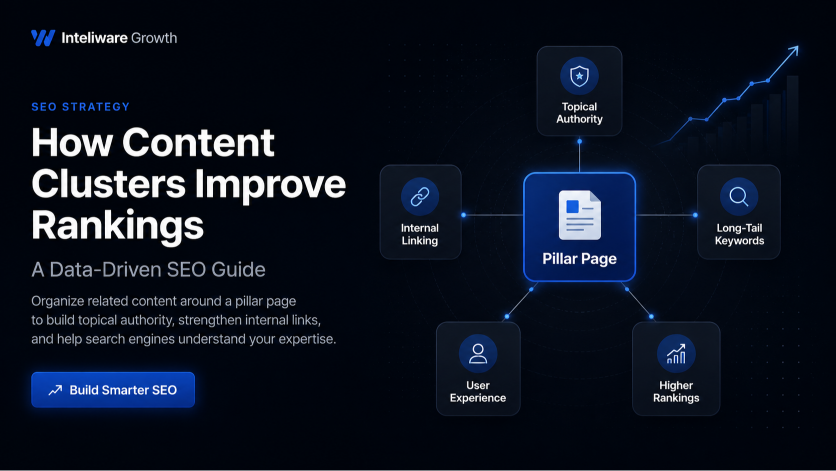
Content clusters improve search rankings by organizing related articles around a central pillar page, which builds topical authority and helps search engines understand your site's expertise.
At Inteliware Growth, we don't believe in tricks or hacks. We believe in performance infrastructure. Whether you are running Google Ads for a taxi company in London or scaling an immigration law firm, the backbone of your organic visibility relies on how you structure your information.
Google has evolved. It no longer looks at individual keywords in isolation; it looks at entities and topics. If your website is a scattered mess of random blog posts, you are fighting a losing battle against competitors who have organized their content into strategic silos.
Here is the deep dive into why content clusters are the engine of modern SEO and how you can implement them to dominate your niche.
How content clusters help SEO
Understanding the why is crucial before implementing the how. Search algorithms have shifted from string matching to entity recognition. Here is how clusters align with modern search engine requirements.
Builds topical authority
Search engines reward websites that cover a broad topic comprehensively rather than with isolated pages.
Google's goal is to provide the best answer. If you have one article about PCO car hire, you have a single piece of information. But if you have a pillar page on the ultimate guide to PCO car hire supported by articles on PCO insurance requirements, TfL licensing rules, and best PCO vehicles for fuel efficiency, you become the encyclopedia on that subject. This signals to Google that you are not just a marketer; you are an expert in the private hire niche.
Enhances internal linking
Linking your main pillar page to supporting subpages and linking those subpages back passes link equity and helps crawlers index your content.
Internal links are the pathways Googlebot uses to crawl your site. A cluster creates a web of relevance. When you link from a blog post about immigration visa requirements back to your main service page on immigration legal services, you are passing authority to the money page. This not only helps rankings but also guides the user deeper into your sales funnel. Learn more about internal links work directly from Google.
Targets more keywords
Your pillar page targets broad head terms, while individual cluster pages rank for specific, long-tail search queries.
This is where the revenue lies. A broad term like digital marketing is impossible to rank for and has vague intent. However, a cluster page on how to generate leads for app startups in the UK has specific, high-intent traffic. By structuring a cluster, you can capture both the high-volume head terms and the low-volume, high-conversion long-tail keywords simultaneously.
Improves user experience
Clear structures let visitors find related answers easily, which lowers bounce rates and keeps people on your site longer.
User experience (UX) is a ranking factor. If a doctor clicks on your article about patient acquisition, they want to read about retention and local SEO immediately after. If your content is clustered, they can jump to related topics without returning to Google. This behavioral signal tells Google that this site satisfied the user's query.
Pillar vs. cluster pages
To execute this strategy, you must understand the two components of the structure. Unlike standard blog posts, this is a deliberate hierarchy.
The pillar page
A pillar page is a broad overview of a core service you offer. For Inteliware Growth clients, this might be growth marketing for cleaning companies.
This page is usually long-form (2,000+ words) and covers every facet of the topic at a high level. It answers the question of what this is and why it matters. It intentionally leaves room for deeper dives on subtopics.
The cluster pages
These are the supporting articles that answer specific questions related to the pillar. For a cleaning company pillar, clusters might include:
- How to price commercial cleaning contracts
- Local SEO for domestic cleaners
- Google Ads strategies for cleaning services
These pages are shorter, laser-focused, and answer a single question with perfect accuracy. They link back to the pillar page using keyword-rich anchor text.
Build a content cluster strategy
Creating a cluster is not about writing 20 random articles. It requires auditing, keyword research, and data analysis.
Core revenue topics
Start with your business model. At Inteliware Growth, we look at your P&L. What service makes you the most money? If you are an immigration lawyer, your pillar might be UK spouse visa application process. Every cluster article should support the user's journey toward hiring you for that service. Explore our immigration lawyers services to see how we apply this framework.
Long-tail keywords
Use tools like Ahrefs or Semrush to find questions. Look for People Also Ask boxes.
- Question: How long does a spouse visa take UK?
- Question: What documents do I need for a spouse visa?
These questions become your cluster titles.
Reverse silo linking
When writing a cluster post, the first link in the body should point back to the pillar page. The pillar page should, in turn, link out to all cluster posts.
This is non-negotiable. This internal linking structure is the mechanism that makes clusters work. It distributes link juice and tells Google exactly which page is the most important.
High-intent niches
Inteliware Growth specializes in high-stakes industries: doctors, lawyers, and taxi firms. These are not impulse buys; they are high-consideration purchases.
Reducing CAC
Content clusters are the organic counterpart to your paid ads. If you are running Google Ads for an app startup, clicks are expensive. However, if a user finds your cluster article on how to reduce churn rate, they trust you. When they later click a retargeting ad, the conversion rate skyrockets because the organic content did the heavy lifting.
Topical map for taxi companies
Let's visualize a cluster for a taxi company client:
- Pillar: The complete guide to airport transfers in London
- Cluster 1: Heathrow to Gatwick transfer what you need to know
- Cluster 2: Why pre-booking a taxi is cheaper than Uber at peak times
- Cluster 3: Executive travel vs. standard taxi a comparison
This structure not only captures every variation of the search query but also positions the taxi company as the authority on transport logistics, not just a driver. Check out our taxi marketing solutions for industry-specific strategies.
Boost Google rankings
Once you have the map, execution is key. Here is how we apply this at Inteliware Growth using our performance framework.
Audit phase
We run a content audit to find orphan pages (posts with no internal links). We identify which existing articles can be grouped together. Often, you already have a cluster; you just haven't linked them properly.
Content refresh
Sometimes you don't need new content. Updating old blog posts with current data (e.g., updated visa fees or new TfL regulations) is a massive Google signal. We update the publish date, fix broken links, and ensure the content matches current search intent.
Measuring impact
We use real-time dashboards to track:
- Keyword position: Is the pillar page moving to page one?
- Time on page: Are users staying longer because they are bouncing around the cluster?
- Assisted conversions: Did a user read a blog post before converting on a landing page?
Best practices
To ensure you aren't just spinning your wheels, follow these rules.
Keep the topic tight
A cluster should not cover all of marketing. It should cover conversion rate optimisation for doctors. The tighter the topic, the higher the relevance score. Google's helpful content guidelines emphasize the importance of focused content.
Avoid keyword cannibalization
Do not write two articles targeting the exact same keyword. If you have two posts about cleaning leads, merge them or delete one. Otherwise, Google will split the authority and neither will rank.
Place content in the funnel
Every article in the cluster should have a job.
- Top of funnel (TOFU): Why you need a cleaning service (awareness).
- Bottom of funnel (BOFU): Cost of end of tenancy cleaning (decision).
The BOFU articles should link directly to your book a free consultation page, not just the pillar. See our cleaning leads services for a complete funnel approach.
Conclusion
Content clusters are the strategic alignment of SEO with user psychology. By moving away from isolated keywords and embracing topical ecosystems, you give Google the context it needs to rank you.
For businesses in the taxi, legal, or medical sectors, the competition is fierce. You cannot out-spend the giants forever, but you can out-think them. Building a content cluster is the foundation of sustainable growth. It compounds over time, lowering your reliance on paid ads while increasing your brand's authority.
If you are ready to build a content architecture that actually drives revenue, let's talk. Visit our blog for more insights on growth marketing.
Contact Us
📞 +92 344 3503901
📧 sales@inteliwaregrowth.com
📍 London, United Kingdom
FAQs
How many articles should a content cluster have?
Start with a pillar and 5-10 supporting articles. Focus on covering the topic completely rather than hitting a volume target.
Why are content clusters better than standalone blog posts?
Clusters build semantic relationships between pages, showing Google your topical authority and boosting rankings for all pages in the group.
Do content clusters help with Google Ads quality score?
Indirectly, yes. A strong internal linking structure improves user experience, which can increase dwell time and lower bounce rates, positively impacting quality score.
How long does it take for content clusters to work?
You may see movement in 2-3 months, but significant ranking improvements usually take 6-12 months. Once established, the rankings are stickier and harder for competitors to dislodge.