You’ve published an exceptional service page. It answers every client question, loads fast, and looks great. Yet month after month, it sits on page three of Google while a competitor’s thinner page ranks above yours. The missing piece isn’t more backlinks or more content – it’s how your pages talk to each other. That’s internal linking, and it’s one of the most controllable ranking levers in SEO.
At Inteliware Growth, we’ve watched Taxi Companies dramatically increase organic leads after we fixed their internal link architecture. Immigration law firms and cleaning businesses we work with see the same uplift.
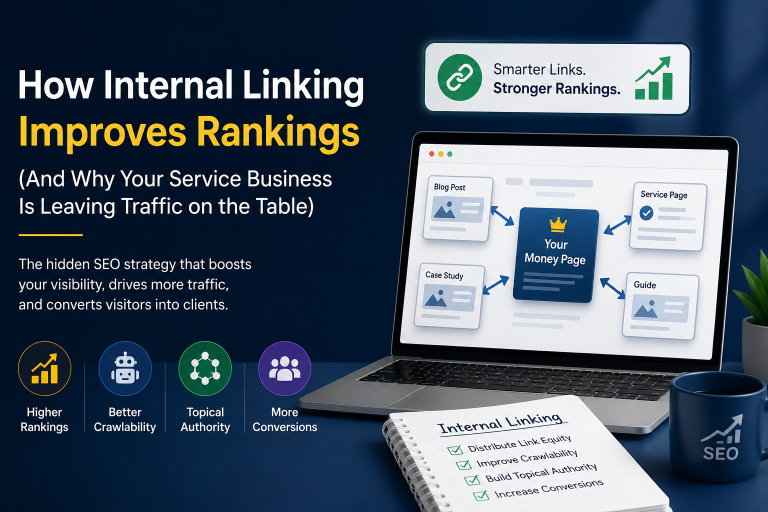
The Mechanics: How Internal Linking Improves Rankings
-
Distributing Link Equity (PageRank) Across Your Site
Internal links pass authority from strong pages to weaker ones. A well-linked service page gains ranking power without needing new external backlinks. -
Enhancing Crawlability and Indexing
Internal links help Google discover and index new pages faster. Orphan pages (with no incoming links) are often ignored by search engines. -
Establishing Site Hierarchy and Topical Clusters
Building pillar pages and topic clusters with strategic internal links signals deep expertise to Google, boosting the entire cluster’s authority. -
Signaling Semantic Relevance with Anchor Text
Descriptive, natural anchor text helps Google understand what the target page is about and which keywords it should rank for. -
Improving User Engagement and Behavioral Signals
Good internal links keep users on your site longer, reducing bounce rates and improving dwell time — strong indirect ranking signals.
Internal Linking Best Practices for High-Intent Service Businesses
- Target your money pages (booking, consultation, quote pages) with contextual links from high-traffic content.
- Keep important pages within 3 clicks from the homepage.
- Use natural, varied anchor text.
- Audit regularly for orphan pages and broken links.
- Prioritise contextual in-content links over navigation or footer links.
Building a High-Impact Internal Linking Strategy in 5 Steps
- Audit – Crawl your site and identify orphan pages and link distribution.
- Strategy – Map topic clusters and pillar pages.
- Execution – Systematically add contextual links from high-authority pages.
- Tracking – Monitor indexing, rankings, impressions, and user behavior in Google Search Console.
- Scale – Continuously link new content into your existing clusters.
Common Internal Linking Mistakes That Hurt Rankings
- Linking only to the homepage
- Using generic anchor text (“click here”)
- Creating orphan pages
- Over-optimizing anchor text
- Linking to irrelevant pages
How Inteliware Growth Elevates Your Internal Linking Strategy
We integrate internal linking into our full 5-step growth framework. Whether you run a taxi company, immigration law firm, cleaning business, or clinic, we ensure your site architecture supports both SEO and conversions.
Book Your Free Consultation
📞 +92 344 3503901
📧 sales@inteliwaregrowth.com
📍 London, United Kingdom
Frequently Asked Questions
1. Does internal linking directly affect Google rankings?
Yes. It distributes PageRank, helps crawlability, and provides contextual signals.
2. How many internal links should a page have?
Focus on quality and usefulness — typically 5–10 relevant contextual links on longer pages.
3. How quickly will changes show results?
Improvements can appear in days to weeks, especially for indexing and mid-tier rankings.