Introduction
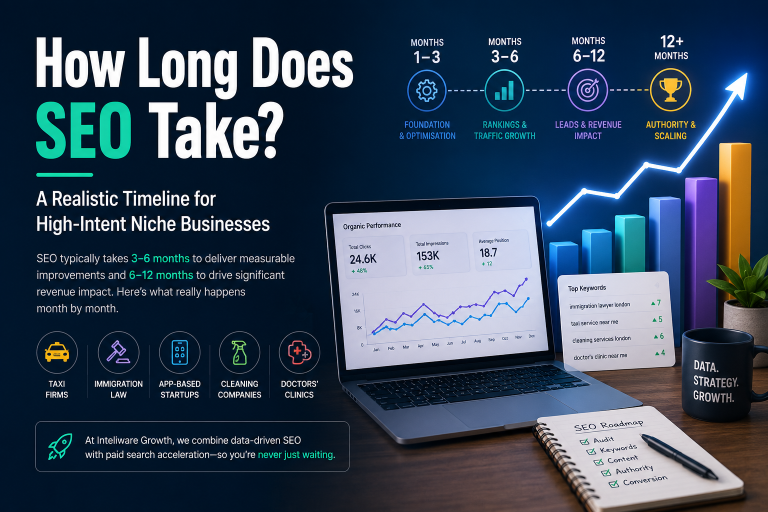
SEO typically takes 3–6 months to deliver measurable improvements, such as higher keyword rankings and increased website traffic, while 6–12 months is generally needed to achieve a significant impact on revenue. But if you’ve ever typed “how long does SEO take” into Google, you already know that number can feel both comforting and maddening. You want leads now — not in six months.
You’re not alone. At Inteliware Growth, we work exclusively with high-intent service industries: private hire taxi firms, immigration law practices, app-based startups, cleaning companies, and doctors’ clinics. For these businesses, every day without a steady flow of qualified leads is money left on the table. That’s why we combine data-driven SEO with paid search acceleration, so you’re never just waiting.
In this article, we’ll give you the most honest, industry-specific breakdown of SEO timelines you’ll find anywhere. You’ll learn exactly what happens month by month, which factors speed up (or slow down) your results, and how to read the silent signals that your SEO is working long before you hit page one. Let’s turn the waiting game into a predictable growth engine.
The Short Answer: SEO Timelines at a Glance
If you came for a quick number, here it is. But keep reading — your specific industry changes everything.
| Timeframe | What You Typically See |
|---|---|
| Month 1–3 | Technical fixes, keyword research, on-page optimisation. Little ranking movement, but site health scores rise. |
| Month 3–6 | Measurable improvements: primary keywords move from page 3 to page 1 for low-competition niches; impressions and clicks increase. For local businesses like cleaning companies or clinics, Google Business Profile starts driving calls. |
| Month 6–12 | Significant organic traffic growth, lead generation becomes consistent. Competitive terms (e.g., “immigration lawyer London”) start breaking into top 10. Revenue impact becomes trackable. |
| 12+ Months | Compounding authority. You’re building topical dominance, attracting natural backlinks, and can start scaling content aggressively. SEO becomes a reliable revenue channel. |
But those numbers aren’t magic. They depend on where you’re starting from and who you’re up against. Let’s dive into why SEO takes time — and how your niche can beat the average.
Why Does SEO Take Time? (It’s Not Just Google Being Slow)
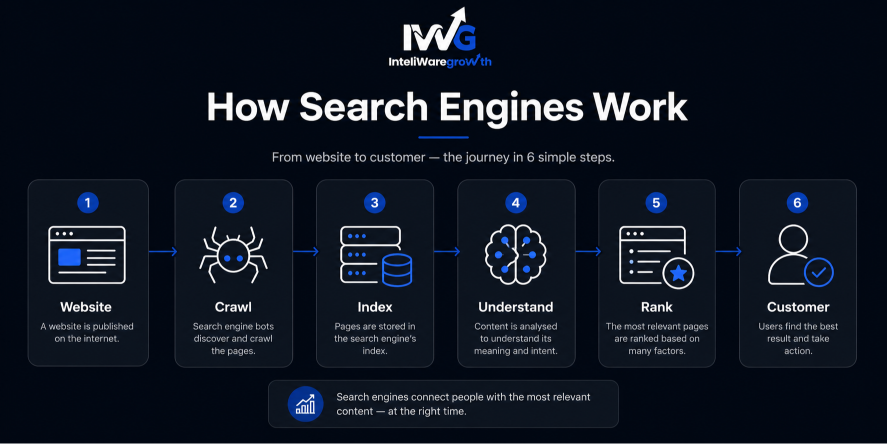
Google’s algorithm isn’t punishing you. It’s managing an impossible job: sorting billions of pages instantly while trying to show the most helpful, trustworthy result. That takes time to assess. Here are the core reasons: Crawling & Indexing Delays Even after you publish a perfect page, Google must discover it, crawl it, and understand its context. For new or low-authority sites, that can take weeks.
The Trust Deficit Google’s Quality Rater Guidelines emphasize E-E-A-T(Experience, Expertise, Authoritativeness, Trustworthiness). Building that trust requires consistent publishing, backlinks from reputable sources, and positive user signals — none of which happen overnight.
Competition Saturation In high-stakes niches like immigration law or London taxi services, your competitors have likely been investing in SEO for years. Catching up is possible, but it demands a smarter, more aggressive strategy.
The “Sandbox” Effect While Google denies an official sandbox, new websites often experience a probation-like period where rankings are suppressed. Our data across dozens of niche clients consistently shows this initial inertia — and how to overcome it.
Link Velocity & Authority Accumulation Backlinks remain one of the strongest ranking signals, but earning natural, high-quality links is a gradual process. A sudden spike of low-quality links can hurt more than help.
The 4 Stages of SEO Results
To set realistic expectations, we walk every Inteliware Growth client through a four-stage roadmap. Understanding these phases removes the anxiety of “is this working?” and replaces it with data-backed milestones.
Stage 1: Foundation & Audit (Months 1–2) What we do:
- Full technical audit (crawl errors, site speed, mobile usability, index bloat).
- Competitor gap analysis — we identify exactly which keywords your rivals rank for that you don’t.
- On-page optimisation of existing high-potential pages.
- Google Business Profile setup or overhaul for local clients (critical for Taxi Companies, clinics, cleaning firms).
What you see:
- Little to no ranking change.
- Site health metrics in Google Search Console improve.
- A clear, bespoke keyword map ready for content deployment.
Key insight: This stage feels slow because you’re building the runway. Skipping it is why most SEO fails.
Stage 2: Content & Relevance Surge (Months 2–4) What we do:
- Publish 4–8 deeply researched service pages and supporting blog content targeting high-intent, low-competition long-tail keywords.
- Local citation building and NAP (Name, Address, Phone) consistency checks for local SEO.
- Internal linking architecture refined to push authority to money pages.
What you see:
- Impressions start climbing for a cluster of new keywords.
- A few long-tail terms reach page 2 or bottom of page 1.
- Google Business Profile impressions increase for nearby searches.
Example from our niche work: A Manchester-based cleaning company saw their “end of tenancy cleaning Salford” page hit position 7 in month 3, generating 12 leads before the main “cleaning services Manchester” term moved an inch.
Stage 3: Authority Building & Ranking Acceleration (Months 4–7) What we do:
- Strategic link building: guest posts on industry-relevant sites, partnerships with local chambers of commerce for lawyers, transport forums for taxi firms.
- Content updates to match evolving search intent.
- Advanced CRO (Conversion Rate Optimisation) tweaks on landing pages to convert the new traffic — because traffic without leads is vanity.
What you see:
- Primary keywords enter striking distance (positions 4–10).
- Organic traffic increases by 50–150% from stage 1 baseline.
- Lead form submissions or phone calls start attributing clearly to organic search.
Stage 4: Compound Growth & Revenue Impact (Months 6–12+) What we do:
- Expand content to capture adjacent topics and build topical authority.
- Harvest “low-hanging fruit” — keywords ranking 5–15 that can jump to top 3 with minor on-page improvements.
- Integrate SEO data with Google Ads for a unified search strategy.
What you see:
- Top 3 rankings for several high-value terms.
- Consistent monthly organic leads.
- ROI becomes clearer, often exceeding paid channels in efficiency over the long term.
8 Factors That Influence Your SEO Timeline (Especially in Your Niche)
No two SEO campaigns are identical. Here’s what moves the needle — and how your sector stacks up.
1. Website Age & Current Authority A brand-new domain for a startup app will take longer than a 10-year-old clinic site with existing backlinks. But a well-structured new site can still rank locally in 4–5 months if optimized aggressively.
2. Competition Level “Immigration lawyer London” is one of the most competitive legal terms. “Family immigration solicitor Harrow” has far less competition. We identify the sweet spot keywords that accelerate your timeline while building toward the big terms.
3. Technical Health of Your Site If your site fails Core Web Vitals, has broken internal links, or isn’t mobile-friendly, you’ll spin your wheels. Many local businesses (taxi firms, small cleaning companies) still run on outdated templates. Fixing these issues can produce quick ranking bumps within 30 days, acting as a springboard.
4. Content Quality and Intent Match Thin, AI-generated content won’t cut it. Google’s Helpful Content System rewards pages that demonstrate real-world experience. For doctors’ clinics, that means content written or reviewed by medical professionals. For Immigration lawyers, it’s content that reflects up-to-date 2025 rule changes. At Inteliware Growth, we never publish a page that doesn’t pass the “would I trust this with my own case” test.
5. Budget and Resources A full-time content and link-building effort obviously compresses timelines. But even with a modest budget, focusing on hyper-local, low-competition keywords can drive leads within 3–4 months. We help you allocate spend where the timeline is shortest and ROI highest — often starting with paid search while SEO matures.
6. Local vs. National Intent A local cleaning company targeting “office cleaning Birmingham” will see faster results than an app startup trying to rank for “best project management app.” Why? Local results are influenced by proximity and Google Business Profile, which you can optimize immediately. National SEO demands broader authority. If you’re in the taxi or clinic space, leverage local SEO to get early wins.
7. Niche-Specific Dynamics (Real Data from Our Campaigns)
- Taxi & Private Hire: Local pack results can move within 60–90 days if GBP is fully optimized and review generation is active. Airport transfer keywords often break into top 5 in 4–5 months.
- Immigration Lawyers: E-E-A-T is paramount. Building the right solicitor profiles and legal citations takes time, but a well-structured “visa type” hub can start producing consultation requests by month 5.
- Cleaning Companies: Service-area pages targeting suburbs or towns can rank in 2–3 months with minimal links, driving a surprising volume of calls.
- Doctors & Clinics: Medical queries fall under YMYL (Your Money Your Life). Authority is non-negotiable. Expect a 6+ month timeline for competitive treatment terms, but “GP near me” local rankings can come much sooner.
- App Startups: Highly competitive. A long-tail content strategy (e.g., “best budgeting app for freelancers UK”) can build a foundation in 4–6 months while you scale paid user acquisition.
8. Ongoing Algorithm Updates Google rolls out thousands of changes yearly. A core update can momentarily shake rankings. Our job is to build sites that align with Google’s long-term direction — helpful, human-first content — making you update-resistant.
How to Speed Up SEO Results Without Cutting Corners
While you can’t force Google to trust you faster, you can compress the timeline by being ruthlessly strategic.
1. Prioritise High-Intent, Low-Competition Keywords Instead of chasing “immigration lawyer” from day one, create content for “Skilled Worker visa solicitor Manchester fee 2025.” These long-tail queries convert better and rank faster. We call this the “wedge” strategy — you build a base of profitable micro-terms that eventually push you into the big leagues.
2. Optimise Your Google Business Profile Now For any local business (taxi, cleaning, clinic), a fully completed GBP with weekly posts, Q&A, and fresh reviews can start generating leads within weeks — completely independent of your website’s organic rankings. This is the closest thing to an SEO fast-forward.
3. Execute an Internal Linking Sprint Often, pages sitting on page 2 or 3 just need a little more authority passed from your stronger pages. A single afternoon of strategic internal linking can boost rankings within days.
4. Leverage Existing Partnerships for Links Are you a member of a local chamber of commerce, a legal association, or a transport forum? Those memberships almost always come with a backlink opportunity. Claim them. One quality local backlink can move the needle more than ten generic ones.
5. Refresh and Repurpose Old Content If you have a blog post from 2021 that’s losing traffic, updating it with 2025 data and re-publishing can give you an instant rankings lift. Google loves fresh content on established URLs.
6. Combine with Paid Search for Immediate ROI While your organic presence builds, Google Ads can put you at the top of the SERP today. At Inteliware Growth, we run integrated campaigns where paid data informs SEO keyword choices, and SEO content improves paid Quality Scores. The synergy slashes your time to profitability.
Want to see what an accelerated timeline looks like for your specific niche? Book a Free Consultation and we’ll map out a 90-day SEO sprint tailored to your industry.
When You Should Consider Paid Search While Waiting for SEO
There’s no rule that says you must choose one channel. The most successful businesses we work with — particularly immigration law firms and App Startups — run Google Ads from day one while the SEO engine ramps up.
- High-intent immediacy: Someone searching “emergency taxi to Heathrow” or “immigration solicitor near me urgent” needs a solution now. Paid ads capture that demand while you wait for organic rankings.
- Data loop: The keyword and conversion data you gather from paid campaigns tells you exactly which terms to double down on for SEO. No guessing.
- Brand reinforcement: Appearing in both paid and organic results for your brand name increases trust and click-through rate.
Our Google Ads service is built specifically for high-intent niches. We don’t do vanity metrics — just cost-per-lead targets that keep you profitable while SEO matures. For cleaning companies, that might mean £5–£15 per booked clean. For lawyers, a qualified consultation enquiry for under £40.
View All Services to see how paid and organic work together.
Signs Your SEO Is Working (Before Page 1)
Waiting without feedback is brutal. Here are the leading indicators that tell us a campaign is on track:
- Increasing impressions in Google Search Console for your target keyword cluster.
- A rising number of queries your site appears for (even if they aren’t main keywords yet).
- Improved click-through rate (CTR) when your pages do appear — a sign that your titles and meta descriptions are resonating.
- Faster indexation — new pages get crawled within hours instead of days.
- Your Google Business Profile showing up for broader searches (“car service near me” when you only used to appear for “taxi service”).
- Spike in branded search — people are looking you up by name.
- Website engagement metrics up: lower bounce rate, longer session duration on blog posts.
If you’re working with a transparent agency, you’ll see these signals reported monthly. At Inteliware Growth, our real-time dashboards give you visibility into every click, impression, and lead — no black boxes.
Why Most “SEO Guarantees” Are Red Flags
We need to address this, because if you’ve been burned before, the question “how long does SEO take” feels like a trap. You might have heard:
“We guarantee page one in 30 days.”
No reputable agency can guarantee specific rankings, and Google explicitly warns against such promises. Rankings are influenced by algorithms no one controls. What you can guarantee is a process: rigorous technical work, elite content, earned authority, and transparent reporting.
Our guarantee is different. If a keyword isn’t performing, we pivot. If a content piece doesn’t attract links, we rework it. The timeline may flex, but the direction never does because our framework has been stress-tested across taxi booking systems, legal aid portals, and clinic appointment funnels.
You can see real outcomes on our Case Studies page. No vanity metrics, just cost-per-acquisition and revenue growth.
Conclusion
SEO takes time, but it shouldn’t take forever. When you work with an agency that understands the mechanics of your niche — whether it’s the compliance constraints of immigration law or the booking intent behind “taxi to Luton airport” — the timeline stops being a guess and becomes a roadmap.
At Inteliware Growth, we apply that niche intelligence to every stage: auditing your current foundation, deploying high-intent content, and layering paid search to bridge the gap. The result? You don’t just wait for rankings; you build a lead engine that compounds in value month after month.
FAQ
How long does SEO take to show results? Typically, initial measurable results (impressions, clicks, long-tail rankings) appear in 3–6 months. Meaningful revenue impact usually takes 6–12 months, depending on competition and niche.
Can SEO work in 1 month? If you have an existing site with strong authority, fixing technical errors or targeting ultra-low-competition local keywords can produce ranking improvements in 30 days. However, a brand-new site will rarely see significant traffic that quickly.
Why does SEO take 3-6 months? Google needs to crawl, index, and assess your content’s relevance and trustworthiness. Additionally, building backlinks, creating authoritative content, and overcoming the competitive gap are gradual processes.
Does industry affect how long SEO takes? Absolutely. Local businesses like cleaning companies or clinics often see faster local pack results. Highly regulated, YMYL niches like immigration law or medical treatments require stronger E-E-A-T signals and take longer.
How can I speed up my SEO results? Focus on low-competition long-tail keywords, fully optimise your Google Business Profile, implement aggressive internal linking, earn local backlinks, and combine SEO with paid search for immediate traffic while authority builds.
Is SEO worth the wait? Yes. Unlike paid ads, which stop the moment you cut the budget, SEO builds compounding organic equity. Over 12 months, a properly executed SEO campaign often becomes your lowest cost-per-acquisition channel.
Ready to Build Predictable SEO Growth?
At Inteliware Growth, we create accelerated SEO strategies tailored to Taxi Companies, Immigration lawyers, clinics, cleaning businesses, and App Startups.
Contact Us
📞 Phone: +92 344 3503901
📧 Email: sales@inteliwaregrowth.com
📍 Location: London, United Kingdom