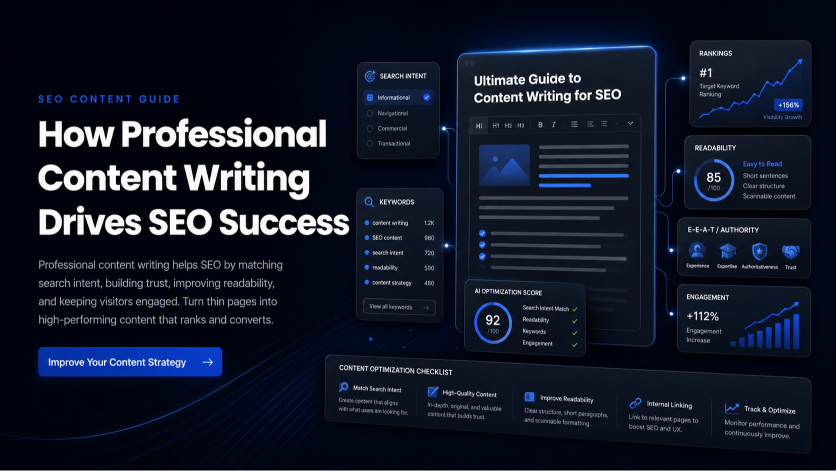
Professional content writing helps SEO by combining helpful, clear information with smart target word choices. It matches what people type into search engines, proves your brand knows its topic, and keeps visitors on your pages longer. This signals to search tools that your site is a trusted source.
At Inteliware Growth, we write and optimize content for taxi companies, immigration lawyers, app startups, cleaning companies, and doctors. We see the same pattern again and again: pages built around search intent outperform pages built only around keywords. This guide explains exactly how professional content writing helps SEO and what you can change on your own site.
What is SEO content writing?
Professional content writing for SEO is not keyword stuffing. It is the process of planning, writing, and structuring pages so they answer a user’s question while following search engine guidelines. It combines on-page SEO, audience research, and clear copywriting to make content useful for humans and easy for crawlers to understand.
When done correctly, professional content writing helps SEO because it gives search engines two things at once: a clear page topic and a helpful answer. That is the foundation of ranking well in Google’s first page and appearing in Google AI Overview.
Why SEO rewards good content
Google’s SEO starter guide states that content should be helpful, reliable, and created for people first. Search engines reward pages that satisfy a query completely. Professional content writing does this by matching user intent, organizing information clearly, and demonstrating real expertise.
Thin or generic content rarely ranks for competitive service terms. In our experience managing paid and organic landing pages, we see that content written with clear structure and original insight consistently earns more impressions, clicks, and leads.
Keywords and search intent
Target terms: Places key phrases naturally in titles, headers, and text so search engines know what the page is about.
User goals: Answers the exact questions users want solved, matching their search intent.
When we write for a taxi company, we do not repeat London taxi service twenty times. We map each page to one primary term and five to ten related terms, then place those phrases where users and crawlers expect them: the title tag, H1, subheadings, body text, image alt text, and URL.
Search intent matters more than keyword density. A cleaning company page targeting office cleaning costs should answer pricing questions and provide a clear quote path. A doctor’s clinic page targeting private GP appointment London should explain booking steps, availability, and location. Professional content writing helps SEO because it aligns the page with the real reason behind the search.
Authority and trust
Firsthand proof: Adds real-world facts, data, or expert quotes to show genuine experience.
Brand trust: Builds high value so other websites link back to your pages as a reliable source.
Google’s guidance on E-E-A-T rewards content that demonstrates experience, expertise, authoritativeness, and trustworthiness. Professional writers do this by including named examples, specific results, client case studies, and industry data. For example, an immigration law firm page that explains a recent visa rule change with accurate legal context will build more trust than a generic immigration lawyers page.
At Inteliware Growth, our sector-specific case studies show real campaign data and lead-cost trends. That is firsthand proof. High-value content also earns links from local directories, industry blogs, and news sites. Those links act as votes of confidence and push your pages higher.
Readability and engagement
Clear structure: Uses short paragraphs, bullet points, and subheadings (H2, H3) so text is easy to scan.
Longer visits: Keeps readers interested, lowering bounce rates and telling search engines your site offers a good experience.
Most people scan content before they read it. If your page is a wall of text, visitors leave. Professional content writing uses short paragraphs, clear headings, bold key phrases, and bullet points to make information easy to digest. This improves dwell time and reduces bounce rate.
Search engines interpret longer visits and multiple page views as positive quality signals. When a visitor lands on your taxi service page, reads your pricing guide, and then visits your contact page, Google sees a satisfied user. That is exactly what professional content writing helps SEO achieve.
Our SEO content framework
Our agency follows a five-step roadmap: Audit, Strategy, Execution, Tracking, and Scale. Professional content writing plugs into every step.
- Audit: We audit existing content, competitor pages, and search intent gaps. This shows us which pages should rank but do not.
- Strategy: We build a content map around primary keywords, related questions, and conversion goals. Every page gets a clear KPI.
- Execution: We launch custom landing pages and blog content that align with your service pages and ad campaigns. Each piece follows a structured brief.
- Tracking: We use real-time dashboards and analytics to measure which content drives calls, form fills, and booked appointments.
- Scale: We double down on content that generates leads and pause or rewrite content that does not.
This data-driven approach is why professional content writing helps SEO for high-intent service industries instead of just creating generic blog posts.
Why thin content fails
Thin or generic content repeats what already ranks. Search engines reward pages that add something readers cannot get elsewhere. Original value can be a unique pricing comparison, a local service-area checklist, an expert commentary on a rule change, or an internal data set from campaign performance.
For example, a taxi company blog post that lists exact airport transfer prices from London postcodes is far more valuable than a generic article titled Why Taxis Are Important. At Inteliware Growth, we create content that answers real buyer questions and includes actionable next steps.
Content by industry
Different service industries need different content approaches. Below is how we tailor professional content writing for each sector we serve.
Taxi companies
Professional content writing helps taxi companies capture local search intent. We write service-area pages, airport transfer guides, fare calculators, and booking pages around terms like taxi near me and airport transfer London. Clear content improves local rankings and pre-qualifies ride requests. Visit our Taxi Companies page to see how we build industry-specific funnels.
Immigration lawyers
Immigration content must be accurate, compliant, and helpful. We write guides on visa categories, appeal processes, and eligibility requirements. This builds E-E-A-T and attracts high-intent clients. Visit our Immigration Lawyers page for more.
App startups
App startups need SEO content for both web search and app store visibility. We write feature pages, comparison posts, and onboarding guides that drive installs while lowering customer acquisition cost. Visit our App Startups page.
Cleaning companies
Cleaning companies need lead-generation content. We create service pages, pricing guides, and local landing pages around office cleaning, end of tenancy cleaning, and city names. This captures high-intent commercial searches. Visit our Cleaning Companies page.
Doctors & clinics
Medical content is YMYL, so accuracy and trust are critical. We write patient education pages, treatment explanations, and location pages with clear booking calls to action. Visit our Doctors & Clinics page.
SEO content checklist
Use this checklist before publishing any page:
- Identify search intent before choosing a primary keyword.
- Place the primary keyword in the title, H1, first 100 words, one H2, and meta description.
- Answer the main question in the first two paragraphs.
- Use H2 and H3 subheadings that contain related questions.
- Add real examples, data, or case studies.
- Use short paragraphs and bullet points.
- Add internal links to relevant service and industry pages.
- End with a clear call to action.
- Write a 40–60 word direct answer for AI Overview visibility.
- Update content regularly to keep it fresh.
Content mistakes to avoid
Avoid these mistakes if you want your content to rank:
- Keyword stuffing: Repeating the same phrase unnaturally hurts readability and can trigger penalties.
- Ignoring search intent: A page that sells when the user wants information will not rank.
- Thin content: Fewer than 500 words with no original insight offers little value.
- Missing internal links: Orphan pages are harder for crawlers to find.
- No clear CTA: Visitors leave without taking action.
- Poor formatting: Long paragraphs and no headings increase bounce rate.
- Generic advice: “High-quality content is important” without examples adds no value.
Professional content writing helps SEO by avoiding these errors and building pages that actually solve user problems.
SEO content and paid ads
SEO content does not operate in a silo. At Inteliware Growth, we use professional content on landing pages to improve Google Ads Quality Score. Clear, relevant landing pages reduce cost per click and increase conversion rates. Content that matches ad copy improves user experience and tracking accuracy.
For service businesses running Google Ads Management, Paid Social Advertising, Conversion Rate Optimisation, or App Install Advertising, professional content is the bridge between traffic and revenue. It helps every campaign perform better.
FAQs
What is professional content writing for SEO?
It is content planned and structured to answer user questions while following search engine guidelines, using keywords and clear copy.
How long does SEO content take to rank?
Usually 3–6 months, depending on competition and domain authority. Targeting low-competition, high-intent terms can speed it up.
Does professional content writing help local SEO?
Yes. Localized pages with city headings, FAQs, and internal links help rank for near me and Google Maps.
Can content writing improve Google Ads Quality Score?
Yes. Relevant landing pages improve Quality Score, reducing cost per click and improving ad position.
What content should I write first for my service business?
Start with core service pages, then add supporting blog posts and FAQs.
Conclusion
Professional content writing helps SEO because it solves the reader’s problem while giving search engines clear signals. It integrates keywords with search intent, proves E-E-A-T, and keeps users engaged. It turns thin pages into trusted resources that earn links and rank for high-intent terms.
If your service business wants to rank higher, start with content built around real questions and real user intent. At Inteliware Growth, we combine professional content with paid traffic and conversion optimization to turn search visibility into booked revenue.
Free SEO consultation
Ready to improve your content and SEO performance? Contact Inteliware Growth for a free consultation.
Contact Us
📞 +92 344 3503901
📧 sales@inteliwaregrowth.com
📍 London, United Kingdom