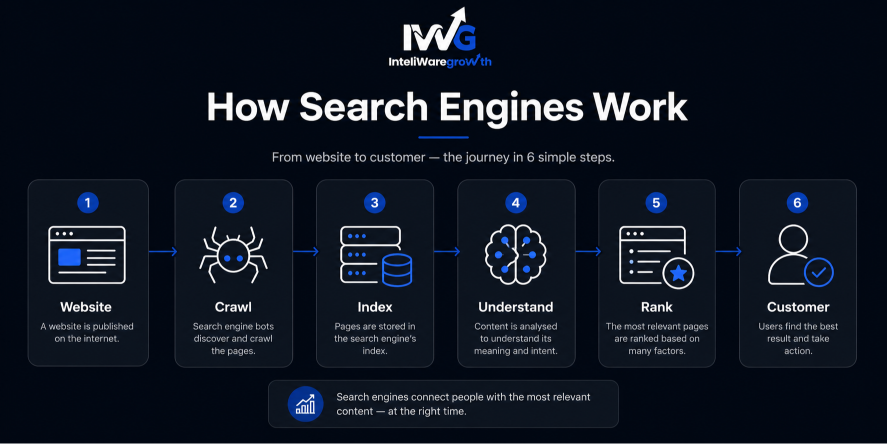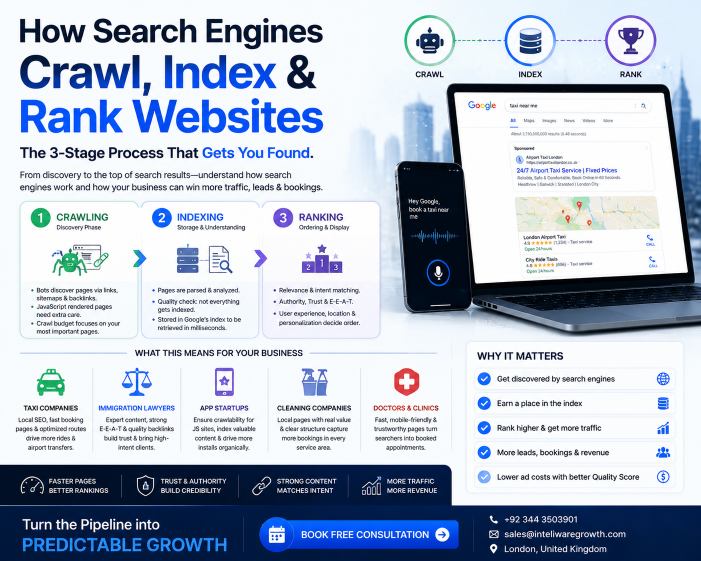
You type a query taxi near me immigration lawyer London cleaning company and in under a second a perfectly ordered list appears. That list was not pulled from the live web. It came from a colossal pre-built database called the search index. Every page you want to rank must pass through three core pipelines first: crawling indexing and ranking.
If you are running a taxi firm a law practice a clinic or an app startup these are not just technical concepts. They are the foundation of every lead every booking and every download. Master them and you stop guessing why your pages do not show up. Let us walk through each stage and translate the mechanics into growth.
1. Crawling the discovery phase
Search engines send automated bots spiders to discover new and updated pages. Googles main crawler is Googlebot.
How bots find you
Crawlers do not search the web blindly. They start with known URLs and follow links. They also find pages through:
- XML sitemaps you submit in Google Search Console.
- Internal links from your own popular pages.
- Backlinks from other websites pointing your way.
If a page is not linked internally or externally and you have not submitted a sitemap it might never be discovered. You can learn more from How Search Works.
Javascript and rendering
Many modern sites load content via JavaScript. Googlebot can render JavaScript to see the page like a user but it takes extra resources. If your key content only appears after scripts execute it may be missed or indexed with delay. For App Startups or sites using heavy JS frameworks server-side rendering or dynamic rendering becomes essential to protect visibility.
Crawl budget your sites visiting limit
Crawlers do not visit every page daily. They allocate a crawl budget based on server speed content freshness and the quality of your internal linking. Thin duplicate or slow-loading pages waste that budget. A cleaning company with 200 near-identical location pages risks having its best booking pages crawled infrequently. Focus crawl attention on pages that actually convert.
2. Indexing the storage and understanding phase
Once crawled a page is processed and either stored in the index or discarded. This is where the search engine decides what your page is about and whether it deserves a slot.
Parsing the page
The engine breaks down your content: text title tags meta descriptions image alt text and structured data. It then maps the page to topics and entities. A page about end of tenancy cleaning gets associated with moving tenancy deposits and local service providers.
Quality control: not everything makes the cut
Indexing is selective. Search engines routinely filter out:
- Duplicate content, including printer-friendly versions.
- Pages with a noindex tag.
- Thin pages that add no unique value.
- Spam or manipulative content.
Every indexed page must justify its place. For high-stakes sectors like law or medicine quality thresholds are even higher. A thin page with just immigration solicitor London and no depth will not survive this filter.
The inverted index
The index is built like the back of a book. Instead of scanning all pages for a word the engine looks up the word and finds every URL where it appears. This structure enables sub-second retrieval. Optimising for doctor appointment booking helps the index map your clinics page to that exact phrase and related variations.
3. Ranking retrieval ordering and display
When someone searches the engine pulls pages from the index and orders them using hundreds of signals. The goal is one perfect answer at the top.
Relevance intent is everything
The first signal is relevance. The algorithm checks whether your pages content matches the query and crucially the intent behind it. A search for how to book an immigration solicitor needs an informational guide. A search for immigration solicitor near me demands a transactional service page with contact details. Matching intent is not optional. If you serve the wrong intent you cannot rank.
Authority and trust: E-E-A-T in action
Google evaluates Experience Expertise Authoritativeness and Trustworthiness (E-E-A-T). For legal medical or financial topics these signals carry enormous weight. Trust is built through:
- Authoritative backlinks from respected relevant sites.
- Clear author credentials privacy policies and physical addresses.
- Consistent accurate information across the web.
Googles E-E-A-T guidance explains how these signals are assessed. An Immigration law firms with verified solicitor profiles Law Society links and genuine reviews demonstrates the trust signals that algorithms reward. A doctors page referencing NHS guidelines and displaying GMC registration does the same.
User experience (UX) as a ranking signal
Even relevant trustworthy content gets demoted if it delivers a poor experience. Key UX factors include:
- Core web vitals loading speed visual stability interactivity.
- Mobile-friendliness over 60% of searches happen on phones.
- Https security a basic prerequisite.
- No intrusive interstitials pop-ups that ruin the mobile experience.
You can measure these signals using Core Web Vitals. A taxi booking page that takes five seconds to load on 4G will not just lose rankings it loses fares. Google uses real-user metrics like how often searchers click and how long they stay as indirect quality signals.
Personalization and location
Results adapt to the searchers location language and history. For service businesses local intent dominates. A search for cleaning services in Manchester will never show a London-based firm no matter how well-optimised. Consistent NAP name address phone data across the web and a fully optimised Google Business Profile are mandatory for local pack visibility.
How the three pipelines work together
Think of it as a supply chain. Crawling finds the inventory. Indexing warehouses and catalogues it. Ranking displays the most appealing products to each customer. A break anywhere undiscovered pages thin indexed content poor ranking signals keeps your business invisible even if your services are exactly what the searcher needs.
This is why SEO cannot be only about keywords. You must engineer the entire pipeline: technical health for crawling meaningful content for indexing and trust plus experience for ranking.
What this means for your business
At Inteliware Growth we do not do generic SEO. We build visibility systems for five high-intent niches. Here is how the crawl-index-rank reality translates into wins for each.
- Taxi Companies: Local search is your battleground. A verified Google Business Profile fast booking pages under two seconds and internal links from route guides to your booking page direct both bots and riders. Speed is a ranking factor and a conversion factor we optimise for both.
- Immigration Lawyers: E-E-A-T is everything. Thin location pages hurt you. Instead build comprehensive hub pages per visa category authored by named solicitors with visible credentials. Earn links from legal directories and authoritative publications. A single thorough guide that demonstrates real expertise will outrank dozens of shallow city pages.
- App Startups: JavaScript rendering can block discovery. If your web presence is a single-page app implement dynamic rendering so Googlebot sees your value proposition. Supplement paid install campaigns with indexed educational content that captures organic top-of-funnel traffic. Crawlability and speed are as critical as your ad creative.
- Cleaning Companies: Local pages need substance. Replace Cleaning London with pages like End of Tenancy Cleaning in Hackney including real prices checklists and photos. Manage crawl budget by consolidating near-duplicate area pages and using a clear category structure. Bots follow signals; give them a clean path to your most profitable services.
- Doctors & Clinics: Medical queries demand accuracy and trust. Cite official health guidelines use structured data for rich results and ensure your appointment booking flow is mobile-first and flawless. Pages that load quickly and display authority keep patients and rankings healthy.
Across all these industries the same principles apply when we manage your paid ads. Landing page relevance speed and trust directly influence Google Ads Quality Score lowering your cost per lead. The organic and paid pipelines reinforce each other when built correctly.
Frequently Asked Questions
How long until my new page appears in search?
It varies from hours to weeks. Speed it up by submitting the URL in Search Console and linking to it from an already-indexed page.
Can a page be crawled but not indexed?
Yes. If content is thin duplicated or blocked by a noindex tag the crawler visits but the indexer rejects the page. Quality is the gatekeeper.
Do paid ads boost organic rankings?
No. Google separates the two systems. However a fast high-quality landing page built for ad traffic can indirectly benefit organic rankings through better user signals.
What is the quickest way to check what is indexed?
Use Google Search Console Index Coverage report or type site:yourdomain.com into Google to see a rough list.
Turn the Pipeline into Predictable Growth
Understanding how search engines crawl index and rank is the first step. Translating that understanding into measurable revenue for your taxi company law firm app cleaning service or clinic requires specialist execution. We audit your technical foundation align your content with real search intent and build paid and organic strategies that feed each other transparently.
Every penny you invest should move you closer to the top of the search results and to a new customer.
Contact Us
📞 +92 344 3503901
📧 sales@inteliwaregrowth.com
📍 London, United Kingdom
Book Your Free Consultation Today