The decision to invest in SEO is a commitment to long-term growth. But choosing the wrong partner for that journey can cost you thousands of dollars and months of lost opportunity. You are not just looking for a vendor. You are looking for a growth partner. At Inteliware Growth, we have seen too many businesses trapped in contracts that prioritize activity over revenue. We built our agency on a performance-first framework, and we want to help you apply that same critical eye to your vendor selection.
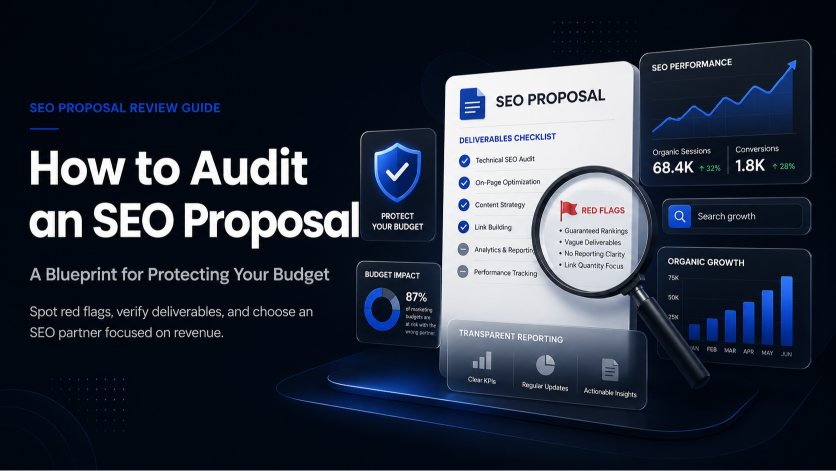
To audit an SEO proposal, check for specific, customized strategies rather than generic templates. Review the scope of work for realistic deliverables, transparent reporting, clear timelines, and alignment with your business goals rather than empty guarantees like instant #1 rankings.
Before you sign that contract, you need to analyze the document the way a forensic accountant analyzes a balance sheet. You need to strip away the fluff and look at the mechanical reality of what is being proposed.
Red flags to watch for
Most bad SEO deals share common DNA. If you spot these elements in a proposal, it is time to pause the negotiation or walk away entirely. These are not just inconveniences. They are indicators that the agency is either unskilled or prioritizing their margins over your results.
The danger of guaranteed rankings
No agency can promise the #1 spot on Google since algorithms change constantly. If an SEO provider offers you a guarantee that you will rank #1 for a specific keyword, you are likely dealing with a firm that is either lying to you or planning to use black-hat tactics that will eventually get your domain penalized. Google’s own documentation explicitly warns against this.
While you might see short-term gains, these are often built on a house of cards. A stable, credible agency will guarantee a process, like transparent reporting or turnaround times on fixes, but they will never guarantee a position.
Vague deliverables: the optimization trap
Look closely at the line items. Vague phrases like “SEO optimization” without listing exact tasks, content pieces, or technical fixes are a massive red flag. What does “optimization” actually mean in the context of that invoice?
A valid proposal should be granular. It should state, for example, that the team will compress images on the top 20 visited pages to improve Core Web Vitals, or that they will publish two 1,500-word pillar pages targeting transactional intent. If the scope of work looks like it was copied from a generic marketing brochure, the strategy likely is too.
No initial audit: flying blind
A proposal sent without first analyzing your site's current traffic, backlink profile, and technical health is not a strategy. It is a guess. SEO is not a one-size-fits-all medication.
If an agency tells you they know exactly what you need before even looking under the hood of your website, they are using a template. Your industry, your current domain authority, and your conversion funnel dictate the strategy. An agency that does not ask for access to your Google Search Console or Analytics before sending a quote is missing the foundational step of the entire process.
Core areas to evaluate
Once you have screened out the obvious scams, you need to evaluate the substance of the proposal. You do not need to be an SEO expert to understand the fundamentals of a good plan. You just need to know what questions to ask. Here is how we deconstruct a proposal at Inteliware Growth when auditing a client’s previous failed campaigns.
Technical scope: the foundation of visibility
The most beautiful content in the world is useless if Google cannot crawl it. Does the proposal address site speed, mobile usability, indexation, and crawl errors?
Look for specific mentions of technical debt. Are they planning to fix broken links? Are they looking at your XML sitemap? Are they prioritizing mobile-first indexing? If the proposal only talks about “keywords” and “content,” you are missing half the battle. The web is competitive. If your site loads in 5 seconds and your competitor loads in 1.5 seconds, you will lose.
Content strategy: matching user search intent
Does the plan target real search intent and keyword gaps instead of just high-volume fluff? This is a crucial distinction. An agency might pitch you on getting traffic for 10,000 monthly searches, but if that traffic never converts, what is the point?
You need to check if they are targeting bottom-of-funnel keywords. For example, if you are a cleaning company, ranking for “how to remove a wine stain” is informational intent and less valuable than “professional carpet cleaning services London,” which is transactional intent. The proposal should demonstrate an understanding of who is searching, why they are searching, and what action they want to take.
Link building: white-hat vs. black-hat
Are they using safe, white-hat outreach or sketchy automated link directories? Link building is often the most controversial part of SEO. It is also where agencies cut corners.
You need to audit where these links are coming from. Are they claiming they will build 100 links a month for $500? Those links are likely toxic. Google’s spam policies prohibit paid links and automated link schemes. A good proposal will talk about Digital PR, niche edits on relevant sites, and building relationships within your specific sector, like securing links from legal directories for Immigration Lawyers or local business associations for Taxi Companies.
Reporting & KPIs: vanity vs. revenue
Do they track meaningful metrics like qualified organic traffic and conversions, rather than vanity rankings alone? This is the litmus test for a modern agency.
Rankings fluctuate based on location, personalization, and search history. If your agency sends you a screenshot of a #1 ranking every month but your phone is not ringing, they are failing. The proposal should specify that you will receive reports on:
- Organic qualified leads: How many form fills or calls?
- Assisted conversions: Did SEO assist a sale that started from a direct visit?
- Engagement: Bounce rate and time on page.
The Inteliware Growth framework: beyond the audit
As a performance marketing agency, we apply our 5-step roadmap to everything we do, including auditing our own strategies. When you audit an SEO proposal, you are essentially looking for this level of rigor.
Step 1: the deep dive audit
We do not just look at your meta tags. We dive into your competitor data, audience intent, and existing funnels. You can see examples of our deep dive audits in our case studies. We look at why your Google Ads might be converting while your SEO is not. For industries like Doctors & Clinics or Immigration Lawyers, compliance and trust signals, often called E-E-A-T, are just as important as technical fixes.
Step 2: custom strategy, not templates
We build custom roadmap KPIs. For an App Startup, this might mean focusing on branded search volume and driving direct downloads. For a Cleaning Company, it means dominating the near me map pack. The audit should validate that the proposal is tailored to your unit economics, not just your traffic.
Step 3: execution & tracking
We track based on attribution. Does the proposal mention how they will handle phone call tracking? If you are a Taxi Company, most of your leads are calls. If the SEO proposal does not include a call tracking solution, you are flying blind. That is a non-negotiable in a modern audit.
The ROI audit: who is qualified to help you
You need to assess whether the agency understands business, not just ranking factors. Ask yourself: Does this proposal read like it was written by a technician or a business partner?
Technicians fix code. Business partners fix revenue. A strong proposal should connect SEO efforts to your bottom line. It should acknowledge that SEO is a channel, not a silo. At Inteliware Growth, we often bundle SEO audits with Conversion Rate Optimisation because getting traffic to a broken landing page is a waste of money.
Your SEO proposal audit checklist
To help you make a decision, print this list out and check off the boxes as you read through the proposal.
The red flag check
- □ Does it guarantee specific rankings? If yes, reject.
- □ Are the deliverables vague? If yes, ask for specifics.
- □ Did they review my website before sending this? If no, request a follow-up audit.
The strategy check
- □ Does it include Technical SEO fixes for site speed and mobile?
- □ Does it differentiate between informational and transactional content?
- □ Does it mention Toxic Backlinks or Disavow Files?
The reporting check
- □ Does it track conversions, not just clicks?
- □ Is there a review call scheduled monthly or quarterly?
The business check
- □ Does it mention my specific industry, such as Immigration Law, Cleaning, or Taxi?
- □ Does it integrate with Paid Ads or CRO?
Need help reviewing a proposal? Contact our team for a free consultation.
Conclusion: trust but verify
The digital marketing landscape is full of yes men. Many agencies will tell you exactly what you want to hear to get your signature. Auditing an SEO proposal is about protecting your brand from bad actors and protecting your budget from inefficiency.
Look for an agency that pushes back slightly. Look for a proposal that admits that SEO is a long game but backs up that timeline with concrete steps, technical audits, and a focus on revenue metrics. Whether you are targeting patients for a clinic or users for a mobile app, the principle remains the same. The proposal should be as unique as your business.
If you are currently reviewing a proposal and feel like you need a second pair of eyes, we are here to help. Do not navigate the murky waters of digital marketing alone.
Ready to scale your business with a team that values data over vanity?
View Our Services to see how we drive revenue for niche service industries.
FAQ
1. Why should I distrust an SEO agency that guarantees results?
Search engines change algorithms constantly, so no one controls rankings. Guarantees usually mean the agency is using risky spam tactics that can get your site penalized.
2. What is the difference between an SEO Audit and an SEO Proposal?
An audit analyzes your current website health. A proposal is a sales document outlining what the agency will do to fix issues. Never accept a proposal without a recent audit.
3. How do I know if a keyword is high-intent?
High-intent keywords contain words like buy, hire, services, near me, or cost. They show the user is ready to act, unlike research keywords.
4. Does my local business need SEO if we already run Google Ads?
Yes. Google Ads stops when you stop paying, while SEO builds a compound asset. Strong organic presence also often lowers your cost per click in paid campaigns.
5. What reports should I ask for in an SEO proposal?
Ask for a sample report that shows organic sessions, keyword position changes, goal completions, and backlink growth. If the report is just a spreadsheet with no context, ask for a better one.
Contact Us
📞 +92 344 3503901
📧 sales@inteliwaregrowth.com
📍 London, United Kingdom