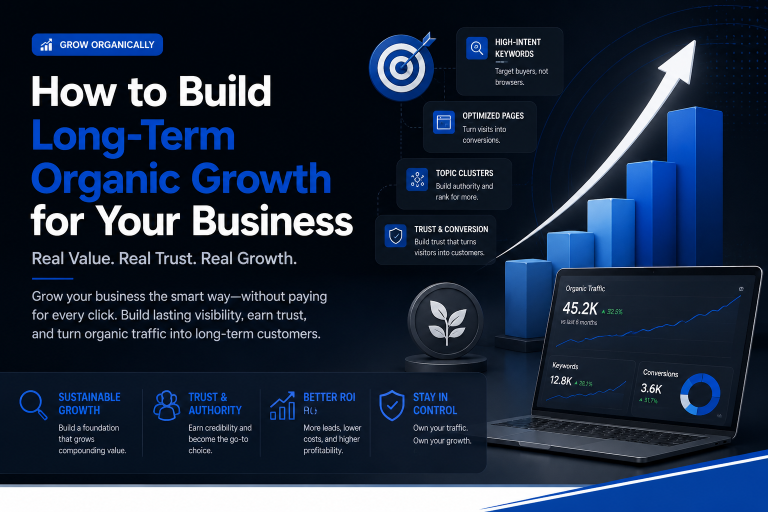
Building long-term organic growth means expanding your business, website, or audience using only your internal resources, value, and consistency rather than paid ads or buying other companies. It takes time, but it builds real trust and keeps your brand safe.
At Inteliware Growth, we see many UK businesses trapped in a cycle of renting their audience. They spend thousands on Google Ads to buy traffic, but the moment they pause the budget, the leads stop. Organic growth is different. It is the compounding interest of the digital world.
Whether you are running a taxi company in London, an immigration law firm, or a cleaning service, the principles of organic growth remain the same. It is about being found when your customers are ready to buy, not just when you are paying to be seen.
Here is our data-backed framework for building organic growth that lasts.
Target high-intent keywords
The biggest mistake in content marketing is chasing traffic that will never turn into revenue. To drive long-term organic growth, you must shift your focus from volume to intent.
Look for commercial signals
Focus on commercial and bottom-of-funnel (BOFU) terms instead of broad educational words. While a blog post titled What is Immigration Law might attract students, it will not pay your bills. You need to target phrases containing words like pricing, best, services, agency, or specific use cases.
For example, instead of targeting cleaning tips, a commercial cleaning company should target commercial cleaning services pricing in London. This is where the buyers are.
Align with reality
Align search intent with what your business actually sells to prevent empty clicks. If you are an app startup looking for users, targeting How to build an app is useless. You want keywords like app install agency or reduce app CAC.
By mapping your content to the bottom of the funnel, you ensure that every organic visitor has the potential to become a paying customer. Use tools like Google Search Console to see which queries already bring in clicks, and double down on those that have high engagement but low conversion, often a sign of misaligned intent.
Optimize service and landing pages
Once you attract the right visitors, your website must be prepared to convert them. Too many businesses treat their service pages like digital brochures. To grow organically, you need to treat them like salespeople.
Shift from we to you
Turn standard informational service pages into clear decision pages. A doctor's clinic should not just list their equipment; they should explain how they solve the patient's pain. Address buyer questions, pricing transparency, alternatives, and comparisons directly.
If you are a taxi company, do not just say We have cars. Explain, We offer fixed-price airport transfers with free waiting time, unlike other firms that charge surge pricing. This kind of specificity reduces bounce rate and builds trust.
Clarity over cleverness
Keep text simple, clear, and focused on user problems rather than aggressive selling. The user wants to know if you can solve their problem quickly. Use bullet points, short paragraphs, and clear headings to facilitate scanning.
A landing page for an immigration lawyer should answer three questions within five seconds: Can you handle my visa type? How much does it cost? How long will it take? If those answers are buried, the user will leave, and Google will notice.
Build topic clusters
Search engines have moved away from keyword stuffing toward topical authority. To rank for high-value keywords, you need to prove you are an expert on the entire subject, not just one phrase.
The hub and spoke model
Group related articles, FAQs, and guides around a single customer challenge. If you are an immigration lawyer, your hub is your service page for Skilled Worker Visas. Your spokes are articles about Visa Fees, Processing Times, and Document Checklist.
Each spoke should answer a specific question that a potential client might type into Google. Over time, this creates a web of content that covers every possible angle, leaving no room for competitors to outrank you.
Connect the dots
Connect supporting content to main service pages using strong internal links. This passes ranking power to the pages that make you money. It also keeps users on your site longer, signaling to Google that your website is a valuable resource.
For example, if you run a cleaning company, a blog post titled How to Choose a Commercial Cleaning Service should link directly to your Office Cleaning Services page with anchor text like professional office cleaning. This internal linking strategy is one of the most underrated organic growth levers.
By establishing deep topical authority for the specific services you provide, you make it impossible for competitors to outrank you.
Improve conversion and trust elements
Organic growth is not just about getting clicks; it is about getting customers. If your traffic increases by 50% but your conversion rate stays at zero, you have wasted your time.
Prove your worth
Add social proof like client reviews, case studies, and testimonials across your pages. In high-stakes niches like healthcare or legal services, trust is the primary currency. A testimonial from a Dr. Smith is worth more than a thousand words of self-promotion.
Include specific numbers: We helped a London taxi firm increase bookings by 40% in three months. Vague praise is less effective than measurable results.
Remove friction
Use simple, easy-to-use mobile forms and clear call-to-action buttons. If a user has to zoom in to click a button on their phone, you have failed. Your CTAs should be obvious: Book a Free Consultation.
Keep forms short: name, phone, email, and maybe one qualifying question. Every extra field reduces conversion rates. Also ensure that your phone number is click-to-call on mobile devices; many users still prefer to speak to a human before committing.
Technical health
Fix page speed and technical errors to create a frictionless user experience. A slow-loading page kills conversions and harms your rankings. At Inteliware Growth, we audit every element of the user journey, from the ad click to the final booking form.
Google's Core Web Vitals are now a ranking factor. If your site takes more than three seconds to load, you are losing both organic rankings and potential customers.
Measuring organic growth
You cannot improve what you do not measure. To ensure your long-term organic strategy is working, track the right indicators.
Keyword rankings
Monitor where your high-intent keywords rank. Use tools like Google Search Console or Ahrefs to see if you are moving from page two to page one for terms like taxi service London or immigration lawyer near me. Ranking improvements take time, but consistent upward movement is a leading indicator of future traffic.
Organic sessions and conversions
Traffic alone is vanity. Track how many organic visitors actually complete a desired action: booking a consultation, requesting a quote, or calling your office. Set up conversion goals in Google Analytics to see which pages drive the most leads. If a page has high traffic but zero conversions, revisit the intent alignment and CTA placement.
Engagement metrics
Bounce rate, time on page, and pages per session tell you if users find your content valuable. A high bounce rate on a service page suggests a mismatch between what the user searched for and what you delivered. Improve the page or adjust the keyword target.
Assisted conversions
Organic content often plays a supporting role in the buyer journey. Use multi-channel funnel reports to see how many users first found you through a blog post and later converted via a direct visit or branded search. This proves the long-term value of content even when last-click attribution ignores it.
Inteliware Growth framework
While this guide focuses on organic growth, the principles of high-intent targeting and conversion optimization are the same ones we use in our paid advertising campaigns.
At Inteliware Growth, we do not believe in generic marketing. We build growth frameworks for high-intent niche service industries. Here is how we apply the Organic Mindset to paid acquisition for our clients:
- Audit: We dive into competitor data and audience intent. We don't just look for keywords; we look for profitability signals.
- Strategy: We build custom roadmaps with specific KPIs. If you are a cleaning company, we are tracking bookings, not just clicks.
- Execution: We launch custom ad creatives and landing pages that mirror the clarity of a well-optimized organic page.
- Tracking: We implement advanced attribution models. You will see exactly which keyword or ad generated a phone call or a form fill.
- Scale: We expand budget based purely on winning, automated data.
Who we help
We specifically tailor this organic and paid hybrid strategy for:
- Taxi Companies: Turning local search intent into ride requests.
- Immigration Lawyers: Compliant, low-cost lead generation.
- App Startups: Profitable user acquisition and reducing CAC.
- Cleaning Companies: Consistent, high-volume lead generation.
- Doctors & Clinics: Patient acquisition and local appointment booking.
Conclusion
Building long-term organic growth is a marathon, not a sprint. It requires a strategic commitment to targeting the right keywords, optimizing your on-page experience, and building topical authority.
You cannot build a skyscraper on a weak foundation. By focusing on high-intent traffic and user experience, you create a brand that survives algorithm updates and market shifts.
Stop renting your audience. Start owning your digital real estate. If you are ready to scale your niche service business with data-driven precision, Inteliware Growth is ready to help.
FAQs
1. How long does it take to see organic growth?
Typically 3 to 6 months, depending on competition and content quality. Unlike paid ads, results compound over time.
2. Do I still need paid ads if I have organic traffic?
Yes. Paid ads offer immediate visibility for testing, while organic provides long-term stability. Use both for maximum impact.
3. What is more important: content or backlinks?
Both. Content provides value, backlinks provide authority. You need both to rank high-intent commercial keywords.
4. Can Inteliware Growth help with organic growth and paid media?
Yes. We specialize in Google Ads, Paid Social, and Conversion Rate Optimization, ensuring both channels work together seamlessly.
Ready to scale your business?
Stop guessing. Start growing. Contact Inteliware Growth today for a Free Consultation.
Contact Us
📞 +92 344 3503901
📧 sales@inteliwaregrowth.com
📍 London, United Kingdom