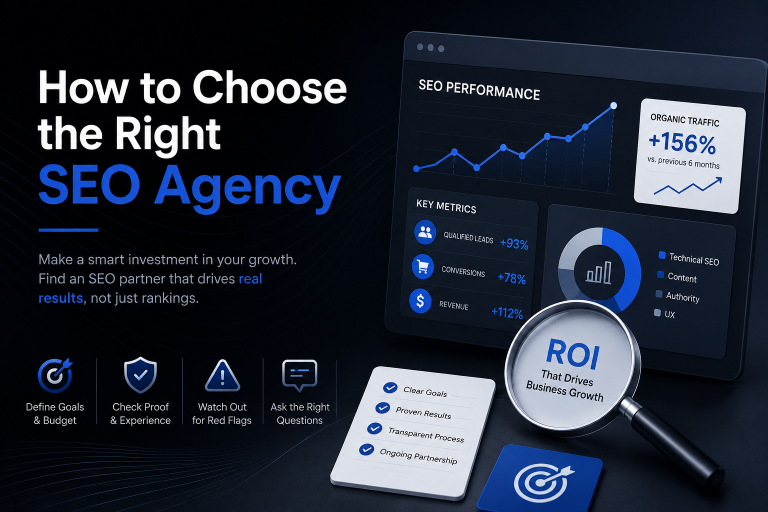
Choosing the right SEO agency requires defining your goals, verifying real Case studies, and avoiding unrealistic guarantees. Before hiring anyone, establish clear business targets and a realistic monthly budget.
Partnering with an SEO company is not just about outsourcing routine website management. It represents a critical strategic investment in your organization's long-term digital authority and market reach. In today's modern search ecosystem, where Google AI Overviews, generative search experiences, and continuous algorithm adjustments dictate visibility, selecting an agency that delivers verifiable business growth rather than vanity traffic is essential to protect your marketing capital.
Define your goals and budget
Before contacting prospective search engine optimization agencies, establish internal consensus regarding what you expect organic search to accomplish. SEO encompasses diverse disciplines, meaning a generic, one-size-fits-all methodology rarely succeeds.
Set clear performance targets
Know if you want more website visits, direct leads, or online sales. Establish precise commercial targets before initiating discovery calls with prospective partners.
A local medical practice requires high visibility across localized Google Maps results to capture patient appointments. Conversely, an app startup needs targeted landing page traffic to drive installs and lower customer acquisition costs. Defining your key performance indicators allows you to grade agencies on their ability to move metrics that directly influence your financial bottom line.
Establish a realistic monthly budget
Real SEO takes time and effort; be wary of very cheap packages that use risky shortcuts. Sustainable organic search dominance requires dedicated technical maintenance, continuous content development, and strategic link building.
According to data compiled in Ahrefs' SEO statistics report, over 78% of established search marketers rely on ongoing monthly retainer agreements because meaningful search authority takes consistent effort. Low-cost SEO plans frequently deploy automated link-building schemes, low-quality AI content, and spam tactics that risk severe search engine penalties. Align your financial commitment with the competitive landscape of your industry.
Check proof and experience
Any marketing firm can present a polished sales deck filled with complex jargon. A dependable growth partner proves competence through verifiable real-world execution and documented results.
Ask for data-backed case studies
Ask for Case studies by looking for real examples of past work and data-backed traffic increases. Request performance records that outline baseline starting positions, specific strategies implemented, and resulting revenue or lead growth.
Move beyond vague claims of increased keyword positions. Require agencies to demonstrate how organic traffic growth translated into real contact form submissions, phone inquiries, qualified consults, or direct e-commerce transactions for organizations within your market sector.
Match agency specialization to your needs
Match your needs by ensuring they specialize in what you need, whether it is local maps, heavy technical fixes, or content writing.
Resolving complex JavaScript indexing bottlenecks for enterprise platforms demands a distinct skillset compared to executing local search campaigns for private hire drivers or driving compliant lead acquisition for legal practices. Review [Inteliware Growth's core services](https://inteliwaregrowth.com/Services) to examine how specialized performance models align with distinct business challenges.
Watch out for red flags
The search marketing industry contains agencies that make bold promises they cannot fulfill. Identifying warning signs early protects your business from financial loss and domain damage.
Avoid unrealistic ranking guarantees
No guarantees. Avoid any company that promises instant number-one rankings on Google, as search engines change constantly and no one can guarantee exact placements.
Official guidance in Google Search Central's SEO hiring documentation explicitly warns site owners against consultants claiming priority access to Google or guaranteeing top positions. Search algorithms evaluate hundreds of real-time signals. Reputable agencies focus on building sustainable domain equity, topical authority, and high-intent traffic rather than promising artificial positions.
Demand clear and transparent communication
Clear communication is essential, so look for transparent reporting that explains what the data means for your business rather than hiding behind confusing jargon.
If an agency provides monthly reports full of raw impressions and generic clicks without clarifying how those figures affect your lead pipeline, customer acquisition, or return on investment, they fail to offer true strategic value.
Critical questions to ask before hiring an agency
Interviewing prospective search agencies requires examining their operational methodology in detail. Pose these targeted questions during initial discovery meetings to evaluate their strategic depth.
Keyword strategy and intent research
Ask prospective teams how they conduct keyword research and analyze search intent. Qualified specialists will outline how they identify high-intent terms that attract paying customers rather than chasing superficial search volume.
Technical optimization and content execution
Inquire about their technical standards and editorial policies regarding site speed optimization, schema implementation, and human-first content creation. Competent agencies explain their auditing procedures and hands-on technical execution clearly.
ROI measurement and revenue attribution
Clarify performance metrics by asking how they connect organic search improvements directly to revenue. Answers should focus on conversion rates, cost per acquisition, lead volume, and overall contribution to business revenue.
The 90-day onboarding roadmap
Inquire about immediate workflows and specific milestones that mark the initial 90 days of engagement. Structured agencies present a clear timeline starting with technical audits, competitive analysis, and strategic mapping before execution starts.
Why industry specialization beats generic marketing
Generalist agencies often apply template-driven SEO playbooks to every client, regardless of unique sector dynamics. High-performing growth strategies require tailored frameworks built around specific buyer psychology and industry search habits.
At Inteliware Growth, we focus on performance marketing and conversion strategies tailored specifically for high-intent service sectors
- Taxi and private hire companies Focused on turning local search intent and map visibility into immediate ride bookings.
- immigration law firms Built for compliant, cost-effective lead generation and high consultation conversion rates.
- App-based startups Designed around profitable user acquisition, reducing customer acquisition costs, and scaling active app downloads.
- cleaning companies Focused on high-volume lead acquisition strategies to secure commercial and residential service contracts.
- Doctors and medical clinics Dedicated to establishing local practice authority to drive patient acquisition and appointment scheduling.
The proven 5-step growth roadmap
An effective digital agency does not rely on intuition. Growth requires a structured, repeatable framework designed to build organic dominance and convert traffic into revenue.
[1. Deep Audit] → [2. Strategy] → [3. Execution] → [4. Tracking] → [5. Scale]
Step 1: Deep Audit
Conducting exhaustive audits across technical health, competitor positioning, target audience intent, search funnel gaps, and conversion barriers.
Step 2: Custom Performance Strategy
Building a tailored execution roadmap complete with clear performance KPIs, channel projections, high-intent keyword mapping, and structural content architecture.
Step 3: Precision Campaign Execution
Deploying technical optimizations, on-page search enhancements, high-converting ad assets, and landing page conversion rate optimization (CRO).
Step 4: Advanced Revenue Tracking
Implementing full-funnel attribution tracking, call monitoring, and real-time client dashboards to provide total visibility over every pound invested.
Step 5: Data-Backed Scaling
Expanding campaign scope, expanding keyword targeting, and scaling budgets based strictly on proven, profitable conversion performance.
Comparing vanity metrics against real business growth
To keep your agency accountable, evaluate the specific metrics they highlight during periodic performance reviews.
Understanding low-value vanity metrics
Vanity metrics include total page impressions, broad keyword rankings detached from commercial intent, and general traffic spikes that do not yield qualified leads. While these figures appear positive on superficial reports, they do not impact operational profitability.
Measuring high-value revenue indicators
Revenue-focused metrics monitor qualified lead volume, target keyword movements for commercial search queries, customer acquisition cost (CAC), and overall campaign ROI. Prioritizing these indicators ensures search engine visibility actively expands your business operations.
| Performance Area | Vanity Metrics (low value) | Revenue Metrics (high value) |
|---|---|---|
| Search Performance | Broad rank tracking without traffic intent | Keyword movements on high-intent commercial terms |
| Traffic Quality | Total page views and raw impression numbers | Qualified organic sessions arriving on target sales pages |
| User Engagement | Standard page views and overall bounce rate | Form submissions, incoming phone calls, and appointment bookings |
| Business Impact | Estimated brand impression estimates | Organic customer acquisition cost (CAC) and campaign ROI |
Essential questions to ask before hiring a SEO agency
Interviewing potential search partners requires digging deep into their execution methodology. Ask these direct questions during your discovery call:
- How do you perform keyword research and intent analysis?
- What is your approach to site speed, schema markup, and human-first content creation?
- How do you tie search performance back to actual revenue?
- What specifically happens during the first 90 days of our campaign?
Frequently Asked Questions
How long does it take to see tangible results from SEO?
SEO represents a compounding, long-term investment. While technical corrections and localized optimizations often produce visible momentum within 60 to 90 days, substantial revenue growth and competitive keyword authority generally require 4 to 6 months of systematic optimization.
What is the difference between SEO and Google Ads (PPC)?
Google Ads provides immediate search visibility by charging a fee for every click. SEO builds permanent organic authority, creating a sustainable marketing channel that yields leads over time without ongoing cost-per-click charges. Combining both channels creates complete search engine coverage.
Should I hire a local agency or a specialized performance agency?
While local agencies offer in-person meetings, specialized performance agencies typically deliver stronger financial returns. Selecting an agency with demonstrated expertise in your specific industry sector matters far more than physical office location.
How much should a quality SEO retainer cost?
Professional agencies typically offer monthly retainers between £1,500 and £5,000+ depending on market competitiveness, technical complexity, and content requirements. Retainers below £500 monthly often indicate automated practices that carry long-term domain risks.
Contact Us
📞 +92 344 3503901
📧 sales@inteliwaregrowth.com
📍 London, United Kingdom