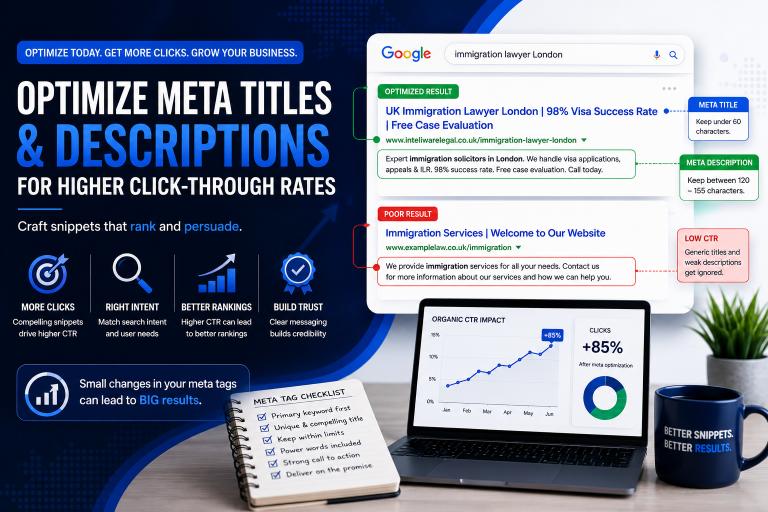
To optimize meta titles and descriptions, focus on character limits, search intent, and click-through-rate (CTR). Keep meta titles under 60 characters and meta descriptions between 120 and 155 characters to prevent truncation in search results. However, there’s an art and a science to doing it right. A perfectly crafted snippet doesn’t just inform—it persuades a potential customer to choose your link over nine other blue lines on the page.
At Inteliware Growth, we’ve spent years perfecting the tiny details that turn passive searchers into qualified leads for service industries. A meta tag isn’t an SEO checkbox; it’s your first handshake with a high-intent user. Get it right, and your organic traffic becomes a conversion machine. Get it wrong, and you’re leaving money on the table.
Let’s break down exactly how to write meta titles and descriptions that Google loves to show and users love to click.
Why meta titles and descriptions are your unfair advantage
A search engine results page (SERP) is the most competitive real estate online. You’re fighting for attention against competitors, ads, and Google’s own features. Your meta title is the primary clickable headline and a confirmed ranking factor. Your meta description acts as organic ad copy. While it doesn’t directly boost rankings, a compelling description can lift your organic CTR by 5-10%, and a higher CTR often correlates with better rankings over time.
Think of it this way: if you’re an immigration lawyer in London, your beautifully designed website means nothing if a worried visa applicant scrolls past your result because the snippet looks generic. Your meta tags must instantly communicate relevance, authority, and a solution.
How to optimize meta titles
Your meta title is the heavy lifter. It tells Google and the user exactly what the page is about. Here’s how we structure title tags that convert.
Place primary keywords first
Google reads from left to right, giving more weight to terms that appear earlier. Always front-load your most important target keyword. For a cleaning company’s “end of tenancy cleaning” page, a weak title is: Services – Sparkle Clean London. A powerful one is: End of Tenancy Cleaning London | Guaranteed Deposit Return | Sparkle Clean. The core intent is captured instantly.
Mind the 60-character limit
Aim for 50–60 characters. Google cuts titles off around 600 pixels wide on desktop, and mobile screens are even less forgiving. If your title gets truncated, you lose brand signals and keywords. We always test our clients’ snippets on both desktop and mobile preview tools before pushing a page live. A truncated title for a taxi firm reading “Book a Reliable Airport Transfer in Heathrow...” might cut off the city name, losing a critical local intent signal.
Include branding strategically
Add your brand name at the end using a pipe | or hyphen -. This builds recognition without eating up prime keyword space. For an app startup client, we use the format: Primary Keyword | App Name. It’s clean and scannable.
Use power words to stop the scroll
Words like “Best,” “Ultimate,” “Proven,” “Free,” or numbers like “10 Ways” tap into psychological triggers that boost CTR. A clinic’s title that reads 10 Proven Ways to Reduce Joint Pain | London Physio Clinic will dramatically outperform Joint Pain Treatment London. The number promises scannable value; the word “proven” builds instant credibility.
Keep every title unique
Duplicate title tags confuse search engines. If you run a taxi company serving multiple cities, each location page needs a distinct, localized title. Airport Transfers Manchester | Fast Cabs and Airport Transfers Liverpool | Fast Cabs signal relevant uniqueness. We audit our clients’ sites to wipe out any generic titles, replacing them with surgical precision.
How to optimize meta descriptions
Meta descriptions are the sales pitch that gets the click. A well-optimized snippet can lower your ad costs by improving Quality Score, and it makes every organic impression fight harder.
Write for the human, not the algorithm
Clearly summarize what the page delivers and why the user should care. An Immigration law firms description shouldn’t read “We offer visa services.” It should read: “Facing a refused spouse visa? Our UK immigration solicitors have a 98% success rate in appeals. Free case evaluation available.” That’s problem-aware, empathetic, and results-driven.
Respect the 120–155-character limit
Google truncates descriptions around 155 characters on desktop and closer to 120 on mobile, as outlined in their snippet guidelines. Since over 60% of searches happen on mobile, prioritize the first 120 characters. Place your most critical value proposition and CTA there. If you’re targeting a mobile-heavy industry like taxi apps, never bury the “Book in 3 taps” message after the cut-off.
End with a clear call to action
A meta description without a Call to Action is a missed opportunity. Use active nudges: “Read more,” “Get your free audit,” “Book a ride now.” For a doctor’s clinic, “Book an appointment today — same-day slots available” removes friction. We test CTA variations quarterly to find which verbs drive the highest click-through.
Include keywords naturally
Sprinkle primary and secondary keywords where they fit organically. When a user searches “immigration solicitor near me”, Google bolds “immigration solicitor” in your description. That visual pop acts like a highlighter. A description like Expert immigration solicitors in Manchester. Visa applications, appeals & ILR support. Call for a confidential chat. will have bolded terms that make the result look tailor-made.
Promise only what the page delivers
Misleading descriptions cause users to bounce. A high bounce rate tells Google your page likely didn’t satisfy the query, and Google may automatically rewrite your snippet. In fact, Google rewrites meta descriptions over 70% of the time for various queries. Don’t give up that control. Always ensure the description accurately reflects the on-page experience.
The overlooked connection: meta tags and your Google Ads performance
For the service industries we specialise in—taxi firms, clinics, lawyers—your organic meta strategy directly impacts paid media efficiency. Google Ads uses a metric called Ad Relevance, which considers how closely your ad copy and landing page match a user’s search terms. When a landing page has a tightly optimized meta title and description, the theme of the page is clearer.
This alignment strengthens your Quality Score, lowering your Cost Per Click and improving your ad position. We’ve seen immigration law firms slash their CPC by 20% simply by aligning the landing page’s meta title with their best-performing ad copy—a strategy we apply regularly through our [Google Ads management services](https://inteliwaregrowth.com/GoogleAds). Clear, honest meta descriptions that deliver on their promise lead to longer dwell times, reinforcing quality signals on both the organic and paid sides. At Inteliware Growth, we treat SEO and Google Ads as one unified channel capturing high-intent demand.
Common meta tag mistakes that kill your CTR
Even experienced marketers slip into these traps. Check your site for:
- Keyword cannibalisation: Multiple pages targeting the same title tag phrase, forcing Google to pick one and ignore the others.
- Missing descriptions entirely: Google will auto-generate a snippet, often pulling a broken sentence or date. You lose all persuasive power.
- Quotation marks in the title: A stray double quote in your CMS can cut your title short in the SERP code.
- All caps shouting: “BOOK LONDON TAXI NOW!!!” looks spammy and violates Google’s style guidelines, triggering a rewrite.
- Ignoring local intent: A doctor’s clinic writing “Best healthcare” instead of “Best GP Clinic in South London” misses the modifier that signals local relevance.
How Inteliware Growth optimizes every pixel for revenue
We don’t just hand you a list of best practices. Our performance marketing framework bakes meta tag optimization into every stage, ensuring your snippets work for your bottom line:
- Audit Phase: We dissect competitor snippets, identify emotional triggers, and map every title tag against search intent.
- *Strategy Phase: We build custom title tag templates for your service pages, local landing pages, and blog content, all tied to your revenue KPIs.
- Execution & Tracking: We implement tags and link them to real-time dashboards. If a meta description tweak lifts call bookings by 8% for a clinic, we roll that pattern across the site.
- Scale: Only winning patterns survive. We reinvest the data into your paid campaigns, scaling budgets against proven, high-converting messaging.
Whether you need a complete SEO overhaul, a Google Ads campaign that lowers your Customer Acquisition Cost, or a conversion-optimised funnel for your taxi booking app, our data-driven approach ensures every meta tag pulls its weight.
Contact Us
📞 +92 344 3503901
📧 sales@inteliwaregrowth.com
📍 London, United Kingdom
Frequently Asked Questions
1. Does Google always show my meta description?
No. Google rewrites snippets about 70% of the time, but a well-crafted, intent-matching description greatly increases the chance yours is displayed.
2. Should my meta title exactly match my H1 tag?
Not necessarily. Keep your meta title keyword-focused for the SERP, while your H1 can be more descriptive to engage on-page visitors.
3. How often should I update my meta tags?
Quarterly. Seasonal businesses should update for current offers, and A/B testing key pages can lift CTR and revenue.
4. Can I use the same meta description for multiple pages?
Never. Every page serves a unique intent, so each description must feature a specific value proposition and call to action.