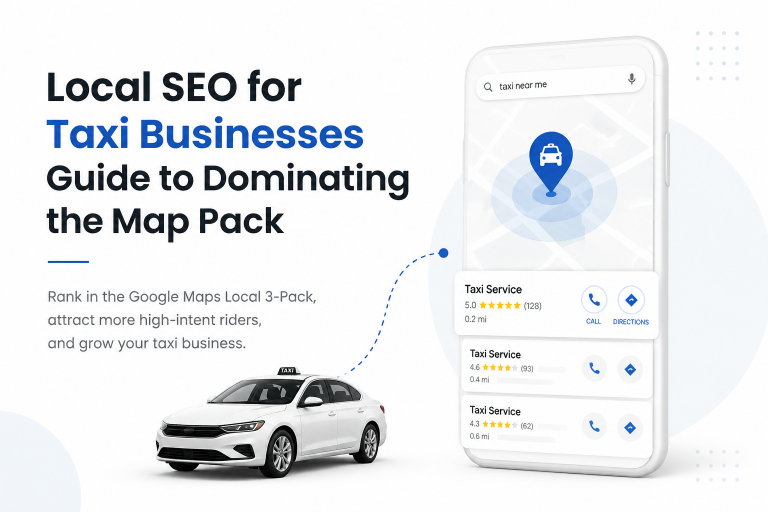
Local SEO helps taxi businesses rank in the Google Maps Local 3-Pack and local search results when customers search for rides nearby.
If you run a private hire or taxi company, you know the frustration. You watch ride-hailing apps take a cut of your profits while your phone sits silent. The problem is not your service; it is your visibility. Today, passengers do not flip through phone books. They pull out their phones and search taxi near me or airport transfer in their city.
If you are not in the top three results on Google Maps, you are invisible to the highest-intent customers in your area.
At Inteliware Growth, we specialize in performance marketing for high-intent service industries. We have built growth frameworks specifically for Taxi & Private Hire Companies. We know that ranking on Google is not about magic; it is about applying a specific scientific checklist.
Here is the must-do checklist to outrank your competitors and turn local search intent into ride requests.
Why local SEO matters
Before we dive into the how, we need to understand the why. Paid ads stop the moment you stop paying. Local SEO compounds.
When someone searches for a taxi on their smartphone, they are not browsing. They need a ride now. This is high-intent traffic. Google understands this urgency. The algorithm rewards businesses that provide clear, trustworthy, and localized information.
Unlike generic marketing, a local SEO strategy builds a digital asset that works 24/7. It lowers your Customer Acquisition Cost (CAC) over time because you are not paying per click every single time a user calls. You are earning that call through authority.
Moreover, users trust organic results more than paid ads. Studies show that a significant majority of consumers prefer to click on organic map listings over sponsored ones. When you rank organically, you appear as the obvious choice, not a business that paid for attention. That trust translates directly into bookings.
Google Business Profile optimization
Your Google Business Profile is your new storefront. It is the single most important ranking factor for the Local 3-Pack. If you ignore this, you cannot rank.
Claim and verify your profile
Claim and verify your Google Business Profile to control how your business appears on Maps. Without verification, you are not eligible to appear in local search results. This is the first step in your audit. You can start the process directly on Google support.
Maintain strict NAP consistency
Use a consistent name, address, and phone number (NAP) across all online listings. If your website says St. but your Facebook page says Street, Google gets confused. Confusion lowers your trust score. Ensure every directory, social profile, and citation matches exactly.
Select the right business category
Pick the right primary category like Taxi Service or Airport Taxi Service. Do not select Transportation Service as a catch-all. Google uses categories to understand what you do. Being specific helps you rank for specific, high-converting queries.
Set accurate operating hours
Set accurate operating hours, or mark your business as 24/7 if you offer round-the-clock rides. If a customer arrives at your office at 3 AM to find you closed when Google says you are open, you lose trust. Accurate hours prevent bad reviews and improve user experience.
Upload professional media
Upload real, professional photos of your cars, drivers, and team. Stock photos are a red flag. Show your fleet is clean and modern. Geo-tagging your photos can also provide additional local signals to Google.
Build a mobile-friendly website
Most taxi searches happen on a phone, often in a crowded street or a noisy airport. Your website must be a conversion machine, not a digital brochure.
Optimize for speed
Make your site load fast on mobile phones where most ride searches happen. If your site takes longer than three seconds to load, users bounce back to Google and book with a competitor. Compress your images and use a clean theme.
Include click-to-call functionality
Add a clear click-to-call phone number and an easy online Book Now button. Do not make a passenger type your number into their dialer. One tap should initiate the call. The Book Now button should be sticky on the screen at all times.
Embed Google Maps
Embed a Google Map of your service area on your contact or homepage. This reinforces your location signals to Google and helps customers visualize your coverage area.
Create localized service pages
Create dedicated pages for specific local routes, neighborhoods, or services like airport transfers. Do not just have one Services page. You need a page for Heathrow Airport Transfers, a page for Taxi to Birmingham, or Night Out Taxis in your city. This allows you to target specific keywords.
Gather customer reviews
Reviews are the lifeblood of local SEO. They are also a primary conversion factor for new customers who are comparing you to a rival firm.
Ask for feedback
Ask happy riders to leave positive feedback on your Google listing. The best time to ask is immediately after the ride ends. You can use automated SMS tools or include a QR code in the back of the cab.
Aim for volume and quality
Aim for more than 50 genuine reviews and a rating above 4.5 stars to outrank local competitors. The Local 3-Pack often filters results by rating. If you have a 4.2 and a competitor has a 4.8, they get the click.
Respond to every review
Reply to all customer reviews quickly to show active engagement. This applies to positive and negative reviews. A professional response to a complaint shows potential customers that you care about service quality. It also signals to Google that your business is active.
On-page SEO and schema markup
Your website must speak Google's language. Without proper on-page elements, even the best business profile will underperform.
Optimize title tags and meta descriptions
Each page on your site needs a unique title tag and meta description that includes your target location and service. For example, Airport Taxi in Manchester | 24/7 Private Hire. This is what users see in search results, so make it compelling.
Use local business schema
Schema markup is code that helps search engines understand your content better. Adding TaxiService schema to your site tells Google exactly what you do, where you are located, and your phone number. This increases your chances of appearing in rich results and the Google AI Overviews. You can review the guidelines on Schema.org for implementation details.
Create content for local routes
Write short, helpful blog posts or landing pages about popular routes or local events. For instance, Taxi from Luton Airport to Central London or Taxi Services for the Manchester Arena Concerts. This captures long-tail search intent and positions you as the local expert.
Scaling with Inteliware Growth
Once you have the basics down, you need to scale. This is where strategy meets execution. At Inteliware Growth, we do not just list directories; we build a roadmap for revenue.
Audit the competition
We perform a deep dive into competitor data, audience intent, and existing funnels. We look at who is ranking in the 3-Pack and reverse-engineer why. We analyze their backlinks, their review velocity, and their keyword density.
Conversion optimization
Driving traffic is useless if that traffic does not convert. We focus on Services to tweak your landing pages. Is your Book Now button red or blue? Where is the phone number located? These small changes can double your bookings.
Leverage real-time dashboards
We believe in transparency. Our lead generation strategies are backed by real-time dashboards. You see exactly which keyword triggered the call, how much that lead cost you, and which neighborhood is booking the most. This allows us to scale budgets based on winning data, not guesses.
From search intent to ride requests
Google has changed. Users now expect answers instantly. With the rise of Google AI Overviews, having structured, clear, and authoritative content is more important than ever.
When Google's AI generates an answer for best taxi service near me, it pulls data from Business Profiles and websites that are structured clearly. By following the steps above—optimized profiles, fast sites, and authentic reviews—you are feeding the AI the data it needs to recommend you.
Conclusion
The taxi industry is competitive, but the rules of the game have changed. You no longer need to be the biggest fleet; you need to be the most visible fleet.
By implementing this checklist for Local SEO for taxi businesses guide to dominating the map pack, you can stabilize your booking volume and reduce reliance on expensive aggregator apps. It requires consistency, but the payoff is a steady stream of organic, high-intent customers.
If you are ready to stop guessing and start scaling, Taxi marketing is here to help. We build growth frameworks tailored specifically for Taxi & Private Hire Companies. We focus on turning local search intent into ride requests.
Contact us today for a free consultation.
Contact Us
📞 Phone: +92 344 3503901
📧 Email: sales@inteliwaregrowth.com
📍 Address: London, United Kingdom
FAQs
1. How long does it take to rank for Taxi near me?
With a perfectly optimized Google Business Profile and consistent reviews, most firms see significant movement in the Maps pack within 3 to 6 months.
2. Do I need a website if I have a Facebook page?
Yes. A mobile-friendly website gives you full control over SEO, booking funnels, and conversion tracking, which a Facebook page cannot provide.
3. What is the difference between local SEO and standard SEO?
Local SEO focuses on geographic-specific queries and relies on Google Business Profiles and local citations, while standard SEO targets broader informational keywords.
4. Can I do this myself?
You can implement the basics, but advanced strategies like schema markup and CRO often require specialized tools and expertise for best results.
5. How important is the Google Business Profile category?
It is critical. The category determines which local searches you appear for, so it must align with your most profitable service offering.