Introduction
Search engines have become the first place customers go when they need a service. Whether someone is searching for a local taxi company, an immigration lawyer, a private clinic, a cleaning service, or a mobile app solution, businesses that appear higher on Google have a significant advantage.
But ranking on Google requires more than simply publishing content. Successful SEO depends on multiple factors working together, including website optimization, content quality, authority building, technical improvements, and user experience.
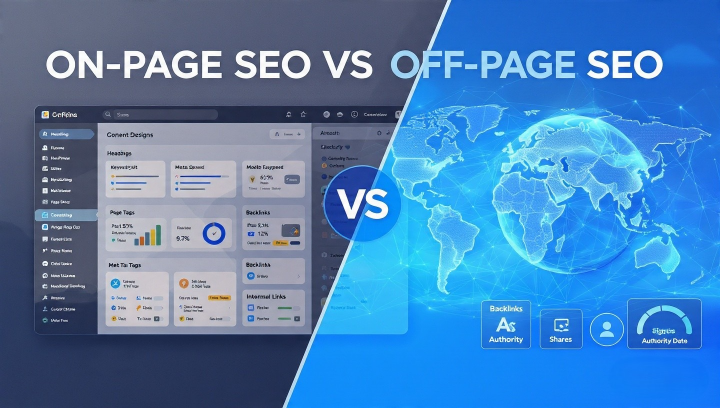
Two of the most important parts of SEO are On-Page SEO and Off-Page SEO.
While On-Page SEO focuses on improving elements within your website, Off-Page SEO focuses on building your website’s authority and reputation across the internet.
Understanding the difference between helps your businesses create a complete search strategy that attracts qualified visitors and converts them into customers.
At Inteliware Growth, we help businesses move beyond basic rankings by combining SEO, paid advertising, conversion optimisation, and data-driven marketing strategies designed around measurable growth.
What is SEO and Why Does It Matter?
Search Engine Optimisation (SEO) is the process of improving your website so search engines like Google can better understand, trust, and rank your content.
A successful SEO strategy helps businesses:
- Increase organic website traffic
- Reach customers actively searching for services
- Generate qualified leads
- Improve brand visibility
- Reduce long-term dependency on paid ads
However, SEO is not just about getting more visitors. The goal is attracting the right visitors who are more likely to take action.
For example:
A taxi company does not simply need thousands of website visitors. It needs people searching for airport transfers, local taxi bookings, or private hire services.
A medical clinic does not need random traffic. It needs patients searching for appointments and healthcare solutions.
This is why a complete SEO approach combines technical optimisation, content strategy, authority building, and conversion-focused improvements.
On-Page vs Off-Page SEO: The Main Difference
The simplest way to understand the difference:
On-Page SEO improves your website.
Off-Page SEO improves your website’s reputation.
| Aspect | On-Page SEO | Off-Page SEO |
|---|---|---|
| Focus | Optimisation inside your website | Activities outside your website |
| Goal | Improves relevance and user experience | Builds authority and trust |
| Control | Controlled directly by your business | Requires external signals |
| Key Activities | Focuses on content, keywords, structure, and technical elements | Focuses on backlinks, mentions, reviews, and reputation |
Both strategies are important because Google evaluates not only what your website says but also how trustworthy and authoritative your website appears.
What is On-Page SEO?
On-Page SEO refers to all optimisation activities performed directly on your website to improve rankings and user experience.
It helps Google understand:
- What your website is about
- Which searches your content should appear for
- Whether your website provides valuable information
- Whether visitors can easily navigate your pages
Key Elements of On-Page SEO
-
Keyword Optimisation
Keywords are the phrases people type into Google when searching for information or services.Effective keyword optimisation means using relevant keywords naturally throughout your website.
For example:
A cleaning company targeting London customers may optimise pages around terms such as:
-
Cleaning services London
-
Office cleaning company
-
Professional cleaners near me
However, modern SEO is not about repeating keywords unnecessarily. Google focuses on understanding the meaning behind searches, so content should answer the user's actual problem.
-
High-Quality Content
Content remains one of the strongest ranking factors.A strong SEO article should:
-
Answer customer questions
-
Provide practical information
-
Demonstrate industry knowledge
-
Solve real problems For example, an immigration law firm should create content explaining visa processes, common mistakes, and legal requirements instead of publishing generic articles.
Useful content builds trust with both Google and potential customers.
-
Title Tags & Meta Descriptions
Your title tag and meta description influence how your page appears in search results.A strong title should:
- Include the main keyword
- Clearly explain the page topic
- Encourage users to click Example: Weak: SEO Services Better: Data-Driven SEO Services That Generate Qualified Leads
-
Website Structure & Internal Linking
A well-organised website helps users and search engines navigate your content.Internal links connect related pages together.
For example:
A healthcare clinic website may link:
-
SEO services page → Doctors & Clinics marketing page
-
Blog article → Contact page
-
Case studies → Service pages
Internal linking improves user experience and helps search engines understand your website structure. Explore [our services](https://inteliwaregrowth.com/services): -
Conversion Rate Optimisation
-
Lead Generation
-
Technical SEO
Technical SEO ensures your website performs properly.Important factors include:
- Fast loading speed
- Mobile responsiveness
- Secure HTTPS connection
- Proper URL structure
- Search engine crawling
- Image optimisation A slow website can negatively affect rankings and reduce conversions.
What is Off-Page SEO?
Off-Page SEO includes activities performed outside your website to improve your authority and credibility.
Google considers external signals because they show whether other websites and users trust your brand.
Key Elements of Off-Page SEO
-
Backlink Building
Backlinks are links from other websites pointing to your website.A backlink works like a recommendation.
For example:
If respected industry websites link to your marketing agency, Google sees your website as more trustworthy.
However, quality matters more than quantity.
A few relevant, authoritative links are more valuable than hundreds of low-quality links.
-
Online Reputation Management
Customer reviews and online mentions influence trust.For local businesses, reviews are especially important.
Examples:
-
Taxi Companies receiving positive customer feedback
-
Clinics building patient trust through reviews
-
cleaning companies showcasing reliability
A strong reputation improves customer confidence and supports local SEO performance.
-
Local SEO Signals
For businesses serving specific locations, local SEO is essential.Important factors include:
-
Google Business Profile optimisation
-
Local citations
-
Customer reviews
-
Location-based content
For example, a London clinic needs visibility when someone searches:

“private doctor near me”

or

“London healthcare clinic.”
- Social Media Visibility
Social media activity does not directly replace SEO, but it can increase:
-
Brand awareness
-
Website visits
-
Content visibility
-
Customer engagement
Sharing valuable content across platforms helps businesses build stronger digital presence.
Which is More Important?
Both are equally important.
On-Page SEO creates the foundation.
Without proper website optimisation, Google may struggle to understand your business.
Off-Page SEO builds authority.
Without external trust signals, competing websites may outrank you even with good content.
Think of it this way:
On-Page SEO tells Google what your business offers.
Off-Page SEO proves that your business is trustworthy.
A successful SEO strategy requires both working together.
How businesses can combine on-page and off-page SEO for better results
A strong SEO campaign follows a structured approach.
At Inteliware Growth, our growth framework focuses on:
- Audit We analyse:
- Website performance
- Competitor strategies
- Search intent
- Existing SEO issues
- Conversion opportunities
- Strategy We create a customised roadmap based on:
- Business goals
- Target audience
- Keywords
- Industry competition
- Growth opportunities
- Execution We implement:
- SEO improvements
- Landing page optimisation
- Content strategies
- Advertising campaigns
- Tracking We monitor:
- Rankings
- Traffic quality
- Leads
- Conversions
- Revenue performance
- Scale
We increase investment in strategies that generate measurable results.
SEO should not only increase traffic. It should help businesses generate more enquiries, appointments, customers, and revenue.
Which one should your business start with?
If your website has technical issues, poor content, or unclear messaging, start with On-Page SEO.
If your website is already optimised but struggles to compete, focus on Off-Page SEO.
For most businesses, the best approach is a combination:
- Fix website foundations
- Create valuable content
- Improve user experience
- Build authority
- Track conversions
This creates sustainable growth rather than short-term ranking improvements.
Industry-Specific SEO Strategies
Different industries require different SEO approaches.
At Inteliware Growth, we create tailored strategies for:
- Taxi Companies — Helping taxi and private hire businesses capture local search demand and increase booking enquiries.
- Immigration Lawyers — Building compliant marketing strategies focused on attracting high-intent clients.
- App Startups — Improving visibility and user acquisition through SEO, paid campaigns, and conversion optimisation.
- Cleaning Companies — Generating consistent enquiries through local search and lead-focused strategies.
- Doctors & Clinics — Helping healthcare providers improve online visibility and increase appointment bookings.
Frequently Asked Questions
What is the difference between On-Page and Off-Page SEO?
On-Page SEO focuses on improving elements inside your website, such as content, keywords, structure, and technical performance. Off-Page SEO focuses on external factors like backlinks, reviews, and online reputation.
Is On-Page SEO enough to rank on Google?
On-Page SEO creates a strong foundation, but competitive industries usually require Off-Page SEO strategies to build authority and improve rankings.
How long does SEO take to show results?
SEO results depend on competition, website condition, industry, and strategy. Many businesses begin seeing improvements within several months, but sustainable growth requires ongoing optimisation.
Are backlinks still important for SEO?
Yes. High-quality backlinks remain an important ranking signal because they help demonstrate website authority and trust.
Can SEO generate leads for my business? Yes. When SEO targets the right search intent, it can attract users actively looking for your products or services and convert them into enquiries or customers.
Final thoughts
The debate between On-Page vs Off-Page SEO is not about choosing one over the other.
Successful SEO requires both.
On-Page SEO ensures your website provides valuable, relevant information.
Off-Page SEO builds the trust and authority needed to compete in search results.
For businesses that want sustainable online growth, SEO should be combined with conversion-focused marketing strategies, accurate tracking, and continuous optimisation.
At Inteliware Growth, we help businesses turn digital visibility into measurable growth through data-driven SEO, advertising, and conversion strategies.
Ready to Grow Your Business Online?
On-Page and Off-Page SEO work best when combined with conversion optimisation and data-driven strategies.
At Inteliware Growth, we help businesses turn search visibility into measurable revenue.
Contact Us
📞 Phone: +92 344 3503901
📧 Email: sales@inteliwaregrowth.com
📍 Location: London, United Kingdom