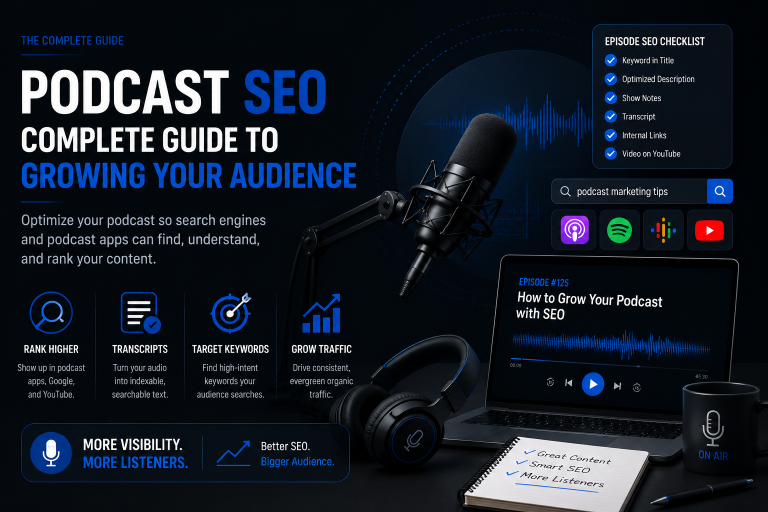
Podcast SEO means optimizing your show so search engines and app directories can read your audio content. Because platforms cannot listen to audio files, success relies on text metadata like clear titles, rich descriptions, transcripts, and a dedicated website.
If you’re pouring hours into recording, editing, and promoting your podcast yet still struggle to get discovered, the missing piece is discoverability. Audio is invisible to search engines unless you translate it into words. Podcast SEO bridges that gap, turning your spoken episodes into content that Google, Apple Podcasts, and Spotify can index and rank. Over time, well-optimized episodes attract evergreen organic traffic while supporting your wider content ecosystem.
At Inteliware Growth, we use the same [performance marketing services](https://inteliwaregrowth.com/services/) that scale taxi fleets, immigration law firms, and clinics to make your podcast a measurable acquisition channel. This guide breaks down every layer of podcast SEO so you can apply it yourself.
Why podcast SEO matters
More than 4 million shows are fighting for attention. Platforms rely almost entirely on text signals to rank and recommend, so if you aren’t feeding them structured, keyword-rich data, you’re invisible.
Good podcast SEO puts you in front of three distinct audiences: searchers inside podcast apps, searchers on Google, and browsers on YouTube. Each requires a slightly different playbook, but they all start with the same raw material — your words. One well-optimised episode can bring listeners for years, making it a true compounding asset.
In-app optimisation
Podcast directories are search engines in their own right. Apple Podcasts and Spotify rank shows and episodes based on the text you supply. Here’s how to maximise your visibility inside those walled gardens.
Put keywords first in titles
Put searchable keywords at the front of your title and make the topic obvious. For example, “Vegan meal prep: 7 beginner recipes” works far better than “My food experiment #3.” Both Apple and Spotify weigh the first words heavily, and a clear title that mirrors what people actually type wins every time.
Include guest names only when they carry search value. If you interview a well-known solicitor, place their name and “UK visa advice” right at the start. This simple shift has helped our legal-sector clients more than double episode downloads in weeks.
Optimise author metadata
Don’t just enter your name in the author or host field. Stuff it with your niche, expertise, or show-level keywords. Write “Taxi & private hire industry expert | London PHV compliance & business growth” rather than “John Smith.” Apple Podcasts uses this field for classification and it can influence whether you appear in category charts or personalized recommendations.
Treat the author field as a miniature billboard. Every character should reinforce why someone should trust your content.
Front-load descriptions
Directory apps cut off descriptions after the first couple of lines on mobile, so make those words count. Start with a one-sentence summary that includes your primary keyword, then tease the episode’s most valuable insight. Avoid leading with guest bios or sponsor messages — save those for later when they won’t cost you a listener.
Website & Google SEO for podcasts
Optimising inside apps is only half the battle. The real SEO goldmine lives on your own domain, where you control every word Google indexes.
Dedicated episode landing pages
Give every episode its own web page containing an embedded player, show notes, and a full text transcript. Each page targets a specific long-tail keyword tied to the episode topic. When someone searches “how to prepare for a UK spouse visa interview,” your immigration-focused podcast page can answer that query directly, pulling in potential clients.
We build these pages with clear H1 titles, semantic headings, and internal links to related episodes or service pages. A structured episode library signals topic authority and keeps visitors on your site longer.
Use transcripts for indexable text
A full transcript transforms every spoken word into content Google can crawl. Instead of a few hundred words of show notes, you’re suddenly giving search engines thousands of indexable words per episode, capturing long-tail queries you never specifically targeted.
Transcripts also improve accessibility and dwell time, both positive ranking signals. Embed a cleaned-up auto-transcript below your player or use a time-synced interactive version. Either will massively outperform a page without one.
Cross-publish on YouTube
YouTube is the world’s second-largest search engine. Upload each episode as a video, even a static image with an audio waveform, and optimise the title, description, and tags exactly as you would for a podcast. Use YouTube’s keyword research tools to find video-specific queries around your topic. A cleaning business podcast, for instance, might target “how to price domestic cleaning services” and capture an audience the audio version alone would miss.
Podcast keyword research
Keyword research for podcasts must span multiple platforms: Google, Apple, Spotify, and YouTube. Start with Google’s autocomplete and “People also ask” boxes, then plug those phrases into Spotify and Apple Podcasts to see how the results differ.
Use a tool like Chartable to analyze competitor rankings inside Apple Podcasts and Spotify. Finally, run your list through a traditional SEO tool to gauge search volume and difficulty. Map each episode to one primary keyword and three secondary keywords — this becomes your content brief for titles, descriptions, transcripts, and show notes.
Leveraging show notes for on-page SEO
Great show notes include a clickable table of contents with timestamps, key takeaways, and links to resources mentioned. This structure provides rich anchor points for Google’s featured snippets; we regularly see paragraphs from well-crafted show notes pulled directly into “People also ask” boxes.
Always link internally to related episodes to build topic clusters. Google rewards tightly interlinked content with higher rankings for your pillar pages — the main category pages of your podcast site.
Link building for podcast websites
Backlinks are still a core ranking factor. Guest appearances are your most natural link-building tactic. When you appear on another show, ask for a dedicated episode page that links back to your show’s homepage. Create a “media” or “appearances” page on your own site that links out to those guest spots; this often prompts further collaboration.
Syndicate transcripts on Medium with a canonical link back to your original page. If your podcast serves a local market, a London cleaning company, for example, earn links from local business directories, community blogs, and industry associations. Those geo-specific backlinks amplify local SEO, which feeds directly into lead generation.
Promote with paid ads
Organic SEO builds long-term momentum, but paid ads can accelerate your reach. A well-targeted Google Ads campaign places your episode page at the top of search results for high-intent queries while you wait for organic rankings. A doctor’s clinic running a podcast on men’s health could bid on “men’s health checkup London” and direct traffic to both the episode and a booking page.
Paid social campaigns on Meta build lookalike audiences from your current listeners, and careful conversion rate optimisation ensures each click turns into a subscriber or a lead. At Inteliware Growth, we integrate real-time dashboards so you see exactly how every pound of ad spend converts, whether you’re after app installs, consultation bookings, or ride requests.
Measuring podcast SEO success
Track the metrics that match your business model. For brand awareness, monitor impressions and click-through rates inside Apple Podcasts Connect and Spotify for Podcasters. Podchaser provides valuable historical ranking data so you can track directory visibility over time. For website traffic, use Google Search Console to watch clicks and average position for episode-specific queries. For lead generation, set up event tracking in Google Analytics for key actions like “Book Consultation” from episode pages, and use UTM parameters to attribute YouTube-driven conversions.
We build custom dashboards that pull all these sources into one view, so you instantly know whether your content engine is performing.
Common podcast SEO mistakes
Even experienced podcasters slip up. Editing auto-generated episode titles before publishing to include target keywords is the simplest fix. Ignoring image alt text for episode artwork on your website wastes an easy ranking opportunity; describe the cover using your primary keyword. Embedding the audio player above the fold is critical — Google interprets quick bounces as a low-quality signal. Finally, failing to add PodcastEpisode structured data to your site means you miss the chance to show playable episode cards directly in search results, a major visibility win.
How Inteliware Growth helps podcasters scale
We apply the same 5-step process that scales service businesses: Audit your current podcast presence and competitor landscape; build a custom Strategy with a keyword-driven content calendar; Execute optimised titles, transcripts, landing pages, and paid ads in sync; Track everything with advanced attribution and real-time dashboards; and Scale budgets and content production based purely on what the data proves is working.
Whether you need to fill appointment slots, generate cleaning jobs, or acquire app users, our integrated organic and paid approach turns your podcast into a measurable growth channel. See how we have delivered millions in revenue for niche service businesses across the UK.
Frequently Asked Questions
Can a podcast rank on Google without a website?
Yes, but only inside podcast directories. A website gives you control over metadata, backlinks, and indexing, dramatically improving long-tail ranking potential.
How long does podcast SEO take to show results?
Low-competition keywords can improve within weeks, but competitive terms usually need 3–6 months. Consistent, transcript-rich pages speed up the timeline.
Do I need to transcribe every episode myself?
Automated tools can generate a first draft, but always review and correct them. Accuracy matters for both user experience and Google’s evaluation.
Will YouTube help my podcast SEO?
Absolutely. YouTube often outranks traditional web results for how-to queries, and a well-optimised video with a link to your site creates a powerful cross-channel signal.
Make your podcast a client engine
Podcast SEO isn’t a one-off setup; it’s an asset that grows with every episode. Each optimised show adds another indexed page, another keyword cluster, and another entry point for your ideal listener and future client.
At Inteliware Growth, we combine technical SEO, paid advertising, and conversion-rate optimisation into a single framework that has already scaled businesses across sectors. Explore our blog for deeper marketing insights.
Contact Us
📞 +92 344 3503901
📧 sales@inteliwaregrowth.com
📍 London, United Kingdom