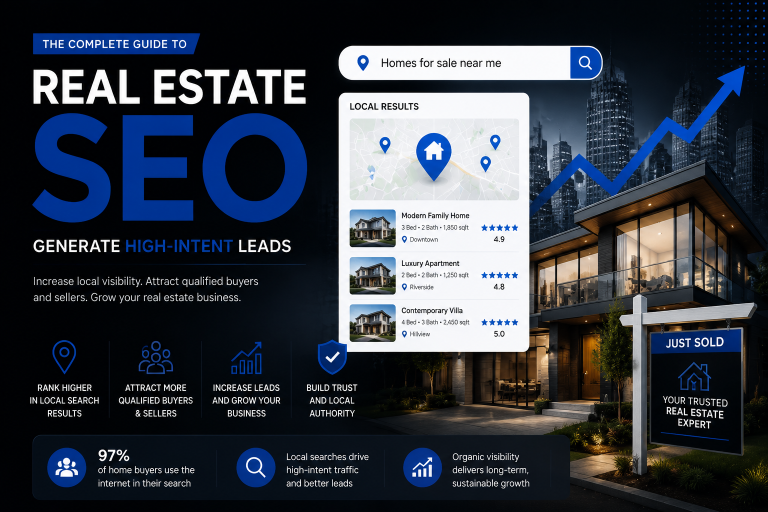
Real estate SEO (Search Engine Optimization) drives inbound leads by optimizing your website and online profiles to rank higher in local search results. With 97% of home buyers using the internet during their search, local visibility isn’t optional. It’s the primary pipeline for modern agents. If you’re invisible when someone searches “homes for sale near me,” you’re handing ready-to-transact prospects directly to competitors.
What is real estate SEO?
Real estate SEO is the practice of refining your online presence to appear prominently for property-related searches, especially locally. It blends on-page optimization, technical health, content strategy, and a strong focus on local signals: Google Business Profile, reviews, NAP consistency, and neighbourhood-specific keywords. It also tackles unique assets like IDX listings and property schema, giving search engines clear signals about who you serve and where.
Why real estate SEO matters now
Buyers and sellers start with search. They type “[neighbourhood] homes for sale” or “[city] first-time buyer tips” and trust the results on page one. Relying solely on referrals or paid ads leaves a massive segment of high-intent traffic untouched. SEO builds a long-term asset: an optimized blog post or area guide can generate free, qualified leads for years. It also signals authority, ranking organically tells prospects you’re the local expert. In competitive markets, the agents who invest early in organic visibility build a moat that paid campaigns alone can’t replicate.
Optimize local maps
Claim and optimize your Google Business Profile with exact contact info, service areas, and a steady stream of reviews. Your GBP directly determines whether you appear in the local map pack, those top three spots that sit above organic results.
- Use your precise business name, address, and phone number exactly as they appear on your website.
- Set “Real Estate Agent” as the primary category; add relevant secondary categories.
- Define service areas by naming specific neighbourhoods, cities, or postcodes.
- Upload high-quality, geotagged photos of your team, office, and recent sales.
- Publish Google Posts weekly with market updates, just-sold announcements, or open house invitations.
- Actively request reviews after every transaction and respond to every single one.
A fully optimized, review-rich profile is often the first touchpoint, and the deciding factor, for a motivated seller or buyer. Treat your GBP like a social channel: answer questions before clients ask, enable messaging, and add a detailed services menu. Every interaction signals freshness to Google. When you respond to reviews, naturally include location or service keywords to reinforce local relevance.
Niche down keywords
Competing for “[Your City] Real Estate” against giants like Zillow is nearly impossible. Target hyper-local and long-tail keywords (e.g., “[Neighbourhood] homes for sale” or “[City] living guide”). Your opportunity lies in the searches portals can’t serve deeply: neighbourhood-level, intent-rich phrases.
Go after terms like “[School district] property values,” “sell my house fast [Postcode],” or “first-time buyer mortgage tips [City].” Map each keyword cluster to a dedicated, comprehensive page. Over time, you build a library of hyper-relevant content that attracts long-tail traffic and establishes you as the neighbourhood authority. Interlink these pages to form topic clusters, connecting a pillar guide to supporting posts about schools, amenities, and recent sales.
To find these terms, use Google’s autocomplete and “People also ask” boxes. Study competitor rankings to spot gaps. Sort keywords by intent: informational, commercial, and transactional. A single neighbourhood guide can rank for dozens of long-tail queries if you structure it with clear, search-friendly headings and cover everything from property types to commute times.
Use schema markup
Implement specialized Real Estate Agent and Real Estate Listing schema codes on your pages to help search engines easily read your property data. Structured data translates your content into a language search engines instantly understand, often earning rich results like star ratings, price, and images in the SERPs.
Add Real Estate Agent schema on agent bio pages, Real Estate Listing on each property page, and Local Business schema on the homepage. Use JSON-LD format and test everything with Google’s Rich Results Test. Schema can also power the property carousel and boost visibility in AI Overviews. Include details like price, bedrooms, bathrooms, and photos on listing pages, and use review schema to display star ratings in search results, making your link stand out.
Boost site speed and mobile
Compress heavy property images and ensure flawless mobile functionality, as most house hunters browse on their phones. A slow, clunky mobile experience kills conversions and harms rankings.
Compress listing photos using WebP and lazy loading. Minify CSS and JavaScript, leverage browser caching, and use a CDN. Aim for a mobile score above 90 on Google PageSpeed Insights. Optimize Core Web Vitals, LCP, FID, and CLS, to keep visitors engaged and bounce rates low. Audit your listing pages specifically. Use modern image formats and set explicit dimensions to prevent layout shifts. A one-second delay can drop conversions significantly, so speed is a direct revenue lever.
Create hyper-local content that answers real questions
Content for real estate isn’t generic top 10 tips. It’s ultra-local resources matched to the decision journey. Produce neighbourhood guides with commute times, school ratings, and video walkthroughs. Publish monthly market reports by postcode. Create relocation guides, home-selling case studies, and checklists like “First home buyer inspection checklist [City].” Each piece targets a low-competition keyword cluster and links naturally to your listings, valuation tools, or contact page.
Add seasonal content like summer moving guides or winter selling checklists. Embed local data, median prices, days on market, and original photography of neighbourhood landmarks. Search engines favour content that demonstrates real-world, local experience. Unique images and genuinely helpful answers earn stronger rankings and higher engagement.
Earn local backlinks from trusted sources
Backlinks remain a top-ranking factor. Local links from relevant, authoritative sites signal community trust. Partner with mortgage brokers, home inspectors, and removal companies for cross-linking. Contribute expert commentary to local news outlets on housing trends. Sponsor community events and get listed on partner pages. Join the local Chamber of Commerce for a high-quality backlink. A few .gov, .edu, or trusted local business links will outperform dozens of low-quality directory entries.
Create linkable assets like original market reports or interactive maps that local bloggers want to reference. Write a guest column for the local newspaper’s real estate section. When you close a sale in a new development, pitch a story to a hyper-local blog about buyer trends in that area. These hard-to-replicate links send powerful local relevance signals.
Conquer technical SEO for IDX listings
If your site displays listings via an IDX feed, duplicate content can prevent ranking. Differentiate by adding unique agent commentary to each listing page, using canonical tags that point to your URL, and blocking indexing of thin IDX frames. Embed FAQ sections (e.g., “What are the nearby schools?”) on listing pages to add original value. Internal links between listings and neighbourhood guides further strengthen the topical cluster. Ensure your IDX setup uses clean, crawlable URLs and apply “noindex” to filtered views that offer no unique value.
Build a review generation engine
Reviews feed your Google Business Profile prominence, click-through rate, and overall trust. Automate post-transaction review requests via email and SMS with a direct Google review link. Respond to all reviews, thank clients for praise and resolve complaints empathetically. A steady stream of fresh reviews is a competitive moat in local real estate SEO.
Embed a reviews widget on your site to display recent Google reviews and keep content fresh. Send a quick follow-up to clients who haven’t left a review, always making it easy with a pre-populated link and optional template. Each new review is fresh local content that Google indexes, keeping your profile active and climbing.
How Inteliware Growth turns real estate SEO into revenue
Inteliware Growth built on data-driven frameworks, we don’t chase vanity metrics. Our process connects SEO rankings directly to measurable leads and sales. We audit your market and technical health, then build a custom roadmap blending organic SEO, paid advertising, and conversion rate optimisation. Every headline, landing page tweak, and button colour is tracked and refined.
Our five-step roadmap ensures sustainable growth:
- Audit: competitor and audience intent analysis.
- Strategy: keyword mapping, content blueprint, and channel forecasting.
- Execution: technical fixes, on-page optimisation, and content deployment.
- Tracking: real-time dashboards with full attribution.
- Scale: doubling down on winning keywords and pruning underperformers.
This same playbook powers growth for taxi companies dominating local ride searches, doctors and clinics scaling patient appointments, and Immigration lawyers generating compliant leads. Our case studies show exactly how these frameworks translate into leads for high-intent service niches.
Own your local market today.
Contact Us
📞 +92 344 3503901
📧 sales@inteliwaregrowth.com
📍 London, United Kingdom
Frequently Asked Questions about real estate SEO
What is real estate SEO?
It’s the process of optimizing your website and online profiles to rank higher for property searches, with a strong local focus, covering Google Business Profile, local keywords, schema, and content.
How long until I see results?
Noticeable improvements often appear in 3 to 6 months, with significant lead growth in 6 to 12 months. Consistent content and technical health accelerate the timeline.
Can I compete with Zillow and Rightmove?
You won’t outrank them for broad terms, but you can dominate hyper-local, long-tail searches where portals have thin content. That’s where high-intent leads live.
Does schema really help?
Yes. It enables rich results that boost click-through rates and can feed Google’s property carousel and AI Overviews, giving you an edge over competitors without structured data.