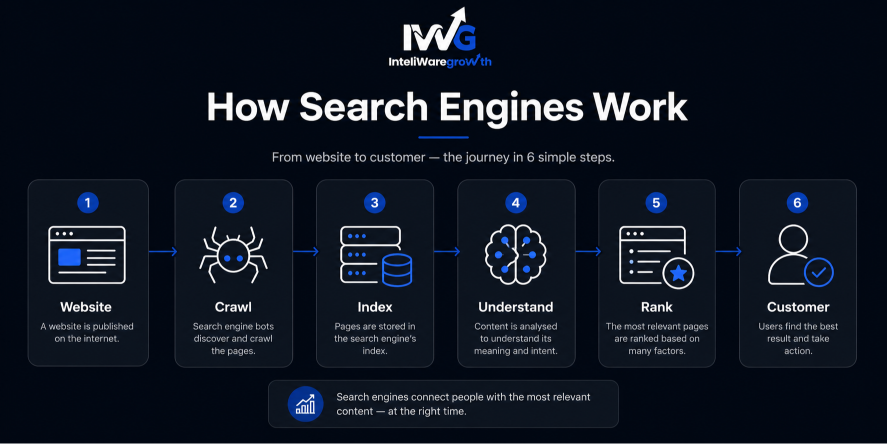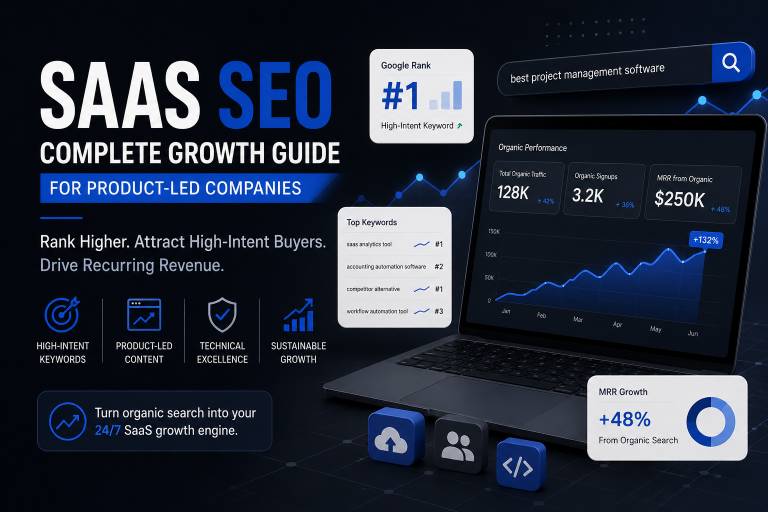
SaaS SEO is the process of optimizing a software-as-a-service website to rank higher in search engines, focusing on high-intent buyer keywords, product-led content, and driving recurring revenue. Unlike traditional SEO, it’s not just about traffic. It’s about attracting users who are ready to solve a problem with software and converting them into loyal subscribers.
For app startups and established SaaS companies alike, organic search is the most predictable growth lever. When a decision-maker searches for “[competitor] alternative” or “best tool for automated accounting,” they are signalling purchase intent. Showing up at that exact moment turns your website into a 24/7 sales engine.
At Inteliware Growth, we’ve seen how combining precise SEO foundations with performance advertising can slash customer acquisition costs. This guide breaks down the entire SaaS SEO playbook, from the core pillars that drive rankings to the execution tactics that build authority, all structured to help you capture the high-intent buyers already looking for your solution.
Why SaaS SEO demands a different playbook
SaaS companies operate on a recurring revenue model. Every new customer has an immediate value and a long-term lifetime value. The SEO strategy must align with the full customer journey.
- Longer sales cycles: B2B SaaS products involve multiple decision-makers. Your content must nurture, not just convert.
- Product-led growth: Free tools, templates, and integrations attract users who later upgrade.
- High-intent niches: A well-chosen group of bottom-of-funnel keywords generates more qualified leads than thousands of top-of-funnel blog visits.
By treating organic search as a customer acquisition channel rather than a vanity traffic source, you build a sustainable growth engine that feeds directly into your MRR.
Core pillars of SaaS SEO
Every successful SaaS SEO strategy stands on three non-negotiable pillars. These are the structural elements that let search engines trust your site and users find the solution they need.
Bottom-of-funnel (BoFu) pages
The fastest path to revenue sits at the bottom of the funnel. You target competitor alternatives and pricing keywords, where users are ready to buy. Pages like “[Competitor] alternatives,” “best [category] software,” and “[your product] pricing” capture searchers with a credit card in hand. These pages must clearly differentiate your value proposition and provide a frictionless path to sign-up or book a demo.
One BoFu page that converts at 3% can outperform fifty generic blog posts that convert at 0.1%. Write a detailed alternative page for each major competitor, highlighting your unique strengths without disparaging the competitor. Transparent pricing pages with FAQs also win featured snippets and build buyer confidence instantly.
Product-led content
Product-led content lets the user experience your software’s value before they ever sign up. Create templates, integration guides, and use-case pages that naturally position your software as the solution. When a visitor uses your free ROI calculator or integration roadmap, they are already inside your ecosystem.
This type of content attracts links, gets shared, and ranks for long-tail problem-aware keywords. Embed your product in the answer. If you offer a project management SaaS, publish a “Sprint Planning Template” that uses your tool’s terminology and includes a one-click import link. The content is genuinely useful, and the path to paid conversion is organic.
Technical health
No amount of brilliant content will rank if the site is slow, mobile-unfriendly, or poorly indexed. Ensure fast load times, clean mobile responsiveness, and proper indexation while keeping your app dashboard hidden from search crawlers. SaaS platforms often load heavy JavaScript, which can block crawlers if not handled correctly. Implement server-side rendering or dynamic rendering for critical public pages.
Pay special attention to Core Web Vitals. A delay of one second in mobile load time can reduce conversions by up to 20%. Regularly audit your robots.txt file so search engines don’t waste crawl budget on in-app URLs. Technical hygiene is invisible when done right, but fatal when ignored.
Execution and growth
With the pillars in place, growth becomes a matter of disciplined iteration. The following two tactics consistently produce the highest return for the time invested.
Low-hanging fruit optimization
Before you create anything new, update existing pages already ranking on page one or two to capture quick wins. A page ranking on the second page for a high-volume term only needs a few improvements to break into the top ten. Refresh the introduction to match current search intent, add a relevant statistic from this year, and include a practical example.
Often, simply adding a comparison table or an FAQ section pushes the page over the ranking threshold. Use Google Search Console to find queries with high impressions but unusually low CTR (for example, under ~2–3% on strong-ranking pages). Improve the title tag and meta description to better match the query, and watch your organic traffic climb without a single new backlink.
Authority building
Search algorithms and AI engines reward brands they trust. Earn high-quality backlinks and digital PR mentions to build trust with search algorithms and AI engines. For SaaS companies, the most natural link magnets are original data studies, free interactive tools, and definitive guides that become industry references.
A single study on “State of Remote Work in Accounting Firms” can attract dozens of links from accounting media outlets. Collaborate with complementary software tools on co-branded integration guides, which earn links from both partner blog. When AI overviews pull information for commercial queries, they heavily favour websites with strong link profiles and brand mentions across the web.
How SaaS SEO integrates with paid advertising
SEO builds the long-term asset; paid ads provide the immediate data. The two channels feed each other in a virtuous cycle that mature SaaS companies rely on.
- Keyword intelligence: Use Google Ads search term data to identify high-converting keywords that you can later target organically with dedicated landing pages.
- Retargeting pools: Organic visitors who didn’t convert become a highly qualified audience for retargeting campaigns on Meta and Google.
- Conversion rate synergy: The messaging that wins in paid search can be tested on BoFu SEO pages and vice versa, lifting overall conversion rates.
At Inteliware Growth, we help app startups and SaaS founders combine paid customer acquisition with a solid organic foundation. Our [performance marketing services](https://inteliwaregrowth.com/services/) ensure you capture demand today with precision ads, while building the ranking authority that brings free, high-intent traffic tomorrow. This dual approach consistently drives down blended CAC and accelerates the path to profitability.
Measuring SaaS SEO success beyond rankings
Traffic and rankings are vanity metrics. True SaaS SEO success is measured in revenue impact. Connect your analytics and CRM to track the complete journey.
- Product sign-ups by landing page: Identify which organic pages produce trial starts or demo requests.
- Lead-to-customer rate by channel: Organic leads often convert at a higher rate than paid social, so segment your data.
- Assisted conversions: SEO content frequently introduces a brand that converts later via branded search. Use a multi-touch attribution model.
- MRR from organic: The ultimate metric. Tag new customers by original source and calculate monthly recurring revenue from organic search.
Real-time reporting, something we embed in all our client frameworks at Inteliware Growth, ensures no marketing dollar goes unmeasured and gives your leadership team a clear picture of the SEO investment. Explore our Case studies to see these metrics in action.
Why SaaS companies in niche verticals have an edge
If your SaaS serves a specific vertical—like immigration law firms, cleaning companies, or private hire taxi businesses—your SEO advantage multiplies. Generalist keyword competition is fierce. Niche-specific content faces far fewer established competitors.
For example, a SaaS providing booking software for taxi companies can create content like “How to Reduce No-Show Rides with Automated Dispatching.” These articles rank easily and attract exactly the right operator. The same applies to software built for doctors’ patient booking or cleaning crew scheduling. When your SEO strategy speaks the language of a specific industry, every visit is pre-qualified.
Inteliware Growth has built dedicated growth frameworks for these exact industries. By understanding the pain points of taxi companies, Immigration lawyers, and app-based startups, we craft content and paid campaigns that resonate deeply and convert at a much higher rate. If your SaaS product fits one of these verticals, doubling down on niche SEO is the single highest-impact move you can make.
The SaaS SEO execution roadmap
Implement these steps in order to turn strategy into results.
- Audit your current position: Pull a full export of your organic keywords. Identify pages ranking on pages 2-3 and those with no impressions. This is your low-hanging fruit list.
- Build BoFu landing pages: For each primary competitor, create an alternative page. List features, pricing, and genuine differentiators. Add social proof and a clear CTA.
- Develop three product-led assets: Choose a free template, an integration guide, and a use-case walkthrough that embeds your software.
- Fix critical technical issues: Run a site audit with Screaming Frog or Sitebulb. Prioritise mobile speed, index bloat, and missing schema markup.
- Start a data-driven link campaign: Publish one original data study within six weeks. Outline the methodology, collect anonymised platform data, and create a report journalists will want to cite.
- Connect SEO and paid channels: Feed organic conversion data into your paid campaign audiences. Use retargeting to bring blog readers back with a demo offer.
- Implement a real-time dashboard: Track sessions, conversions, and attributed MRR in one view. Review the numbers weekly with your growth team.
If this feels overwhelming while running a software company, you’re not alone. Get in touch with our team. We frequently build and run this full loop for SaaS companies targeting high-intent service niches.
Common SaaS SEO mistakes that destroy ROI
Even well-funded startups slip on these preventable errors.
- Creating generic blog content: A post titled “10 Benefits of Cloud Software” attracts bots, not decision-makers. Every piece must serve a specific buyer at a specific funnel stage.
- Ignoring search intent mismatch: Trying to rank a product page for “what is EOR” wastes resources. They want an explanation, not a pricing table.
- Letting app pages get indexed: Every indexed /app/dashboard URL dilutes your site’s quality signals. Block them aggressively.
- Chasing volume over intent: A keyword with 10,000 monthly searches but zero commercial intent will never pay back the SEO investment. Obsess over high-intent, lower-volume terms first.
- Neglecting page experience: A slow page that loads a full React app just to display a blog post will repel both users and Google. Keep your marketing site lean.
Conclusion
SaaS SEO is the most sustainable growth investment a software company can make. By building a foundation of high-intent BoFu pages, product-led content, and flawless technical health, you turn your website into a predictable revenue engine. Pair that with disciplined execution, refreshing near-top rankings and earning real authority, and you’ll own the search results that matter most.
The best-performing SaaS brands treat organic search not as a separate channel but as the central pillar of a unified growth strategy that includes paid advertising, conversion optimization, and real-time analytics. When all elements work together, the cost to acquire a customer drops and the lifetime value rises.
If you’re ready to apply this framework to your software business, we’re here to help. From auditing your current setup to launching full-scale performance campaigns, our team builds growth machines for app startups and service-specific SaaS companies.
Contact Us
📞 +92 344 3503901
📧 sales@inteliwaregrowth.com
📍 London, United Kingdom
Book Your Free Consultation
FAQ
What is SaaS SEO?
SaaS SEO optimizes a software website to attract users, drive sign-ups, and grow recurring revenue through intent-based keywords and product-led content.
How is SaaS SEO different from regular SEO?
It prioritizes bottom-of-funnel commercial terms like alternatives and pricing, aiming for product adoption, not just traffic, while carefully managing web app indexation.
How long does SaaS SEO take to show results?
Quick wins from page optimizations can appear in 2-4 months; competitive product terms usually need 6-12 months to build authority and rank.
Should a SaaS company invest in both SEO and paid ads?
Yes. Paid ads deliver instant data and customers, while SEO builds a long-term organic asset that lowers your overall customer acquisition cost.
What are the most important metrics for SaaS SEO?
Track product sign-ups or demo requests from organic pages, lead-to-customer conversion rates, and attributed monthly recurring revenue (MRR).
How do I protect my app dashboard from being indexed?
Disallow the /app/ path in robots.txt and add noindex meta tags on dashboard pages, then monitor Google Search Console for any leaks.
Can small SaaS companies compete with enterprise brands in SEO?
Yes, by dominating niche verticals and long-tail use-case keywords where deep relevance beats big budgets.