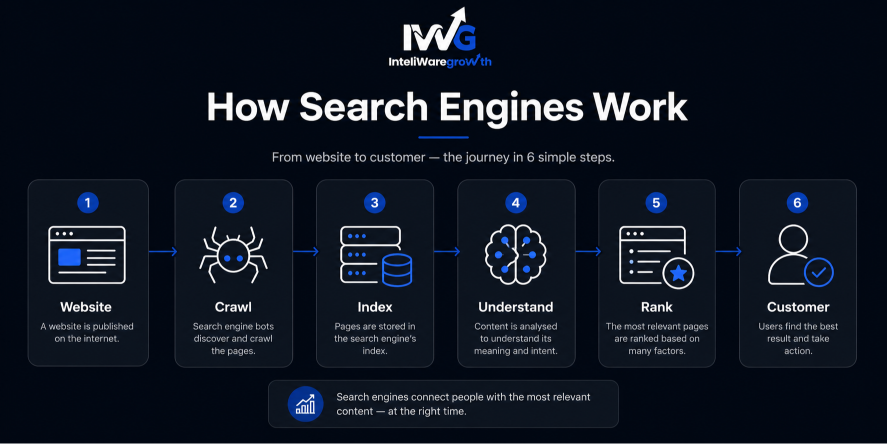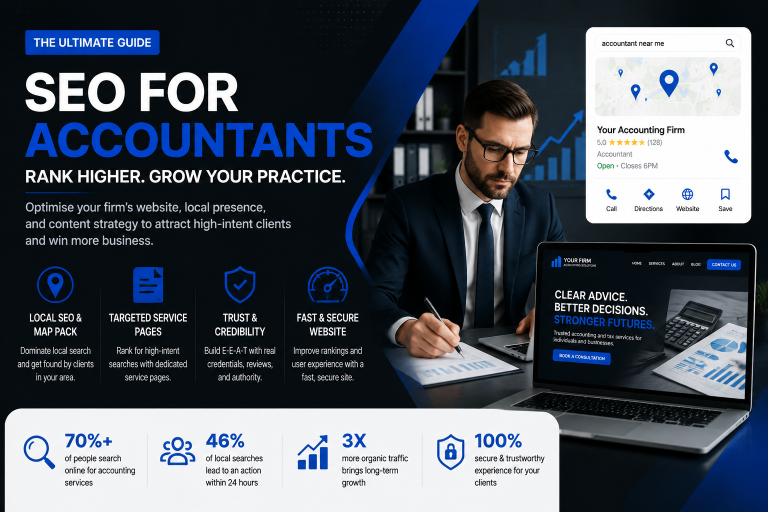
SEO for accountants is the practice of optimizing your firm's website and online profiles so local clients and businesses find your services on search engines. Success relies on local map visibility, service page optimization, and building firm trust. But in a market where every other firm promises expert tax advice, how do you ensure yours is the one they click? This guide breaks down exactly what you need to do, step by step, without the fluff.
Accountants face the same core challenge we’ve seen while building growth frameworks for taxi companies turning high-intent local searches into paying clients. The rules, however, are stricter because you operate in Google’s Your Money or Your Life (YMYL) space. Let’s fix that.
Why SEO matters for accountants
Every month, thousands of people in your city search for tax preparer near me, small business accountant, or help with IRS audit. If your website doesn’t appear in those results, you’re handing revenue to your competitors. Unlike paid ads, SEO compounds over time. A well-optimized service page can bring qualified leads for years without an ongoing click cost.
But generic SEO advice doesn’t work here. Accounting SEO must address local pack rankings, strict trust guidelines, and the specific questions your clients type into Google at 2 a.m. in a tax panic. This guide tackles all of it.
Local SEO & Google Business Profile
Your Google Business Profile is the single most powerful tool for attracting local clients right now. It’s what places you inside the map pack – those top three listings with the big blue map pin. You can find the full setup guide in Google’s official support documentation.
Claim and verify your profile
If you haven’t done this, pause everything and go to google.com/business. Claiming your profile proves to Google that you’re the legitimate owner of the firm. Without verification, you cannot appear in local search results, period.
Nail your NAP + hours
Your firm Name, Address, and Phone number (NAP) must be identical everywhere online. Even a small variation – Street vs. St. – confuses search engines. Enter your real office address (not a P.O. box), accurate open hours, and update them before every holiday. Google loves detailed, up-to-date information and rewards it with visibility.
Collect reviews like clockwork
The map pack ranking is heavily influenced by review quantity, recency, and rating. After every successful client engagement, send a polite review link. A five-star profile with 40+ reviews will almost always outrank a three-star profile with 10. Always respond to reviews professionally – yes, even the unfair ones. It signals an active, trustworthy business.
Target city-specific search terms
Don’t just optimize for accountant. Optimize for accountant in [City] and even neighborhood-level terms. Create a short list of location modifiers – tax services in Birmingham, bookkeeper near Manchester city centre, payroll firm Leeds. These low-competition, high-intent phrases convert at an extraordinary rate.
On-page & keyword strategy
Your website must speak clearly to both Google and a stressed business owner. That starts with smart page structures and keyword use.
Build dedicated service pages
A one-page website that just says accounting will never rank. Build separate, deep pages for each core service – Tax Preparation, Bookkeeping, Payroll Management, Audit Support, and Business Advisory. Each page should focus exclusively on one service, outlining the process, who it’s for, and local relevance. This gives Google distinct topics to rank you for and gives clients a clear path to what they need.
Research the right search terms
Use tools like Google Keyword Planner or Ahrefs to find exactly what people type. You’ll discover a mix of head terms (high volume, like accountant) and long-tail questions (how to file self-assessment when self-employed). The long-tail questions are goldmines for informational traffic and often signal a client ready to hire.
Place keywords naturally
Once you’ve chosen a primary keyword for a page, use it in three critical spots – the title tag (the clickable headline in search results), the H1 header (the main heading on the page), and the first 100 words of your introduction. After that, write naturally. Google’s language models understand synonyms and topic depth far better than they did in 2016. Keyword stuffing will hurt you.
Answer financial questions to capture information seekers
A business owner searching what is the VAT threshold 2026 might not be a client today, but you’ve just earned their attention. Create blog posts, guides, and FAQ sections that answer common financial questions clearly. This builds topical authority and brings your firm into the consideration set early. Later, when they need to hire, they’ll remember you.
Trust, E-E-A-T & technical SEO
Google holds accounting websites to the highest standard because bad advice can destroy someone’s finances. You must prove Experience, Expertise, Authoritativeness, and Trustworthiness. The full framework is detailed in Google’s Search Quality Evaluator Guidelines.
Showcase real credentials and author bios
This is non-negotiable for YMYL sites. Every article and service page should clearly display the qualifications of the author or firm. Are you a Chartered Accountant? An ACCA member? Put those badges and certification logos on the site. Include a robust About Us page with genuine photos, professional biographies, and even links to professional registries. Google’s quality raters actively look for this when assessing a site’s credibility.
Secure your site with HTTPS
An active SSL certificate (that padlock icon in the browser bar) is a tiny technical detail with a massive trust impact. Sites without HTTPS are flagged as not secure by Chrome, and Google officially confirmed HTTPS as a ranking signal. If a client sees a security warning when they land on your tax preparation page, they will bounce immediately.
Improve mobile responsiveness and page speed
Over 60% of searches for local services happen on a mobile device. Your site must load quickly and look flawless on a smartphone. Use Google’s PageSpeed Insights tool to check your score. Compress large images, minimize code, and use a fast hosting provider. A two-second delay in load time can increase bounce rates by over 30%.
Submit clean XML sitemaps
A sitemap is a file that lists every important page on your website, making it ridiculously easy for Google to find and index your content. Create one and submit it through Google Search Console. This is a free, five-minute task that many firms overlook, leaving new blog posts undiscovered for months.
Content marketing for accountants
Your on-page SEO draws them in. Your content builds the relationship that closes the deal. Focus on two high-impact formats.
First, localized tax guides. Write an annual post like 2026 Tax Deadlines Every Small Business in [City] Must Know. This gets shared in local business groups and consistently earns backlinks from local news outlets and chambers of commerce.
Second, case study-style how we helped stories. Anonymize the details, but walk a reader through a specific problem – say, a startup facing an R&D tax credit claim – and how your firm saved them money. This demonstrates real-world experience in a way a generic service page never can.
Link building & local citations
Think of links from other reputable websites as votes of confidence. For a local accounting firm, quality trumps quantity every time.
Get listed in every relevant professional directory – your country’s accounting body directory, local chamber of commerce, and reputable finance platforms. These are called citations. Ensure your NAP is perfectly consistent across all of them. Then, pursue local links – sponsor a community event and get a link from their page, or partner with a business lawyer and write a joint article. These real-world connections translate directly into digital authority that Google respects.
Measuring SEO success
Don’t just stare at your page-one ranking and call it a win. Link Google Search Console to Google Analytics and track what matters.
Monitor the number of clicks your Google Business Profile receives each month. Track organic traffic specifically to service pages like /bookkeeping or /tax-preparation. Most importantly, set up conversion tracking for every phone call, contact form submission, and email inquiry. If your organic traffic doubled but your client calls stayed flat, you know the user journey needs an audit. At Inteliware Growth, we build real-time reporting dashboards so firms see exactly how each pound spent on digital strategy converts into revenue.
Common SEO mistakes accountants make
Avoiding these will put you ahead of 90% of your local competitors immediately.
- Using identical title tags on every page. Each page needs a unique, descriptive title.
- Neglecting your Google Business Profile posts. Post updates, offers, and tax tips there; it keeps your profile active.
- Having no structured data markup. LocalBusiness and Review schema help Google display rich results like star ratings directly in search listings.
- Creating thin, 300-word service pages that lack depth. If your page doesn’t fully answer a client’s question, Google will find one that does.
Partner with a data-driven agency
We get it. You became an accountant to solve complex financial problems, not to decipher Google’s core algorithm updates. But in 2026, a steady stream of organic leads is what keeps a firm thriving, not just surviving.
At Inteliware Growth, we apply the same performance-focused rigour we’ve refined with immigration law firms to accounting firms. Our five-step roadmap – from deep competitor audit to confident budget scaling – removes the guesswork. You get a comprehensive SEO and Google Ads framework designed to capture high-intent clients exactly when they’re searching for you.
We’ve also scaled cleaning companies and helped app startups acquire users profitably. The same data-driven approach now powers growth for professionals like doctors and clinics.
Don’t let another tax season pass while you rely on referrals alone. Let’s build a system that delivers predictable, high-quality client inquiries every month.
Ready to turn clicks into clients? Work with Inteliware Growth
Contact Us
📞 +92 344 3503901
📧 sales@inteliwaregrowth.com
📍 London, United Kingdom
Frequently Asked Questions
How long does SEO take to show results for an accounting firm?
Typically, local ranking improvements appear in 3–6 months; strong organic growth takes 6–12 months as Google builds trust in your site.
What is the most important ranking factor for an accountant’s website?
For local visibility, your Google Business Profile (completeness, reviews, proximity). For organic rankings, E-E-A-T content and authoritative backlinks.
Can I do my firm’s SEO myself, or should I hire an agency?
You can handle basics like GBP setup and reviews. Technical audits and strategic link building usually need expert help to avoid costly mistakes.
How do I get more Google reviews without feeling pushy?
Send a simple thank-you email with a direct review link right after service completion; most happy clients will gladly leave a review.
Is an SSL certificate really that important for an accounting website?
Yes. SSL encrypts sensitive financial data, prevents browser security warnings, and is a confirmed ranking signal for YMYL sites.