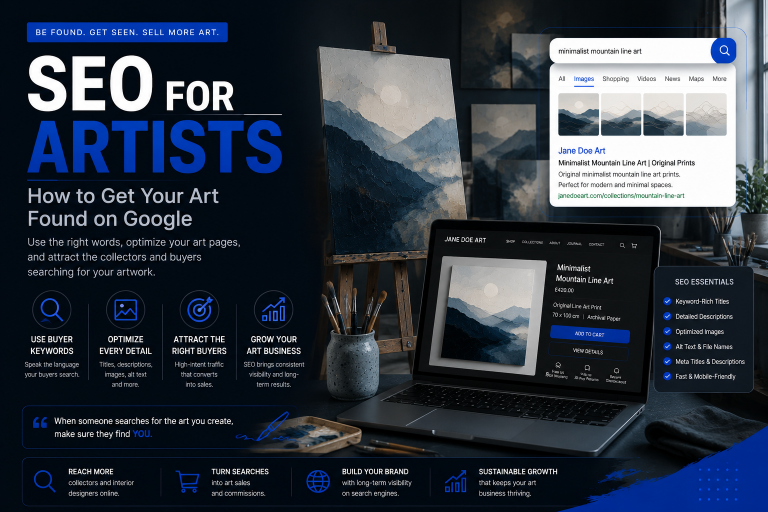
SEO for artists is the practice of describing your artwork using the plain, clear words that art buyers actually type into search engines like Google, instead of using abstract or cryptic gallery titles.
If your online portfolio calls a serene blue landscape Whisper No. 7 but your ideal collector is searching large blue abstract seascape canvas, you’re invisible. Search engines can’t interpret emotion or brushstroke; they read text. And that text has to match real-world buyer language.
This gap between how artists name their work and how people search is the single biggest missed opportunity in the art market. Fix it and you turn your website into a 24/7 sales gallery that collectors and interior designers can actually find. I’ll walk you through exactly how to do that, step by step, with no jargon, no guesswork and a heavy focus on what actually moves art from a page to a wall.
Why SEO matters more than ever for artists
Art sales have shifted online decisively. According to the Hiscox Online Art Trade Report, the online art market was already worth billions and continues to grow as younger digitally native collectors enter the market. These buyers don’t always wander through galleries. They sit on a sofa at 10 p.m., type minimalist mountain line art for living room into Google and buy what appears at the top.
If your work doesn’t show up for those searches, you’re handing every sale to a competitor who understands search intent. SEO for artists isn’t about gaming algorithms. It’s about making sure that when someone looks for precisely the kind of art you create, your website answers that need first.
Finding the right words to describe your art for search engines
Artists often resist descriptive language. It feels commercial or reductive. But using the words buyers type isn’t selling out; it’s being found. This section is your vocabulary bridge between the studio and the search bar.
Use buyer terms, not studio shorthand
Swap poetic conceptual names like Untitled No. 4 or Composition in Ochre for descriptive titles that mirror real searches: minimalist mountain line art, sage green abstract painting, large floral oil on canvas.
Think like a buyer, not a curator. No one falls in love with Untitled No. 4 from a search result page. They fall in love with a thumbnail that matches the mood they’re designing around. Give them the words they already have in their head.
Target specifics that drive purchase decisions
General terms like painting are too broad to rank for or convert. Instead fold in the details that matter to buyers:
- Subject matter: seascape, still life with lemons, city skyline at dusk
- Colour: dusty rose, deep navy, warm terracotta tones
- Style: abstract expressionist, impressionist, contemporary line art
- Mood: calming, dramatic, whimsical, moody
- Intended use: above the sofa, nursery wall art, large statement piece for dining room
Combining these you get powerful purchase-ready phrases like calming abstract seascape in dusty blue large canvas — exactly the kind of long-tail keyword that converts a browser into a buyer.
Optimizing your art pages for search
Having the right words is half the battle. The other half is placing them where search engines look. Every technical element on an art page is a signal. Leave them generic and Google assumes your work is generic too.
File names and alt text for search engines to see
Search engines can’t view your painting the way a human can, but they can read the file name and the alt text. Instead of IMG_5490.jpg or finalversion3.jpg, name your image files with descriptive keywords: blue-floral-oil-painting.jpg, large-abstract-canvas-warm-neutral.jpg, minimalist-mountain-line-art-print.jpg.
Alt text (the HTML attribute that describes an image) should be a clear natural sentence that includes your primary keyword without stuffing. A good alt text for a piece might read: Large blue floral oil painting on canvas with soft brushstrokes, ideal for a modern living room. This is also critical for accessibility and can help your images surface in Google Image search — a massive traffic source for artists.
Detailed descriptions inform, persuade and rank
Every artwork page must include a rich scannable description that answers all the questions a buyer might have before clicking Add to Cart:
- Dimensions and orientation (with inches and centimetres)
- Medium and surface (acrylic on linen, digital print on matte paper, etc.)
- Price and availability
- The story or inspiration behind the piece (two to three sentences that help a buyer emotionally connect)
- Installation ideas (pairs beautifully with neutral minimal decor)
A complete description serves both the hesitant human and the indexing robot, and it often supplies the exact long-tail queries that bring ready-to-buy traffic.
Page titles and meta tags: your first impression in search results
Your browser page title (the blue clickable link on Google) should be short, clear and keyword-rich. Instead of Gallery – Jane Doe Art, use: Minimalist Mountain Line Art | Jane Doe Original Prints
Keep your meta description — the brief summary under the link — within 155 characters. It should entice the click by stating what the page offers: Shop original minimalist mountain line art prints by Jane Doe. Soft neutral tones, museum-quality paper, free UK shipping. View the collection.
Each artwork page deserves its own unique title tag and meta description. This small step significantly boosts click-through rates and sends strong relevance signals.
Beyond the basics: keyword research for artists
You can’t guess your way to search visibility. Smart keyword research uncovers what real people type, how competitive those phrases are and where your opportunities lie. For a real-world example of how data-driven keyword strategy turns browsers into buyers, take a look at how we’ve approached this in our case studies for high-intent niches.
Start with Google’s own suggestions
Type a simple description of your art into Google and look at the autocomplete predictions. Large abstract pain… might autocomplete to large abstract painting for living room, large abstract painting on canvas or large abstract painting black and white. These are low-hanging fruit phrases with proven demand.
Scroll to the bottom of the results page and look at the Related searches section again you’ll discover variations people genuinely use.
Mine marketplaces and Pinterest
Etsy, Saatchi Art and Artfinder are keyword goldmines. Their search bars reveal what shoppers plug in daily. Similarly, Pinterest’s guided search shows trending style and colour combinations. Use these sources to build a master list of terms, then filter for relevance to your specific body of work.
Evaluate and prioritise
Not every keyword is worth chasing. Focus on phrases that combine:
- Specificity: original textured neutral abstract canvas 48x36 beats abstract painting
- Intent: words like buy, for sale, commission, print signal purchase readiness
- Realistic competition: you can rank for long-tail queries even with a modest domain authority
Technical SEO essentials for artist websites
Great content falls flat if your site loads slowly, breaks on mobile or confuses search engines. This is the unglamorous but vital layer.
Mobile-friendliness and speed
Over half of online art browsing now happens on phones. Use Google’s Mobile-Friendly Test tool. Compress images without sacrificing visible quality. A file size under 200 KB per artwork is a good target for portfolio pages. Fast-loading pages rank better and keep potential buyers from bouncing.
Structured data for artwork
Implementing schema markup (specifically VisualArtwork or Product schema) helps Google display rich snippets like star ratings, price and availability directly in search results. This can drastically improve click-through rate. Many website platforms (WordPress with Yoast SEO, Squarespace Commerce) support this with minimal technical fuss.
Image sitemaps
An image sitemap ensures that every single artwork image is discoverable. It’s a straightforward addition that can lift your presence in Google Images noticeably.
Building authority through backlinks and social signals
For artists, authority often flows from shares, features and collaborations.
Guest posts and artist features
Pitch art blog, interior design sites and local lifestyle publications. A single backlink from a relevant trusted domain tells Google your site is credible. Write about the process behind a collection, the intersection of art and wellness or emerging colour trends — positioning yourself as both artist and expert. The same principle of earning high-authority links drives results for completely different sectors too; our work with app startups often leverages strategic media placements to slash user acquisition costs.
Online galleries and artist directories
Reputable directories (think Society6, Bluethumb, regional arts councils) often allow a link back to your primary website. These are relevant high-quality signals that also drive direct referral traffic.
Pinterest and social sharing
Pinterest operates like a visual search engine. Pin your work with keyword-rich descriptions and link back to the specific art page. Over time these pins rank independently, creating a second discovery engine for your portfolio.
Measuring SEO success
You can’t improve what you don’t measure. Set up Google Search Console and Google Analytics (both free) and watch a handful of metrics:
- Organic traffic: is it growing month over month?
- Top landing pages: which art pages attract the most visitors from search?
- Search queries: what terms are you ranking for, and what’s the click-through rate?
- Conversions: enquiries, sales or newsletter sign-ups tied to organic visits
Check Search Console every two weeks. When you find a query you’re ranking on page two or three, revisit that page and strengthen the keyword alignment. Small tweaks can yield big jumps.
Common SEO mistakes artists make
Avoid these silent growth killers:
- Ambiguous titles: Emergence 12 says nothing. Descriptive always wins.
- Duplicate content across multiple listings: each art page must be unique.
- Ignoring image compression: huge files slow your site and frustrate users.
- No internal linking: link from a blog post about your creative process back to the relevant collection page.
- Skipping local SEO: if you exhibit at galleries or run an open studio, create a Google Business Profile. The same local-search discipline powers patient acquisition for our doctors and clinics clients, where appearing in the map pack directly drives appointments.
Frequently Asked Questions about SEO for artists
Can I do SEO myself as an artist?
Yes. Start by renaming image files, writing descriptive titles and alt text, and crafting unique meta descriptions. These foundational steps are entirely within your control.
How long until I see results?
Expect noticeable improvements in 3–6 months for long-tail low-competition terms. It’s a long-term investment that compounds over time.
Does social media help SEO?
Not directly, but it drives traffic, builds brand search volume and can generate backlinks when your work gets shared by blog or media.
Are print-on-demand sites bad for SEO?
Not if you treat your own website as the central hub. Avoid duplicating the exact same descriptions; always create unique content for your site.
Turn found art into sold art
SEO for artists strips away the mystery. It’s a systematic method of matching the words you use with the words buyers search. Start with one actionable change today: pick your three strongest pieces and rewrite their titles, file names and meta descriptions using the buyer-term approach I’ve laid out. Then watch what happens in your Search Console over the next six weeks. Visibility breeds opportunity, and opportunity breeds sales.
When you’re ready to take your online presence even further, the team at Inteliware Growth applies the same data-driven rigour that’s scaled hundreds of high-intent service businesses — from taxi firms and immigration law practices to app startups and medical clinics — to help artists and creatives build measurable, revenue-generating search visibility. Learn more about our approach on our about us page.
Contact Us
📞 +92 344 3503901
📧 sales@inteliwaregrowth.com
📍 London, United Kingdom
Book Your Free Consultation