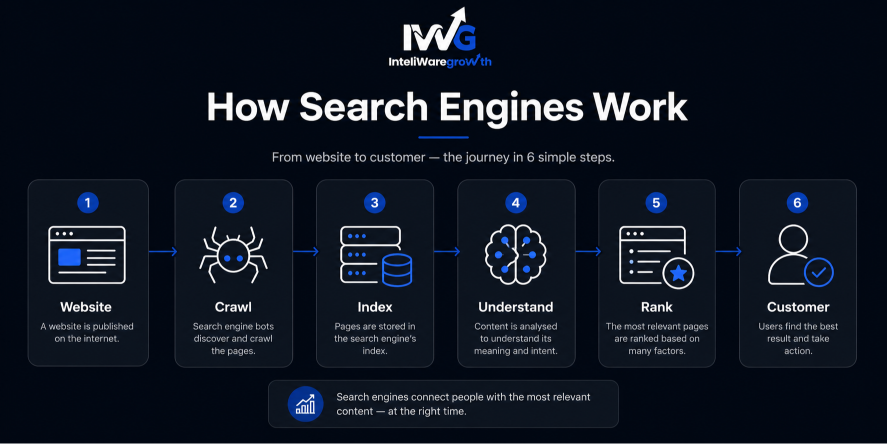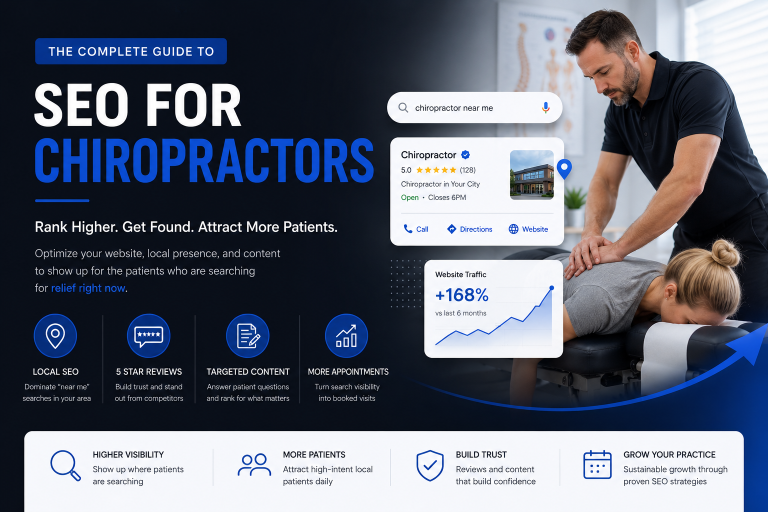
SEO for chiropractors is the process of optimizing your practice’s website and online profiles so local patients find you easily on search engines. It drives free, high-intent traffic by targeting terms like “back pain relief” or a “[city] chiropractor” to grow your patient list.
Most people looking for a chiropractor start with a search engine. In fact, 46% of all Google queries seek local information, and 97% of consumers read online reviews before choosing a local business. If your practice isn't visible when someone types "chiropractor near me," you're handing those patients to a competitor.
This guide walks you through the exact strategies we use at Inteliware Growth to help clinics dominate local search. You’ll learn how to claim your Google Business Profile, create content that answers real patient questions, fix technical issues that hurt rankings, and track everything that moves the needle. No fluff, just actionable steps that deliver measurable growth.
Understanding search intent for chiropractic SEO
Before you touch a keyword tool, you need to understand why a person is searching. Search intent for chiropractic queries falls into three buckets:
- Informational: “What causes lower back pain in the morning” – The user wants education, not an appointment.
- Commercial investigation: “Best chiropractor for sciatica in Chicago” – The user is comparing options and reading reviews.
- Transactional: “Book chiropractor for neck pain today” – The user is ready to schedule.
Your content must match the intent behind each query. A blog post that explains sciatica treatments satisfies informational intent, while a service page with a “Book Now” button captures transactional traffic. When you align every page with the right intent, you keep visitors on your site longer – a strong signal to Google that your content is helpful.
Local SEO & Google Business Profile
Your Google Business Profile (GBP) is the single most powerful tool for attracting nearby patients. When optimized, it appears in the local 3-pack and Google Maps, giving you prime real estate above the traditional organic results.
Claim and verify your Google Business Profile
Start at google.com/business. Search for your practice and claim the listing. Google will mail a verification postcard to your address. Complete this step promptly. An unverified profile cannot appear in local search results.
Add your correct name, address, and phone number (NAP)
Every detail must match exactly across your website, social media, and online directories. Use your official practice name as it appears on your signage. Enter the suite number if you have one. Format your phone number identically everywhere (555) 123-4567, not 5551234567. Inconsistent NAP data confuses search engines and erodes local ranking power.
Collect 5-star patient reviews regularly
Reviews are the lifeblood of local SEO. Practices with a steady stream of fresh, positive reviews consistently outrank those with stagnant profiles.
Make it easy: after a successful treatment, send a text or email with a direct link to your Google review form. Never offer incentives; simply ask a genuine question like, “Would you mind sharing your experience so others can find relief?”
Respond to every review – thank your happy patients and address any concerns professionally. This shows Google you’re active and engaged.
Target “near me” mobile searches
Over 60% of “near me” searches happen on a smartphone. Make sure your GBP listing is complete with business hours, photos of your clinic, and the services you provide. Use Google Posts to share updates, offers, or patient success stories. These small touches keep your profile fresh and increase your visibility when someone’s thumb is hovering over the “Call” button.
At Inteliware Growth, we optimize Google Business Profiles to capture these high-intent mobile visitors and turn them into booked appointments. It’s a foundational piece of our Doctors & Clinics SEO playbook.
Keyword & content strategy for chiropractors
Your website needs pages that match the exact questions and conditions patients are searching for. A generic “Services” page won’t cut it anymore.
Use long-tail keyword phrases instead of single words
“Chiropractor” is broad and competitive. “Chiropractor for pregnancy back pain in Austin” is specific and full of intent. Long-tail keywords make up the majority of searches and convert at a much higher rate. Tools like Google Keyword Planner or Ahrefs can help you find these gems, but you can also mine them from the “People also ask” section on Google, or from the autocomplete suggestions when you begin typing a condition plus your city.
Write pages for specific pain points and treatments
Create a dedicated page for every condition you treat. Instead of one catch-all page, build out:
- Sciatica relief
- Neck pain and whiplash treatment
- Herniated disc therapy
- Prenatal chiropractic care
- Sports injury recovery
- Pediatric chiropractic adjustments
Each page should describe the condition, explain your treatment approach, include patient testimonials, and end with a clear call to action. This structure signals topical authority to Google and gives every visitor exactly what they came for.
Answer patient questions directly in headings and FAQs
When you phrase your H2s and H3s as questions – “How does a chiropractor treat sciatica?” – you’re mirroring the exact voice-search queries patients ask. Search engines love this because it creates an instant answer. Add a dedicated FAQ section at the bottom of each treatment page to capture long-tail voice searches and increase your chances of appearing in Google’s “People also ask” snippet.
Publish clear pages for each service you offer
Beyond conditions, outline your core services. If you offer spinal decompression, laser therapy, or posture correction, give each its own page. Describe who it helps, what a session feels like, and any contraindications. This level of detail builds trust and keeps visitors on your site – a behavioral metric that correlates with higher rankings.
Technical & on-page SEO that boosts rankings
You can have the best content in the world, but if your site is slow or unfriendly on a phone, you’ll lose patients before they even read a word.
Ensure your site is mobile-friendly for patients on phones
Google uses mobile-first indexing, meaning it primarily crawls and ranks the mobile version of your website. Test your site with Google’s Mobile-Friendly Test tool](https://search.google.com/test/mobile-friendly). Text should be readable without zooming, buttons must be large enough to tap, and nothing should scroll horizontally. A responsive design isn’t optional – it’s essential.
Improve page load speed so visitors do not leave
If your page takes longer than 3 seconds to load, over half of mobile visitors will abandon it. Compress your images, leverage browser caching, and minimize the use of heavy scripts. Tools like Google PageSpeed Insights give you a prioritized list of fixes. At Inteliware Growth, our audit phase flags every speed bottleneck and provides a remediation roadmap because every second you save directly impacts your appointment book.
Add Local Business schema markup
Schema markup is code you add to your site that helps search engines understand exactly what your business does and where it’s located. Implement LocalBusiness schema with your NAP, opening hours, and the services you provide. This structured data can earn you a knowledge panel and rich results in search, making your listing stand out. Use Google’s Structured Data Testing Tool to validate your markup.
Optimize meta titles and descriptions for every page
Your meta title and description are your first impression in the search results. Every page needs a unique, compelling title that includes your primary keyword and location. Example: “Sciatica Chiropractor in Denver | [Practice Name].” The description should summarize the page’s value and include a mini call to action: “Get lasting relief from sciatica pain – book your appointment today.” Well-crafted meta tags improve click-through rates, which is a direct ranking signal.
Link building and online citations for chiropractors
Search engines still rely heavily on links and citations to gauge trust. A clean, widespread citation profile combined with a handful of authoritative backlinks can push you past competitors.
- Build consistent citations on high-quality directories: Healthgrades, Vitals, WebMD Care, Yelp, and your local chamber of commerce. Ensure your NAP matches your GBP listing exactly.
- Earn local backlinks by sponsoring a community event, giving a talk at a wellness fair, or writing a guest article for a local news site. These geographically relevant links signal genuine local authority.
- Partner with complementary providers: Physical therapists, yoga studios, and gyms often share your audience. A reciprocal referral page or a co-branded blog post can provide a natural, relevant backlink.
We weave citation building and strategic link acquisition into every campaign because a strong off-site footprint amplifies your on-page efforts.
How Inteliware Growth helps chiropractors dominate local search
We’re not a generic marketing agency. Inteliware Growth is a UK-based performance marketing firm that builds data-driven frameworks specifically for high-intent service niches – and that includes your chiropractic practice.
Our 5-step roadmap ensures every campaign is measurable, scalable, and profitable:
- Audit – We dissect your current site, competitor landscape, and patient search behavior.
- Strategy – A custom blueprint with keyword mapping, content plans, and KPIs.
- Execution – We launch optimized landing pages, GBP enhancements, and ad creatives (if you’re using paid search).
- Tracking – Real-time dashboards show exactly which keywords and pages are driving calls and bookings.
- Scale – Once we find the winning formula, we expand your budget and footprint based on hard data – never guesswork.
While our specialty is helping chiropractors and medical clinics grow their patient base, we also deliver results for taxi companies, immigration lawyers, app startups, and cleaning companies. But your niche gets the full force of our healthcare-specific expertise. Check out our Case studies to see how we’ve helped clinics triple patient inquiries.
Ready to see what a tailored chiropractic SEO strategy can do?
Contact Us
📞 +92 344 3503901
📧 sales@inteliwaregrowth.com
📍 London, United Kingdom
Conclusion
Chiropractic SEO isn’t about tricking search engines – it’s about making your practice the obvious answer when someone in pain looks for help online. Claim and optimize your Google Business Profile, create deep content around real patient conditions, polish your site’s technical health, and build local trust through reviews and citations.
When you combine these strategies, you don’t just rank higher. You become the local authority patients choose with confidence. At Inteliware Growth, we’ve helped clinics just like yours transform a trickle of referrals into a steady stream of new patients, and we’d love to do the same for you.
Frequently Asked Questions
How long does SEO take for a chiropractor?
You can see initial improvements in local rankings within 1–3 months, but significant, sustained growth typically takes 6–12 months. SEO is a long-term investment that compounds over time.
Can I do chiropractic SEO myself?
Yes, many foundational steps like claiming your GBP, collecting reviews, and writing condition pages can be done in-house. However, technical fixes, schema markup, and strategic link building often require a professional touch to avoid costly mistakes.
How much does chiropractic SEO cost?
Costs vary based on your market size and competition. A comprehensive local SEO campaign with content creation, citation management, and technical optimization typically starts at £800–£2,000 per month. Reach out to our team for a personalized quote.
Why are Google reviews so important for chiropractors?
Reviews are a top local ranking factor and the digital equivalent of word-of-mouth. A strong collection of positive, recent reviews builds trust with both Google’s algorithm and potential patients who are comparing providers.
What is the difference between organic SEO and Google Ads for chiropractors?
Organic SEO brings free, long-term traffic through high rankings, while Google Ads place you at the top instantly for a fee. The most powerful approach combines both – ads capture immediate demand while SEO builds a sustainable pipeline.
How often should I update my chiropractic website for SEO?
Publishing a new blog post or updating an existing service page at least twice a month keeps your site fresh. Regularly refreshing content signals to Google that your practice is active and relevant.