Cryptocurrency SEO is the practice of optimizing Web3, blockchain, and digital asset websites to rank higher in search engines. Because Google treats financial content as "Your Money or Your Life" (YMYL), crypto SEO requires strict technical precision, transparent authority, and intent-driven content to build trust with users and search algorithms.
If your token launchpad, DEX, NFT marketplace, or crypto wallet isn’t appearing on page one, you’re invisible to the investors, traders, and users who make the ecosystem run. Over the next few minutes, you’ll get the exact strategies our growth team at Inteliware Growth uses to turn Web3 obscurity into predictable, high-intent organic traffic, and why this discipline looks nothing like traditional SaaS SEO. You can see how we apply this same rigor across all [our services](https://inteliwaregrowth.com/[services](https://inteliwaregrowth.com/services/)).
Why crypto SEO is different
Google’s Quality Rater Guidelines put any site that could affect a person’s financial well-being under a microscope. Your crypto project doesn’t just compete with other protocols; it competes with an algorithmic need for absolute credibility. One outdated security claim or anonymous team page can suppress your entire domain, no matter how innovative the tech is.
Beyond regulations, crypto SEO deals with:
- rapidly changing token definitions and contract addresses.
- duplicate content across aggregators like CoinMarketCap and CoinGecko.
- AI-generated scraping that forces you to prove original value.
- users who search by ticker, chain, use case, and even meme culture terms.
Traditional ranking tactics fail here. Instead, a framework built around high-intent pages, entity recognition, and uncompromising trust signals dominates.
Key strategies for crypto SEO
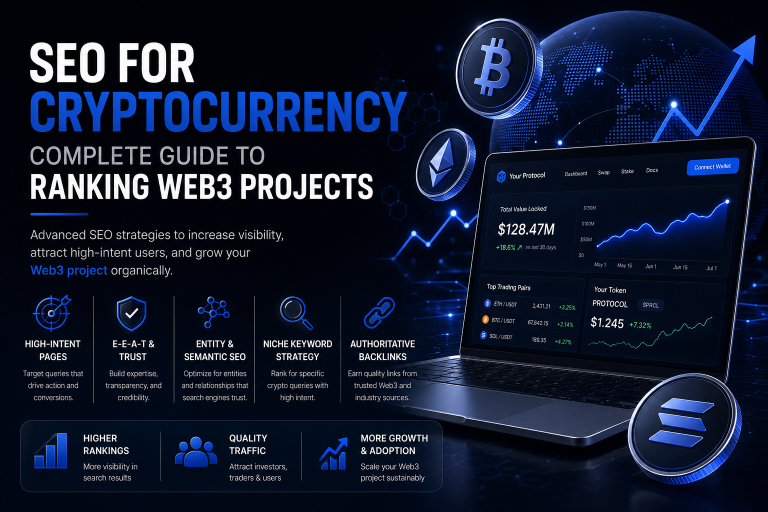
These are the five pillars our team relies on when scaling blockchain projects from zero to sustained search visibility.
1. Build high-intent pages, not more blog posts
Most crypto teams pour resources into generic educational content like "What is Bitcoin?" or "Beginner’s Guide to DeFi." That content battles media giants and exchanges. You win faster by optimizing pages that close a decision.
Prioritize:
- exchange pair pages (BTC/ETH, token/USDT) with price, chart, and swap functionality.
- token hubs that aggregate the contract address, whitepaper, audits, and social links.
- protocol landing pages around specific use cases (lending APYs, liquidity pools, staking dashboards).
- "how to buy X token" guides that lead directly to a verified purchase flow.
Each page matches a bottom-of-funnel search intent. When someone types "buy TRB with ETH," they don’t want a definition, they want a frictionless transaction. Build the page that fulfills that intent, and search engines reward you with featured snippets and AI Overview mentions. Our Case studies show exactly how this approach doubled organic conversions for a DeFi client.
2. Establish E-E-A-T to pass YMYL scrutiny
YMYL crypto sites live or die by Experience, Expertise, Authoritativeness, and Trustworthiness. Google’s systems, and increasingly AI-driven search, evaluate whether your site demonstrates genuine subject matter experience. The Google Search Quality Evaluator Guidelines explicitly prioritize transparent authorship and verifiable credibility for financial topics.
Practical steps we implement for clients:
- verified team profiles: real names, LinkedIn links, conference talks. Anonymous teams are a trust penalty.
- technical whitepapers hosted as clean HTML on your own domain, not just a PDF download. This signals original research.
- security and audit pages: link to third-party audit reports, bug bounty programs, and real-time TVL or reserve proofs.
- clean site architecture: fast load times, no intrusive interstitials, transparent contact information, including a physical address and phone number like ours at +92 344 3503901.
When E-E-A-T is structurally baked in, Google treats your protocol as an authoritative entity, not a risky unknown.
3. Use entity & semantic optimization
Modern search engines build a knowledge graph of entities: people, tokens, chains, concepts. Your site must clearly declare what it is and how it connects.
Leverage structured data (Schema.org) to disambiguate:
- Organization with sameAs links to official Twitter, GitHub, Crunchbase, and CoinMarketCap.
- WebApplication or SoftwareApplication for dApps.
- Product markup for token pages (ticker, chain, contract address).
- FAQPage and HowTo for guides, increasing the chance of appearing in AI Overviews.
Then reinforce entity relationships through internal linking. If you’re a lending protocol on Solana, connect pages about "Solana DeFi," "USDC lending," and "SPL token yields." This helps models like Google’s SGE understand your domain cluster and recommend your pages for complex queries.
4. Master niche keyword research
Broad crypto keywords like "NFT" or "crypto exchange" are dominated by mega-brands. Your advantage lies in specificity.
Build keyword maps around:
- token utility queries: "What can I do with ARB token," "GRT staking rewards calculator"
- problem-aware searches: "bridge MATIC to Arbitrum cheaply," "avoid impermanent loss in concentrated liquidity"
- wallet and tool onboarding: "add Blast network to MetaMask manually," "Ledger Live not showing token balance"
- regional and language variants: localized queries often have far lower competition
Every keyword must connect to a page that solves the exact task. If the search is a question, your heading should be that question, followed by a concise, scannable answer, increasing the likelihood of being pulled into voice search and AI-generated responses.
5. Earn authoritative backlinks the right way
Crypto backlinks are high-risk, high-reward. Google penalizes paid link schemes heavily, and Web3 is rife with them. Build editorial, reputation-based links through genuine participation.
Proven tactics:
- contribute original data: compile on-chain analytics reports and pitch them to CoinDesk, Decrypt, The Block, and niche newsletters. Data earns citations.
- get listed in curated directories: DappRadar category pages, Messari asset profiles, official ecosystem pages (Solana Foundation, Ethereum.org).
- co-author educational content: partner with security firms, wallets, or non-competing protocols. A joint piece with a respected auditor earns a backlink and an implicit trust signal.
- maintain an active open-source presence: GitHub repositories with real usage often attract organic .edu and .gov links.
Each earned link raises Domain Authority and reinforces the entity associations search engines use to understand your relevance.
The Inteliware Growth framework
We don’t treat SEO as a standalone checklist. We plug it into our proven 5-step performance marketing roadmap, which has already scaled Taxi Companies, immigration law firms, cleaning businesses, doctors, and high-growth app startups. Crypto projects benefit from the same data-driven discipline.
Step 1: Competitor & SERP audit
We deep-dive into your competitor’s top pages, backlink profiles, and the SERP features they own. For a DeFi protocol, this means auditing on-chain volume correlations, community sentiment, and which content types Google’s AI Overview is already surfacing.
Step 2: Custom KPI strategy
Unlike ecommerce, your KPIs might include TVL growth, wallet connections, or token swaps from organic search. We map each keyword cluster to a business outcome and build a forecasting model that accounts for crypto-specific seasonality and market cycles.
Step 3: Precision execution
We don’t churn out filler content. We build the exact high-intent pages (token hubs, bridge comparison tools, staking calculators) and optimize them with semantic markup, E-E-A-T signals, and fast Core Web Vitals. Every element is designed to convert, not just rank.
Step 4: Privacy-friendly tracking
Using on-chain analytics alongside privacy-compliant front-end tracking, we connect organic sessions to wallet actions. You see exactly which search query brought in a $10k deposit or a governance token holder, without compromising user privacy.
Step 5: Scale what works
Once we identify pages and content clusters delivering actual on-chain value, we scale through iterative internal linking, deeper topical authority, and selective paid amplification (Google Ads, paid social). Real-time dashboards keep CAC and ROI completely visible.
If you’re running a crypto app or wallet, explore our dedicated growth frameworks for app startups. The acquisition mechanics share the same performance DNA.
Avoid these common crypto SEO pitfalls
Even well-funded projects sabotage their organic growth with avoidable mistakes.
- Thin token pages: a ticker and contract address aren’t enough. Enrich pages with official links, audit badges, tokenomics, and FAQs.
- Duplicate content: token info is syndicated everywhere. Use canonical tags aggressively and claim your official profiles on CoinMarketCap and CoinGecko.
- Poor Core Web Vitals: dApp pages overloaded with wallet scripts often fail mobile speed tests. Lazy-load non-critical scripts and audit performance weekly.
- Local SEO neglect: if you host events, hackathons, or have a physical office in London, optimize your Google Business Profile. Our address is London, United Kingdom; every local signal strengthens overall trust.
- Guaranteeing returns: language resembling financial advice (APY guarantees, "risk-free") invites manual actions. Stick to educational, data-presented language.
Frequently asked questions about cryptocurrency SEO
Is crypto SEO harder than regular SEO?
Yes. Google holds financial sites to a much higher trust standard. Many crypto projects fail to meet it, so getting it right gives you a durable advantage.
How long does it take to rank a new crypto project?
Expect initial traction in 3–4 months for niche terms. Competitive keywords can take 9–12 months as you build domain authority.
Can I just use a blog to rank for crypto terms?
No. A blog supports visibility, but you need dedicated service pages, token hubs, and conversion-focused tools to turn traffic into value.
Does my crypto site need a physical address for Google trust?
Not mandatory, but a real address and contact info (like ours in London, +92 344 3503901) significantly boost YMYL credibility.
How do AI chatbots and Google AI Overview affect crypto SEO?
They pull answers from structured, authoritative sources. Use schema, FAQs, and concise answers to increase your chance of being cited.
Get started with a crypto SEO strategy that converts
Cryptocurrency SEO isn’t a guessing game. It’s a precise combination of technical optimization, entity clarity, and trust building that aligns with Google’s evolving AI-first search experience. Whether you’re launching a token, scaling a DeFi platform, or growing a wallet’s user base, the framework is the same: target high-intent pages, prove your authority, and structure your data so machines recommend you.
At Inteliware Growth, we’ve applied this performance-driven mindset across industries where trust and conversion matter most, from immigration law firms to app startups, and the crypto sector demands nothing less. Our real-time dashboards, rigorous audit process, and scaling frameworks are ready for the next wave of Web3 companies.
Book your free consultation and let’s map out a custom crypto SEO roadmap built on data, not hype.
Contact Us
📞 +92 344 3503901
📧 sales@inteliwaregrowth.com
📍 London, United Kingdom