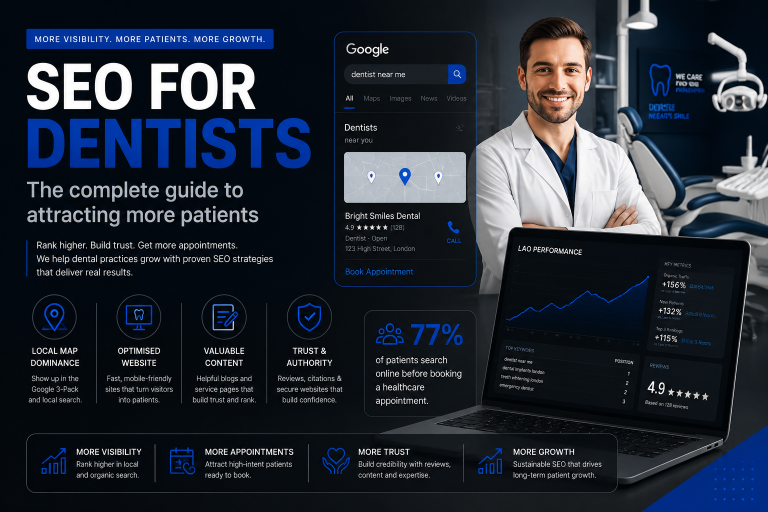
SEO for dentists is the process of optimising your dental practice’s website and online profile to rank higher in local and organic search results. The primary goal is to attract nearby patients searching for services like “emergency dentist” or “Invisalign” by improving local map visibility, website speed, and relevant medical content.
Your next patient is searching for a dentist right now. Not tomorrow, not next week—right now. The question isn’t whether people look online for dental care; over 77% of patients search online before booking a healthcare appointment. The real question is whether your practice shows up when they do. At Inteliware Growth, we’ve helped doctors, clinics, and service businesses turn local searches into appointments using a data-driven SEO framework. This guide gives you exactly that framework, applied specifically to dental practices.
Why dental SEO isn’t just SEO
General SEO advice often misses the unique needs of a dental clinic. You’re not selling products that ship anywhere. You’re selling trust, reassurance, and a convenient local experience. Patients search with high intent—someone typing “root canal cost London” or “dentist open Saturday near me” is ready to book. That means your SEO strategy must blend technical site health, local map dominance, and content that answers real patient fears before they pick up the phone. Every element we cover below is built around that patient behaviour.
Local map optimisation
Claim and verify your Google Business Profile with correct name, address, phone number, and hours.
Your Google Business Profile (GBP) is the single most powerful lever for local dental SEO. Without a verified profile, you won’t appear in the 3-pack map results that sit at the very top of Google. Use your exact practice name as it appears on your signage and registration. Double-check that the phone number is a local area code and that your operating hours—including any lunch breaks—are completely accurate. Even a small mismatch can cost you map visibility.
Collect patient reviews regularly to build local trust and boost map rankings.
Reviews act like word-of-mouth at scale. Google’s algorithm interprets frequent, detailed reviews as a strong trust signal. Set up a simple process: send a follow-up text or email 24 hours after an appointment with a direct link to leave a review. Reply to every review, positive or negative, in a professional, empathetic tone. A steady stream of recent reviews tells both Google and a nervous patient that you’re the right choice.
Ensure your NAP details match identically across all online directories.
NAP stands for Name, Address, Phone number. If your address is “Suite 4B, 12 Harley Street” on your GBP, it must read exactly like that on Yell, NHS Choices, and any other directory—no abbreviations, no extra spaces. Inconsistent NAP information confuses search engines and dilutes your local authority. We regularly audit directory listings for our Doctors & Clinics clients because it’s one of the fastest ways to repair local rankings.
Website and on-page SEO
Create dedicated service pages for major treatments like teeth whitening, implants, and orthodontics.
A single “Services” page that lists everything you do is a missed opportunity. Each high-value treatment deserves its own page. A dedicated page for “Dental Implants” lets you answer the exact questions a patient researching implants is asking: cost, procedure steps, recovery time, and whether it hurts. This depth signals expertise to Google and keeps visitors on your site longer, which improves rankings.
Use clear title tags and H1 headers that include your core service and city name.
Your page title is the first thing people see in search results. A title like “Dental Implants London | [Your Practice Name]” is far more effective than just “Dental Implants.” Include the city or borough where your practice is physically located. The H1 on the page should echo that combination naturally, for example “Expert Dental Implants in London.” This geo-service pairing is exactly what Google looks for when matching a search to a local business.
Make the site mobile-friendly and fast so patients on phones can easily call or book an appointment.
Over 60% of dental searches happen on a mobile device. If your site isn’t fully responsive, with tap-to-call buttons and a booking form that loads in under three seconds, you’re losing patients. Use Google’s Mobile-Friendly Test and PageSpeed Insights. Even a one-second delay can drop conversions by 7%. At Inteliware Growth, we treat site speed as a conversion factor, not just an SEO metric—part of our conversion rate optimisation work that turns visitors into appointments.
Content and technical health
Write helpful blog posts answering common local questions about dental care costs and procedures.
A blog that genuinely helps people builds the kind of topical authority that Google rewards. Think about the questions patients ask at the front desk: “Is teeth whitening safe for sensitive teeth?” “How long does a crown take?” “NHS vs private dentist – what’s the difference?” Turn each one into a clear, compassionate post. Include local details like “in Manchester” or “near Liverpool Street” to catch nearby searches. This content also supplies your social media and email newsletters with shareable material.
Install an SSL certificate (HTTPS) to keep patient data secure.
SSL encrypts the data that moves between a visitor’s browser and your website. For a dental practice collecting contact forms and health-related enquiries, this isn’t optional—it’s a patient trust issue and a ranking factor. Google actively flags non-HTTPS sites as “not secure,” which can frighten a potential patient into clicking away. Your hosting provider can usually install a basic SSL certificate at no extra cost.
Fix broken links and optimise image sizes to keep page load times low.
Broken links create a poor user experience and can block search engines from crawling your site effectively. Run a free crawl using a tool like Screaming Frog to find any 404 errors. At the same time, compress your images—especially before-and-after photos—without losing clarity. Large, unoptimised images are the most common reason for slow-loading dental websites. A technically clean site tells Google your practice is professional and reliable.
The Inteliware Growth framework for dental practices
At Inteliware Growth, we don’t just hand over a checklist. We scale dental practices using a five-step roadmap, adapted from the same framework that powers our immigration law firm and Cleaning Company clients.
-
Audit
We dive deep into your current online presence: competitors’ GBP insights, search terms patients actually use, technical site health, and existing backlinks. For dental clients, this includes a full NAP consistency scan and review volume analysis. -
Strategy
We map out custom KPIs—not just rankings, but phone calls, contact form submissions, and new patient bookings—and forecast realistic timelines. A dental implant campaign will have a different keyword mix than a cosmetic teeth-whitening push. -
Execution
Our team builds location-specific landing pages, creates GBP posts and offers, and writes patient-focused content that answers real questions. We also launch targeted Google Ads for immediate visibility while organic rankings grow, managing every penny through Google Ads management. -
Tracking
We implement advanced attribution so you can see exactly which keyword or ad drove a phone call. Every client gets a real-time dashboard. You’ll know your cost per new patient down to the pence. -
Scale
Once data proves which channels and pages win, we gradually increase budget and content production. Scaling is always based on verified performance, never guesses.
Measuring SEO success
Rankings alone don’t fill chairs. We track metrics that tie directly to revenue:
- Organic traffic to high-intent pages (implants, emergency dentist)
- Phone call clicks from GBP and the website
- Online booking form completions
- Map views and direction requests
- Average review rating and velocity
Every month, our dashboard compares those numbers against the previous period. If a page is climbing but not converting, we tweak the call-to-action. If a service page is converting well, we build a dedicated ad campaign around it. This transparent, numbers-first approach is why our taxi company and app startup clients trust us—and it works exactly the same for dental practices.
Frequently Asked Questions
How long does dental SEO take to show results?
Typically, you’ll see improvements in local map rankings within 3–4 months with consistent effort. Highly competitive terms like “dentist London” can take 6–12 months. That’s why we often pair SEO with paid ads for immediate visibility.
Is SEO better than Google Ads for dentists?
Both have their place. SEO builds long-term, sustainable traffic without per-click costs. Google Ads deliver instant exposure and can be targeted to specific treatments. An integrated strategy almost always outperforms either alone.
How much does dental SEO cost?
Cost varies widely based on competition and how much content and technical work your site needs. We recommend a free custom audit to get an exact quote tailored to your practice.
What’s more important: on-page SEO or Google Business Profile?
They work together. A perfectly optimised GBP gets people to your listing, but a poor website will still lose the booking. You need both the map presence and a site that converts.
Do reviews really affect rankings?
Absolutely. Review quantity, quality, and recency are among the most weighted local ranking factors. A practice with 50 recent 5-star reviews will almost always outrank one with 5 reviews from three years ago.
Can I do dental SEO myself?
You can implement many basics, like claiming your GBP and writing blog posts. However, technical fixes, local citation building, and advanced keyword research often require professional tools and experience to save time and avoid mistakes that harm rankings.
Ready to fill your appointment book?
SEO for dentists isn’t a one-time setup. It’s a continuous process of proving to Google—and to anxious patients—that your practice is the safest, most convenient choice. If you want a partner who treats your marketing budget like their own and uses data to eliminate guesswork, let’s talk.
Book your free, no-obligation consultation today.
Contact Us
📞 +92 344 3503901
📧 sales@inteliwaregrowth.com
📍 London, United Kingdom