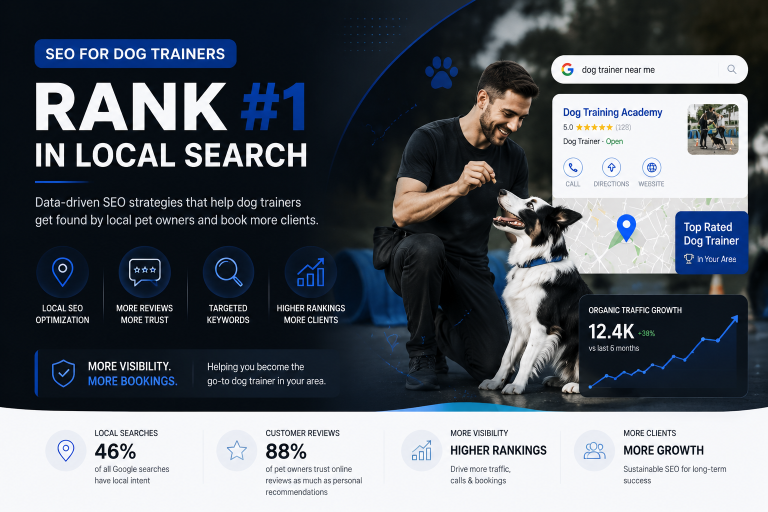
SEO for dog trainers is the process of optimizing your website and online presence to rank higher in search engine results, helping local pet owners find your obedience classes, puppy training, or behavioral modification services.
To get started on improving your search rankings and booking more clients, focus on the core local and on-page optimization steps outlined below. With Google data showing that 46% of all searches seek local information, a smart SEO strategy is your most reliable, long-term client acquisition channel.
Local SEO and Google Business Profile
Your Google Business Profile (GBP) is the single most powerful tool in your local SEO arsenal. It places you directly in front of owners searching for help right now.
Claim and fully verify your Google Business Profile
Claim your profile and complete verification. Then fill every field—hours, services, founding year. A complete, verified profile signals trust to both Google and pet parents before they even click call.
Add exact service categories like Dog trainer or Pet trainer
Select Dog Trainer as your primary category. Add Pet Trainer or Puppy Training Program as secondaries where relevant. These categories tell Google exactly which local searches to surface your business for.
Keep your name, address, and phone number (NAP) consistent across the web
Your NAP must be identical everywhere: website, Facebook, Yelp, local directories. Even St. vs Street discrepancies can dilute local ranking strength. Audit your citations to match your GBP exactly.
Upload high-resolution photos of happy client dogs and training sessions
Profiles with quality photos get significantly more clicks and direction requests. Use clear, bright images of your facility, you training dogs, and happy client shots. Name files descriptively, like puppy-obedience-training-London.jpg.
Collect client reviews systematically after completing training packages
Reviews are a top-three local ranking factor. After a client graduates, send them a direct Google review link via email or text. A personalised request reminding them of the results you achieved makes it effortless. Always respond to every review naturally, mentioning your keywords where appropriate.
Keyword research and on-page SEO
Reflecting the exact language your ideal clients type into Google across your website forms the foundation of organic growth.
Target local high-intent phrases
Skip broad terms like dog tips. Focus on transactional phrases: dog training near me, puppy classes in [City], aggressive dog training. Build a list of 20–30 keywords using tools like Google Keyword Planner. For a London trainer, prioritise dog trainer London, puppy training classes East London, and reactive dog specialist near me.
Write concise, keyword-rich meta titles and descriptions
Keep meta titles under 60 characters and front-load your primary keyword and location. A winning format: Primary Service + Location | Business Name, for example Dog Trainer Manchester | Obedience & Puppy Classes. Meta descriptions should stay under 160 characters, include your keyword, and end with a subtle call to action. Searching for a certified dog trainer in Bristol? We fix leash pulling, aggression, and puppy behaviour. Book your free assessment today.
Place keywords naturally in your H1 and opening copy
Your homepage H1 must instantly confirm what you do: Professional Dog Training in Birmingham. In the first 100 words below that headline, weave in your primary service terms and location naturally. This early placement reinforces topical relevance without forcing it.
Content and technical optimization
A beautiful website is useless if search engines can’t crawl it efficiently or users leave because it loads slowly.
Build distinct service landing pages
Create separate, in-depth pages for Puppy Socialisation Classes, Adult Dog Obedience Training, and Aggression & Behavioural Modification. Each page gets its own meta title, H1, and unique copy targeting a specific keyword cluster. This siloed structure builds topical authority.
List specific service areas, towns, or neighborhoods
Capture hyper-local traffic by naming every area you serve. Instead of just London, list We train dogs in Hackney, Islington, Tower Hamlets, and Canary Wharf. Embed a Google Map and, if content permits, create unique location pages.
Secure your site and maximize mobile speed
An SSL certificate (HTTPS) is a ranking signal. Then run your site through Google PageSpeed Insights. Compress images, eliminate unnecessary code, and leverage browser caching. A site that loads in under three seconds keeps busy owners from bouncing back to search results.
Publish helpful blog posts answering local owner questions
Mirror the questions you hear during consultations. Write posts like How to Stop a Puppy From Biting in 7 Days or Why Does My Dog Pull on the Leash and How to Fix It. These articles attract top-of-funnel traffic, demonstrate expertise, and naturally link to your core service pages to boost their authority.
Building authority through local link building
Backlinks from trusted local sources tell Google your business is a community resource.
Get listed in quality directories
Start with Yell, Yelp, Thomson Local, and pet-specific directories like your local Kennel Club listing. Ensure your NAP is a 100% match to your GBP. These citations solidify local relevance.
Forge partnerships with nearby pet businesses
Reach out to vets, groomers, pet supply shops, and doggy daycares. Offer a guest blog post in exchange for a link back to your site, or create a Local Partners page where you feature them. A link from a respected vet’s website is worth more than dozens of irrelevant directory submissions.
Leverage community events and press
Sponsor a local dog walk or host a free canine first aid workshop. Local news outlets and council websites often list these events and will link to your website as the organiser. These .org and .gov.uk backlinks provide significant local ranking boosts.
How to measure your SEO success
Set up simple tracking so you’re never flying blind.
Monitor Google Business Profile insights weekly
Inside your GBP dashboard, watch the Searches breakdown, website clicks, and phone calls. A steady upward trend confirms your category and photo optimisations are working.
Track keyword rankings with precision
Use a rank tracker to monitor your top 20 keywords. Focus on money-makers: [City] dog trainer, puppy classes near me, behavioural dog training [City]. Record a baseline before implementing changes and check progress monthly.
Connect Google Analytics 4 and Search Console
GA4 reveals which pages drive form submissions and calls. Search Console shows the exact queries your site appears for and your average position. Use the Performance report to identify pages on page two or three that need a refresh, and prioritise those.
Common SEO mistakes dog trainers should avoid
- Ignoring the GBP Q&A section: Owners often ask Do you train aggressive dogs? right on your profile. Answering them with helpful, keyword-informed replies adds free, relevant content.
- Keyword stuffing: Repeating dog trainer Manchester twenty times reads terribly and triggers penalties. Use variations and write for the owner first.
- Setting and forgetting your site: Static sites decay in rankings. Add one new blog post per month and refresh your core service pages quarterly with recent testimonials.
- Chasing irrelevant backlinks: A link from a random cooking blog is worthless. One link from a respected local veterinarian is worth far more. Quality and relevance always trump quantity.
Partner with a data-driven SEO agency that understands service businesses
While this guide gives you the blueprint, executing a full-funnel strategy while running a dog training business is a genuine challenge. That is precisely where Inteliware Growth steps in. We are a UK-based performance marketing agency, and our entire model is built around turning data into booked appointments for high-intent service providers.
How our framework de-risks your SEO investment
We don’t believe in vanity metrics. Our proven 5-step roadmap removes the guesswork:
- Audit: We map your competitors’ backlinks, your current search visibility, and your site’s technical health.
- Strategy: We build a custom keyword and content roadmap aligned with real revenue targets.
- Execution: From technical fixes to localised landing pages, we deploy changes coordinated with your paid ad campaigns.
- Tracking: We implement advanced attribution so you see exactly which organic terms generate leads.
- Scale: Once we identify winning segments, we aggressively expand your content and off-page efforts to dominate your city and neighbouring service areas.
Our clients in adjacent industries cleaning companies, taxi firms, and medical clinics rely on this framework to turn their websites into 24/7 client generation machines. Dog trainers face the same local-search dynamics, and our transparent, data-obsessed approach slots in perfectly. Explore our blog for more insights on building complete acquisition systems.
Ready to turn searchers into training clients?
Contact Us
📞 +92 344 3503901
📧 sales@inteliwaregrowth.com
📍 London, United Kingdom
Book Your Free Consultation
Frequently Asked Questions
How long does it take to rank on the first page for dog training keywords?
For localised terms like dog trainer [City], with consistent optimisation, GBP activity, and review generation, you can often see top-5 movement within 3 to 6 months. Broader terms may take 9 to 12 months. SEO is a long-term equity builder.
What should a dog trainer budget for SEO?
Expect to invest £750–£2,500 per month for a full local SEO service covering technical fixes, content, links, and reporting. If a client's lifetime value is £800, acquiring them for £150 via organic search is an excellent return.
Is SEO better than running Google Ads for my training business?
They work best together. Google Ads deliver immediate visibility while SEO matures. SEO builds a free, compounding source of leads that doesn’t stop when you pause ad spend. An integrated strategy yields the highest ROI.
Can I do SEO for my dog training website myself?
Yes, foundational tasks like claiming your GBP, collecting reviews, and writing locally-optimised service pages can be handled in-house. However, technical audits, advanced link building, and algorithm-proof content strategies often require specialist expertise to avoid wasted effort.
Do I need a blog if I only want local clients?
Absolutely. Answering hyper-local questions Where can I socialise my puppy in Manchester? signals to Google that you are an active, relevant local resource. Each post is a new indexed page that can funnel readers directly to your services.
Conclusion
SEO for dog trainers is a disciplined system of showing Google that your business is the most trusted and relevant answer for local pet owners. By managing your Google Business Profile obsessively, targeting high-intent keywords, building dedicated service pages, and earning local links, you create a flywheel that consistently delivers leads. The trainers who dominate their local market in the years ahead are the ones who treat their website like a 24/7 employee—constantly updated, constantly optimised, and constantly converting. If you would prefer a partner who already deploys this system for multi-location service brands, Inteliware Growth is ready to build a custom SEO roadmap for your dog training business.