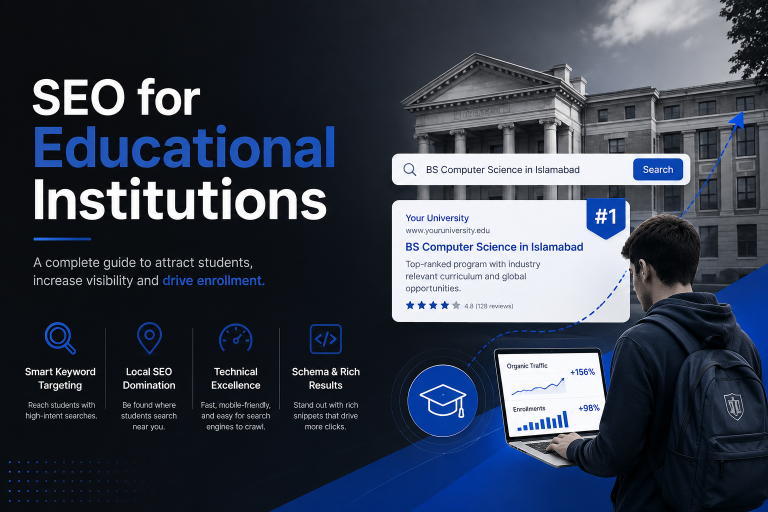
SEO for educational institutions involves optimizing a school or university website to increase organic visibility, attract prospective students, and drive enrollment. It requires targeting long-tail program keywords, building local map authority, and structuring large academic sites for users and search crawlers.
Students today don’t stumble across their dream school. They Google it. Over 90% of prospective students start their journey on a search engine. If your institution doesn’t appear on page one for programs like “BS Computer Science in Islamabad” or “affordable MBA in London”, you’re invisible at the most critical decision-making moment.
That’s where a modern educational SEO strategy stops being a “nice-to-have” and becomes a direct enrollment lever. This guide breaks down the core, data-proven tactics, from keyword research and local Google Business Profile to schema markup and E-E-A-T content, so you can build a pipeline that fills lecture halls, not just vanity traffic counters.
Why SEO matters for educational institutions
Relying solely on traditional fairs, agent commissions, or even paid ads leaves enormous intent on the table. Organic search delivers students who are actively researching programs, comparing fees, and checking accreditation: the highest-converting traffic you can get.
A well-executed SEO strategy for schools brings three things no billboard can buy:
-
Sustained visibility: Unlike PPC, rankings compound. A program page that ranks today can attract applicants for years.
-
Credibility by association: Top Google rankings signal trust. Students instinctively believe a #1 result is a better institution.
-
Lower cost per enrollment: Once technical foundations are in place, organic traffic has effectively zero marginal cost, dramatically lowering your cost per lead compared to paid campaigns.
In short, SEO doesn’t just generate clicks; it builds a self-replenishing enrolment system.
Core SEO strategies for schools
Every education website can dramatically improve its rankings by mastering these five pillars. Implement them systematically, not as one-off projects, and you’ll see a compound effect on your inquiry forms.
1. Keyword targeting to align with student search intent
Generic terms like “top universities” are almost impossible to rank for. The real gold lies in long-tail keywords that mirror exactly what a student types when they’re ready to apply.
What to target:
- Program + Degree + Location: “BSc Nursing in Manchester”, “online MBA no GMAT UK”.
- Fee and financial aid queries: “cost of studying medicine in London for international students”, “scholarships for engineering undergraduates”.
- Career-outcome searches: “graphic design degree with placement year”, “data science master’s job prospects”.
Use tools like Google Keyword Planner, Ahrefs, or Semrush to pull keyword variants. Map every keyword cluster to a dedicated landing page. Never stuff ten programs onto one URL. Each page should answer one specific intent completely.
2. Local SEO to dominate “near me” searches
If you have a physical campus, prospective students will search with location modifiers or simply look for “universities near me” on mobile. You need to show up in the Local Pack (the map and 3 listings) and in localized organic results.
Non-negotiable local SEO actions:
- Claim and fully optimize a Google Business Profile for every campus. Fill out every attribute: address, phone, hours, photos, services, and the “appointment” link.
- Maintain NAP consistency (Name, Address, Phone number) across all directories, from UCAS listings to local chamber of commerce sites.
- Actively solicit and respond to reviews from current students and alumni. They heavily influence local rankings and click-through rates.
- Create location-specific pages with unique directions, nearby amenities, and on-site faculty introductions.
A multi-location education group can build a powerful local search moat that even big aggregators struggle to outrank.
3. Technical health for a crawlable, fast academic site
University websites are notorious for bloated menus, broken links, and labyrinthine information architectures. Search engines punish confusion.
Technical SEO essentials:
- Subdirectories over subdomains: Use example.ac.uk/courses/undergraduate/engineering rather than engineering.example.ac.uk. Subdirectories consolidate domain authority.
- Fix broken internal links and outdated redirects. Regular crawl audits with Screaming Frog prevent a decay spiral where old pages point to 404s.
- Speed is a ranking factor and a conversion killer. Compress images, leverage browser caching, and ensure Core Web Vitals pass for both desktop and mobile. Check scores via Google PageSpeed Insights and act on every “improvement” suggestion.
- Implement a responsive, mobile-first design. Over 60% of education searches now happen on phones. Google indexes the mobile version of your site first. If it loads poorly, you rank poorly.
- Create an XML sitemap split by content type (courses, articles, faculty profiles) and submit it through Google Search Console.
Clean technical foundations ensure your brilliant course content actually gets indexed and seen.
4. Schema markup to stand out with rich snippets
Schema markup is structured data you add to your HTML to help search engines understand what a page is about and display enhanced results, like star ratings, course prices, and program durations, right in the search results.
For educational institutions, the most powerful schema types are:
- EducationalOccupationalProgram: Use on each program page to define credential type, time to complete, delivery format (online/onsite), and application deadline.
- Course: For individual course modules, listing prerequisites and educational level.
- FAQ: For admission procedure pages to earn expandable question-and-answer snippets.
- Organization: With sameAs links to your social profiles, and a nested EducationalOrganization markup for your institution.
Rich snippets increase click-through rates by making your listing visually larger and more informative. Google’s official structured data documentation provides exact code templates you can adapt; no developer guesswork needed.
5. Content & E-E-A-T to build trust and authority
Google’s E-E-A-T (Experience, Expertise, Authoritativeness, Trustworthiness) is not just a checklist; it’s a guide to building a site that genuinely deserves to rank for life-altering decisions like education.
How to signal E-E-A-T:
- Create detailed faculty bio pages linking to published research, industry experience, and credentials. Real expertise on display.
- Publish student outcome data: graduation rates, employment statistics, alumni success stories. Trust flows from transparency.
- Maintain an active blog that answers top-of-funnel student questions such as “How to choose between a BBA and a BS in Management”, not just course pitches. This builds topical authority.
- Show accreditation logos and official affiliations prominently, and link to verifying sources.
- Earn backlinks from respected .edu, .gov, and industry sites through scholarship programs, original research, or digital PR.
Educational SEO runs on trust. A website that looks like a marketing brochure without substance will never outrank one that demonstrates authentic value and outcomes.
Advanced SEO tactics for universities
Once the core strategies are in place, push further with these differentiators:
- Video SEO for campus tours: Host videos on your domain, not just YouTube. Provide transcripts and use VideoObject schema so Google can surface key moments in search.
- FAQ-rich content hubs: Build resource centers around queries like “international student visa process” or “accommodation options near campus”. Answer an entire topic cluster, not just a single question, to win featured snippets.
- Scholarship-based link building: Create scholarship pages that .edu domains are naturally inclined to link to. It’s a white-hat, scalable link acquisition play.
- Internal link silos: Structure blog posts so they funnel authority toward your commercial program pages. A blog about “data science career paths” should link internally to your “MSc Data Science” landing page with keyword-rich anchor text.
Measuring SEO success for schools
Traffic alone doesn’t fill lecture halls. Track metrics that tie directly to enrollment:
- Organic conversions: Inquiry form submissions, prospectus downloads, open day registrations. Set these as goals in GA4.
- Keyword rankings for high-intent program terms: Monitor position changes weekly and correlate with conversion spikes.
- Local pack appearance rate: Track how often your Google Business Profile shows up for “near me” searches in each campus city.
- Click-through rate from search results: An improvement here means your title tags and meta descriptions are resonating.
At Inteliware Growth, we build transparent real-time dashboards so you see every metric that matters: no vanity reports, just data you can act on.
How Inteliware Growth drives enrollment growth beyond SEO
SEO doesn’t exist in a vacuum. The families researching your MPharm program today may need a retargeting ad tomorrow. That’s where our performance-first model excels.
We apply the same rigorous framework used for taxi fleets, immigration law firms, and doctor clinics, high-intent industries where every click must earn its keep, to the education sector. Our services ensure transparency at every stage:
- Audit: Deep dive into your current organic presence, competitor enrollment funnels, and audience intent data.
- Strategy: Custom channel forecasting and ROI projections, with SEO and paid channels complementing each other.
- Execution: From schema implementation to Google Ads enrolment campaigns, we launch on day one.
- Tracking: Advanced attribution so you know whether an application came from an organic blog post or a YouTube pre-roll.
- Scale: Budget expansion only when the data says “yes,” not before.
Case in point: a London-based language school partnered with us. By overhauling their local SEO, implementing program schema, and tying organic landing pages to precise Google Ads search terms, they saw a 147% increase in qualified inquiries within six months, at a 40% lower cost per enrollment.
FAQ
What is SEO for educational institutions?
It's the process of optimizing a school or university website to rank higher for program, admission, and location-based searches, turning organic visitors into student inquiries.
How long does it take to see SEO results for a school website?
Initial ranking improvements often appear in 4–6 months. Significant enrollment impact typically builds over 9–12 months.
Can small private schools afford to compete with large universities?
Yes. They can win on hyper-niche, long-tail keywords and local "near me" searches where big brands often lack focus.
Do we need separate SEO for each campus?
Yes. Each physical campus should have its own location page and Google Business Profile, all under the same main domain to share authority.
What’s the difference between SEO and PPC for student recruitment?
SEO builds sustained, free organic traffic over time. PPC buys instant visibility. The most effective strategy uses both together.
Ready to turn your website into an enrollment engine?
Stop letting competitors capture the students searching for exactly what you offer. Whether you need an SEO foundation overhaul or a full-funnel strategy that combines organic search with paid performance, Inteliware Growth is ready.
Contact Us
📞 +92 344 3503901
📧 sales@inteliwaregrowth.com
📍 London, United Kingdom
Book Your Free Consultation