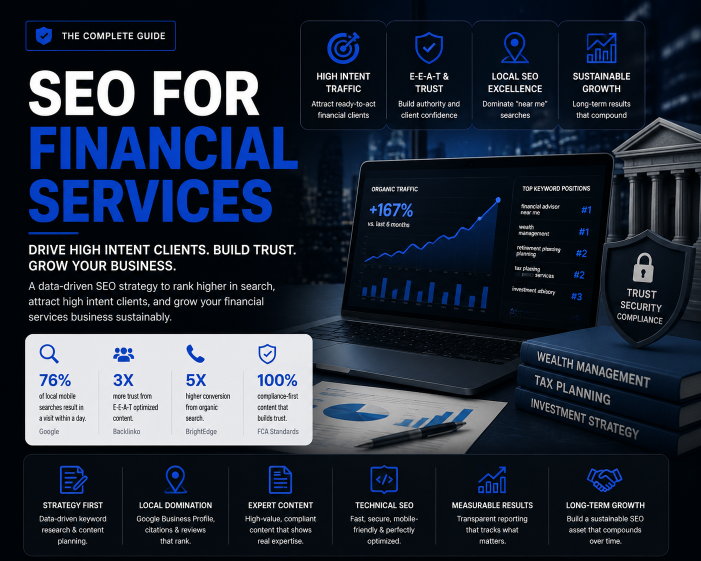
SEO for financial services is the practice of optimizing a finance company's website to rank higher in search engine results, driving organic traffic, building credibility, and converting high-intent clients. It applies specialized search optimization strategies tailored to the strict regulatory and trust-based nature of the finance industry.
If your wealth management firm, accounting practice, or insurance brokerage isn't on page one when prospects search for what you offer, you're invisible to the very clients who need you most. Standard SEO advice rarely fits. Google holds financial sites to an exceptionally high bar because the advice you give can directly impact someone's savings, health, or future.
At Inteliware Growth, we've scaled dozens of regulated service businesses, from immigration law firms to medical clinics, through data-driven strategies that respect compliance and still win top rankings. This guide breaks down exactly how to build a financial services SEO engine that attracts, engages, and converts.
Why financial services need a specialized SEO approach
Most industries can chase quick rankings with broad content. Financial services cannot.
Google's YMYL classification changes everything
Pages like "Your Money or Your Life" affect a person's financial stability or health. Any page offering tax advice, investment guidance, or insurance comparisons is automatically held to the strictest E-E-A-T standards. A thin blog post won't just fail. It could drag your entire domain down.
Regulatory compliance is non-negotiable
In the UK, the FCA requires financial promotions to be fair, clear, and not misleading. Content with bold performance claims lacking proper disclaimers can trigger audits or fines. Every page must balance keyword visibility with compliance language.
Trust drives conversions
Financial services remains one of the least trusted industries globally. Your SEO must therefore do two jobs at once: bring the right visitors and immediately signal safety through credentials, security, and transparent policies.
Competition is spending heavily
Banks and fintechs pour enormous budgets into content and link acquisition. To compete, you need a hyper-focused strategy that targets underserved intent gaps, not generic head-to-head battles.
Core pillars of financial SEO
Every successful campaign stands on five interdependent pillars.
1. Build strong E-E-A-T
Experience, Expertise, Authority, and Trustworthiness are the foundation Google insists on for YMYL niches.
- Display clear author credentials: Every article should show the author's full name, qualifications, and a professional headshot. Attaching a CFP to your retirement planning post can triple organic traffic within months.
- Publish transparent disclaimers: A short note, "This does not constitute financial advice," tells users and Google you operate responsibly. For UK-regulated firms, link to your FCA registration in the footer.
- Show real-world experience: Publish anonymised case studies and original research. Breaking down how you helped a client save £23,000 in tax demonstrates practitioner knowledge far beyond textbook theory.
- Include trust signals: SSL certificates, privacy policies, accessible contact details, and industry memberships all contribute to trustworthiness. A professional, up-to-date design matters more here than in other sectors.
2. Target high-intent keywords
Broad terms like "mortgage broker" are expensive and attract window shoppers. High-intent keywords bring ready-to-act clients.
- Focus on specific, long-tail phrases: Tax planning for small businesses in Manchester converts far better than "tax advice". These queries reveal deep intent and are used later in the decision-making process.
- Use problem-oriented keywords: Phrases like "how to avoid inheritance tax legally" or "best pension for self-employed professionals" attract people actively solving a financial puzzle. Answer it clearly, and you build immediate authority.
- Segment by client niche: Wealth managers might target "wealth management for tech executives"; accounting firms can go after "year-end accounts for ecommerce founders". We apply the same precision at Inteliware Growth as in our Google Ads campaigns, where each keyword cluster maps to a specific buyer persona.
- Build content clusters around pillar topics: A pillar page on "Retirement Planning" linking to pages on pension drawdown, SIPPs, and estate planning signals comprehensive coverage, boosting the entire cluster's rankings.
3. Optimize local SEO for "near me" searches
Many financial relationships still start face-to-face. You must dominate searches like "financial advisor near me".
- Claim and fully optimize your Google Business Profile: Choose the correct primary category, fill in every field, post regular updates, and respond to all reviews promptly.
- Nail NAP consistency: Your Name, Address, and Phone number must be identical across your website, GBP listing, and directories. A quarterly audit prevents local ranking dilution.
- Generate authentic local reviews: Send a personalised email after a milestone with a direct link to your Google review form. Five detailed recent reviews can outweigh 50 generic old ones.
- Create location-specific landing pages: For multi-city practices, build unique pages with the area name in the URL and H1, plus locally relevant content, a tactic we've refined for immigration law firms seeking leads in specific boroughs.
4. Ensure technical excellence
A slow, buggy website kills trust instantly. Technical SEO signals professionalism.
- Secure your site with HTTPS: An SSL certificate is a ranking factor, and "Not Secure" warnings scare off prospective clients immediately.
- Master Core Web Vitals: Aim for an LCP under 2.5 seconds. Compress images, use lazy loading, and keep your theme lightweight. Google's page experience metrics directly affect rankings.
- Fix broken links and crawl errors: Run monthly crawls, redirect 404s, and keep your XML sitemap clean in Google Search Console.
- Implement structured data: Schema for "FinancialService", "LocalBusiness", and "FAQ" helps Google understand your content and can earn rich snippets, lifting click-through rates by up to 30%.
- Ensure a seamless mobile experience: With over 60% of financial searches on smartphones, your site must load fast, with tappable buttons and readable fonts. Google uses mobile-first indexing.
5. Earn authoritative backlinks
High-quality, relevant links act as votes of confidence. In YMYL, quality trumps quantity every time.
- Pursue citations from respected industry publications: Getting quoted in the Financial Times Advisor or a local chamber of commerce site passes genuine authority. Pitch expert commentary on budget announcements to journalists.
- Use original data as link bait: A client survey published as "2026 UK Financial Confidence Index" can earn links from industry blogs and local news.
- Contribute selectively: One detailed guest post on a reputable financial planning magazine outweighs 100 low-quality directory links.
- Leverage professional networks: Ask solicitors and estate agents to link to your resources from their "Useful Links" page. Natural, business-relevant links are safe and sustainable.
- Monitor and disavow toxic links: Periodically review your backlink profile and disavow spammy or irrelevant links to avoid algorithmic penalties.
How Inteliware Growth's framework aligns with financial SEO
Our 5-step roadmap translates these pillars into measurable results.
- Audit: We deep-dive competitor data, audience intent, and technical health to identify which pillar needs attention first.
- Strategy: We define keyword clusters, plan the E-E-A-T content calendar, and set milestones for organic traffic, conversion rates, and revenue attribution.
- Execution: Our team crafts compliant, expert-driven content, optimises your Google Business Profile, and integrates SEO with paid social retargeting campaigns that capture and nurture organic visitors.
- Tracking: Real-time dashboards link organic traffic to consultation bookings and revenue, using call tracking and GA4 events for full transparency.
- Scale: Once a pillar proves ROI, we double down, producing more authority content, expanding local SEO, or investing in digital PR backlinks.
Actionable checklist: financial SEO implementation
- □ Author bios with credentials on every YMYL page
- □ Compliance disclaimers placed near financial advice content
- □ SSL certificate active, HTTPS enforced
- □ Core Web Vitals passing in Search Console
- □ Google Business Profile claimed and fully completed
- □ NAP consistent across website, GBP, and directories
- □ Long-tail keyword clusters mapped to dedicated service pages
- □ Pillar pages created for core topics with supporting cluster content
- □ FAQ schema on your top 5 pages
- □ At least 3 quality backlinks secured from local or industry sources this quarter
Measuring success: KPIs for financial SEO
Track these monthly to ensure your investment generates real growth:
- Organic visibility for high-intent keywords: Monitor aggregate movement of your most valuable 50–100 terms.
- Qualified lead volume from organic search: Set up conversion events for consultation bookings and callback requests.
- Engagement signals: Session duration and bounce rate indicate whether content satisfies intent.
- Backlink quality and domain authority: Focus on earned editorial links, not spammy directories.
- Local pack impressions and actions: Track GBP insights for calls, direction requests, and profile views.
Why choose Inteliware Growth for your financial SEO?
Financial SEO demands deep YMYL knowledge, a data-first mindset, and creative agility. At Inteliware Growth, we've built growth engines for heavily regulated sectors, including immigration law firms, medical clinics, and professional services, that face the same E-E-A-T and compliance hurdles. Our blend of technical SEO, conversion-focused content, and transparent analytics means you never wonder where your money is going. We deliver more qualified client meetings, not fluffy reports.
Ready to turn your financial website into a client-winning asset? Book your Free Consultation today and let's identify the one SEO pillar that will move the needle fastest for your firm.
Contact Us
📞 +92 344 3503901
📧 sales@inteliwaregrowth.com
📍 London, United Kingdom
Conclusion
SEO for financial services is a long-term commitment that builds an asset no advertising budget can replicate. By embedding E-E-A-T, targeting exact client phrases, owning local search, keeping your site pristine, and earning genuine authority links, you create a digital presence that grows trust and revenue simultaneously. The firms that embrace this framework now will dominate page one when the next wave of high-net-worth individuals and business owners go looking for guidance.
Frequently Asked Questions
1. How long until financial SEO shows results?
Typically 4 to 6 months for meaningful ranking and lead movement. YMYL scrutiny can extend this, but consistent E-E-A-T content and quality backlinks accelerate timelines.
2. Can small advisory firms compete with large banks in search?
Yes. Small firms win on long-tail, local, and niche queries. A solo planner optimising for "fee-only retirement advisor in Bristol" can outrank national brands because Google values local relevance and specialist expertise.
3. What role does social media play?
Social signals are not direct ranking factors, but profiles appear in branded searches, building trust. Sharing articles on LinkedIn can attract editorial backlinks, indirectly boosting SEO.
4. How do I create compliant content that still ranks?
Work with writers who understand financial regulations, route content through compliance, use disclaimers, and back every claim with data. Never promise guaranteed returns.
5. Should financial services invest in both SEO and PPC?
Absolutely. SEO builds long-term, low-cost acquisition, while Google Ads capture immediate high-intent traffic. An integrated strategy, exactly what Inteliware Growth delivers, dominates both paid and organic search for the phrases that matter most.