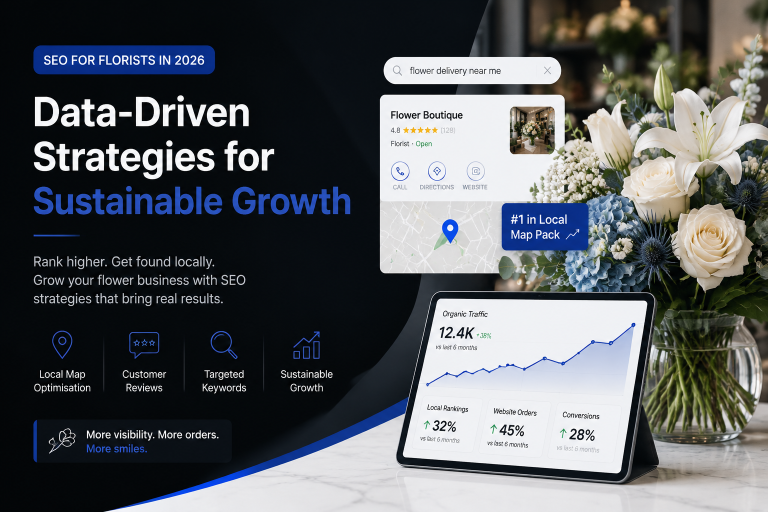
SEO for florists helps local flower shops rank higher in search results so nearby customers can easily find bouquets, event designs, and same-day delivery services. Success relies on local map optimization, targeted local keywords, and fast, user-friendly website pages.
With 46% of all Google searches now carrying local intent, florists who ignore search visibility are silently handing customers to competitors. A stunning shop window means nothing if your digital doors are locked. The good news? A deliberate local SEO strategy puts your arrangements in front of ready-to-buy customers at the exact moment they search. At Inteliware Growth, we don’t guess we apply performance data to turn your flower shop into the obvious local choice. This guide walks you through every component of modern florist SEO, from your Google Business Profile to the technical tweaks that turn browsers into buyers, so your phone rings and your delivery van stays busy.
Local optimisation: getting found in the map pack
When someone searches “flower delivery near me,” Google’s local 3-pack dominates the screen. You can’t afford to be invisible there.
Claim and fully optimise your Google Business Profile (GBP)
Your GBP is your digital storefront. Make sure it shows your exact shop address, phone number, open hours, and a direct link to your ordering page. Upload fresh photos of your arrangements weekly Google favours actively managed profiles. Use the correct primary category, “Florist” or “Flower Delivery,” and add secondary options like “Wedding Service” if relevant. A complete, accurate profile is the single fastest way to appear for high-intent local searches.
Collect customer reviews relentlessly
88% of consumers trust online reviews as much as personal recommendations. After every sale, send a polite text or email with a direct review link. Respond to every review, positive or negative, to show you’re active and to reinforce keywords naturally in your replies. Consistent, recent reviews are one of the strongest local ranking signals and heavily influence click-through from the map pack.
Define your service areas clearly
Add the neighbourhoods and towns you deliver to inside your GBP settings, on your website footer, and in social media bios. Mention specific locations in your on-page copy (e.g., “serving Chorlton, Didsbury, and Central Manchester”). This signals relevance to Google for those specific geographic queries and helps customers instantly know you cover their area.
Leverage Google Posts and Q&A
Use the Posts feature weekly to promote seasonal specials, new arrivals, or limited-time discounts. Populate the Q&A section with common questions about delivery times, bouquet customisation, and payment options. Google often surfaces this directly in search. Pro tip: add driving directions to your GBP using the “driving directions” attribute to help mobile users navigate straight to your shop.
Keyword & content strategy for florists
Ranking isn’t just about quantity of content; it’s about matching real buyer intent with a clear, helpful answer.
Target local long-tail keywords
Move beyond broad terms like “flowers.” Instead, build your strategy around high-intent phrases “wedding florist in [city],” “same-day flower delivery [neighbourhood],” “prom corsages near me,” and “sympathy flowers [town].” Use Google’s Keyword Planner, AnswerThePublic, and the “People Also Ask” boxes to uncover real questions your customers are typing right now. Create a keyword map where each page targets one primary phrase and several closely related secondary phrases.
Build dedicated pages for seasonal spikes
Create standalone, evergreen URLs for Valentine’s Day, Mother’s Day, Christmas, graduations, and funerals. Each page needs its own unique title tag (e.g., “Valentine’s Day flower delivery London | fresh roses & arrangements”), original localised content, and a prominent “Order Now” button. These pages accumulate authority year after year, so publish them early and update them annually. Don’t delete and recreate them.
Write blog posts that solve real problems
Answer the questions your customers ask in the shop how to make flowers last longer, the meaning of different rose colours, or the difference between a posy and a hand-tied bouquet. A florist blog shouldn’t read like a botany textbook. Write like you’re talking to a stressed partner buying an anniversary gift. This conversational, expertise-driven approach wins featured snippets and builds trust. Consider these proven blog topics:
- A guide to wedding flower budgets by season
- How to care for sympathy lilies
- The best office plants that need zero sunlight
- Birthday flowers by birth month and their meanings
For more content ideas and examples of how we structure high-ranking local pages, explore our blog.
Technical website tips that drive conversions
You can have the best bouquets in town, but if your site loads like a 90s dial-up, customers bounce before the roses load.
Compress and resize all bouquet images
High-resolution photos are essential, but they must be compressed without visible quality loss. Convert images to WebP format, implement lazy loading, and always include descriptive alt text (“pink peony wedding bouquet in glass vase” rather than “IMG_0043”). Fast-loading visuals keep users on the page and improve Core Web Vitals, a direct ranking factor.
Keep your online menu clean and mobile-first
Over 70% of local searches happen on smartphones. Your online catalogue should feel like a frictionless shopping experience large product cards, visible prices, a sticky “Add to Cart” button, and a simple checkout. Test your site on a five-year-old Android phone. If it frustrates you, it’s losing you orders. Also, implement a click-to-call button so mobile users can phone you instantly from the search results.
Implement local business and product schema
Add LocalBusiness structured data markup to your homepage so Google instantly understands your shop name, address, phone number, opening hours, and review rating. For individual bouquet pages, use Product schema with price, availability, and image. These rich results can display star ratings and price directly in search, boosting click-through rate by up to 30%.
Ensure HTTPS and a logical site architecture
Every page must load securely via HTTPS. Use breadcrumb trails, interlink seasonal pages to your main shop, and keep your most valuable pages (order now, delivery info) one tap from the homepage. A clear, flat architecture helps Google crawl your site efficiently and helps users find what they need without frustration.
Building local authority with citations and links
SEO isn’t just about what’s on your site; it’s also about how the wider web validates your business.
Secure consistent citations
List your florist on high-quality directories like Yell, Yelp, Thomson Local, and local chamber of commerce sites. Your Name, Address, and Phone number (NAP) must be identical across every single listing. Inconsistencies confuse Google’s trust in your business data and can silently drop your local rankings.
Earn backlinks from local partners
Collaborate with wedding planners, venues, event stylists, and local lifestyle bloggers. Offer to write a guest piece on “Flower trends for spring weddings” in exchange for a link back to your seasonal landing page. A single relevant, local backlink can move the needle more than dozens of generic directory entries.
Get involved in local events
Sponsor a charity gala, donate centrepieces for a fundraiser, or partner with a café for a Valentine’s pop-up. These often yield backlinks from .org or .gov.uk domains pure local authority gold. Send a press release to the local newspaper with a high-quality photo of your arrangement at the event; online news mentions frequently include valuable do-follow links.
Measuring what matters: SEO KPIs for florists
If you’re not tracking, you’re guessing. At Inteliware Growth, we live by the numbers.
Track the metrics that lead to orders
- Local ranking position for your top 10 commercial keywords
- GBP insights calls, direction requests, and website clicks
- Organic traffic to order page and checkout completion
- Conversion rate (completed orders / unique visitors)
- Review velocity and average star rating
- Bounce rate and time on page for key landing pages
Connect Google Search Console with Google Analytics 4
Set up conversion events for “click to call,” form submissions, and online order completions. Add UTM parameters to your GBP website link and social profiles to track exactly which channels are sending paying customers. This closes the loop so you know which keyword generated the £150 anniversary bouquet order.
Real-time dashboards for full transparency
Inteliware Growth builds custom dashboards that show live cost-per-lead, traffic quality, and revenue attributed to organic and paid channels. You see what you’re earning for every pound invested, without waiting for monthly reports. See real examples of our tracking in action on our Case studies page.
Common florist SEO mistakes that cost you orders
Avoid these frequent pitfalls that even established shops fall into.
Mistake 1: Ignoring seasonal page refreshes
Deleting last year’s Valentine’s Day page and creating a new one resets all your earned backlinks and authority. Always update the same URL annually.
Mistake 2: Using stock photos instead of real arrangements
Customers can spot generic images instantly. Original, high-quality photos of your actual work build trust and differentiate you from drop-shippers.
Mistake 3: Keyword stuffing
Writing “cheap flower delivery Manchester cheap flowers Manchester” reads terribly and violates Google’s spam policies. Write naturally for humans first, then review for keyword inclusion.
Mistake 4: Neglecting mobile speed
If your site takes longer than three seconds to load on a mobile device, you’re likely losing over 50% of potential customers before they even see a bouquet.
Mistake 5: Forgetting to add location pages
If you deliver to five surrounding towns, create a unique, valuable page for each, not duplicated thin content. Describe landmarks, local delivery times, and a phone number for each area.
How Inteliware Growth turns florist SEO into predictable revenue
You’ve got the local know-how; we’ve got the data-driven growth engine. Inteliware Growth is a UK-based performance marketing agency that builds precise frameworks for high-intent service businesses. While our deep expertise spans taxi companies, immigration law firms, app startups, cleaning companies, and medical clinics, the methodology we apply to florists is the same obsessive, ROI-first approach.
Our 5-step roadmap for florists
- Audit: Deep dive into competitor data, local search volume, and current funnel performance to find the biggest untapped opportunities.
- Strategy: Custom roadmap with KPIs, a content calendar tied to floristry seasons, and a smart channel mix. Organic, paid search, or both.
- Execution: We craft ad creatives, conversion-optimised landing pages, and GBP posts that turn local intent into phone calls and online orders.
- Tracking: Advanced attribution, call tracking, and transparent dashboards that connect every marketing pound to the cash register.
- Scale: We double down on what works, expanding budgets only when the data confirms profitability, not before.
Beyond organic SEO, our Google Ads management captures urgent “near me” traffic ready to buy immediately. Our conversion rate optimisation fine-tunes your ordering page so that traffic becomes same-day deliveries, not abandoned carts. We’ve helped local service businesses reduce cost per acquisition by over 40% and multiply qualified leads. Florists are the perfect match high visual appeal, local urgency, and strong repeat purchase potential.
[View all services](https://inteliwaregrowth.com/Services) to explore how we can custom-build a growth strategy for your shop.
Frequently Asked Questions about SEO for florists
How long does SEO take for a flower shop?
Local SEO can show initial movement in 4–6 weeks, but sustainable top-3 rankings typically take 3–6 months. Seasonal content often ranks faster when tied to upcoming occasions.
Do I really need a blog?
Yes. Two to three helpful posts per month on flower care, occasion guides, or arrangement styles capture long-tail traffic and build the expertise Google wants to reward.
What’s the fastest way to get more Google reviews?
Send a direct review link via text 24 hours after delivery. Make it effortless, and always respond genuinely to every review you receive.
Can I do SEO myself?
You can handle basics like GBP optimisation and review replies. Technical SEO, strategic keyword mapping, and conversion tracking often demand professional support to avoid costly mistakes.
Is SEO better than paid ads?
They work best together. Paid ads give you immediate visibility for high-intent searches, while SEO builds a long-term, compounding asset. A combined strategy maximises your market coverage and ROI.
Let’s grow your floral business together
You create arrangements that make life’s moments unforgettable. Let us make sure those moments always start with your website visible, fast, and ready to convert. Whether you need a full SEO overhaul, a Google Ads campaign that turns “flower delivery near me” into instant orders, or a conversion-focused website audit, Inteliware Growth has the data-driven playbook to get you there.
Book your free, no-obligation consultation today and discover the exact strategy we’d engineer for your flower shop.
Contact Us
📞 +92 344 3503901
📧 sales@inteliwaregrowth.com
📍 London, United Kingdom