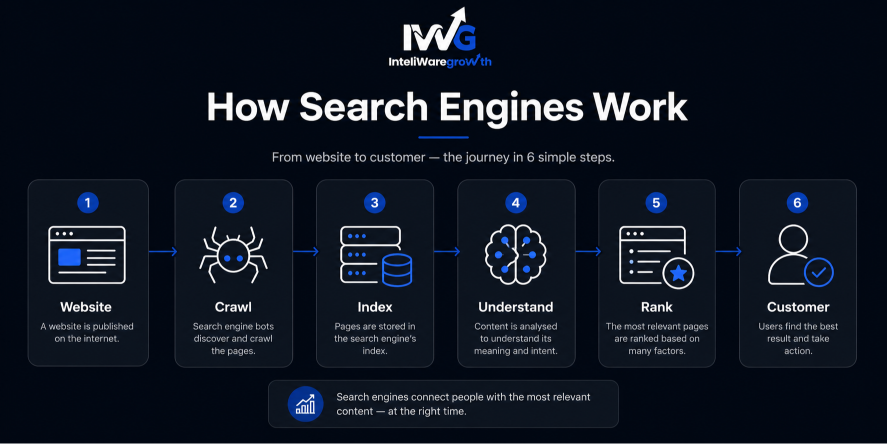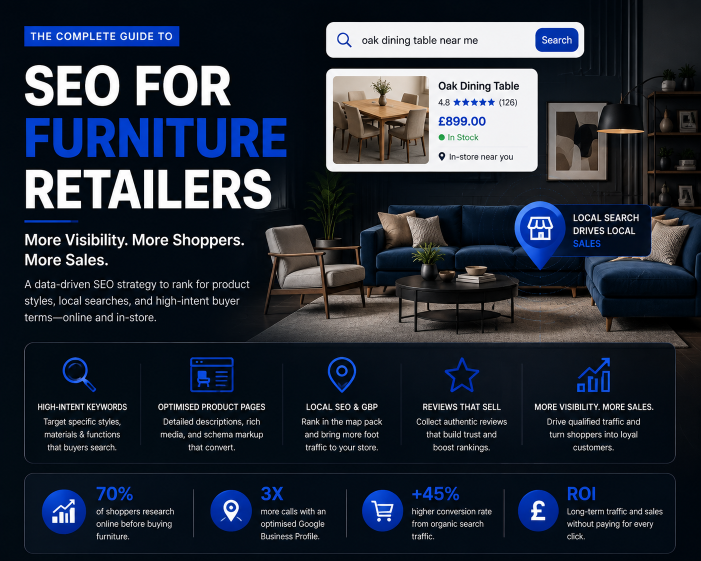
SEO for a furniture retailer involves optimizing your e-commerce site and physical showroom listings to rank for product styles, specific categories, and local searches. Success requires targeting high-intent buyer terms, optimizing rich media product pages, and maintaining a robust local footprint.
When a couple walks into your showroom, you don’t show them a mattress when they’re looking for a mid-century walnut dining set. Your SEO must work the same way. The furniture industry has shifted permanently: 70% of shoppers research online before ever stepping into a store, and high-ticket items demand trust signals that only a well-optimised digital presence can provide. At Inteliware Growth, we build data-driven frameworks for high-intent niches and furniture retail sits at the perfect intersection of local intent, visual-rich content, and specific buyer language. In this guide, I’ll walk you through the exact SEO playbook that moves the needle for furniture retailers, from micro-long-tail keyword targeting to technical image performance and local pack domination.
Keyword and on-page SEO for decor-savvy shoppers
The foundation of furniture SEO lies in how you structure your product and category pages – starting with the exact phrases your buyers use.
Target specific terms, not fashion-week buzzwords
A couch can mean a two-seater, a sleeper sofa, a sectional, or a dusty futon in a basement. Broad terms burn budget and attract browsers. Instead, target the precise materials, styles, and room contexts your ideal customer types into Google at 11 p.m. while redesigning their living room.
Examples of high-converting furniture keywords:
- solid wood dining table
- velvet sectional sofa with chaise
- Scandi oak coffee table
- queen storage bed frame with drawers
- mid-century modern desk for small home office
These phrases contain buyer intent modifiers: material, style, function, and size. Use them in your product page titles, H1s, meta descriptions, and image alt text. A customer searching for a velvet sectional sofa is mentally decorating – they’re far closer to purchase than someone typing sofa.
Optimise product pages as if they’re your best salesperson
Every product page must answer the silent questions a customer asks in-store: What are the dimensions? Can I customise the fabric? How do I care for the oak finish? Google rewards pages that fully satisfy user intent.
- Write detailed, unique descriptions that go beyond the manufacturer’s spec sheet. Include room-fits (e.g., fits comfortably in a 120 sq ft living room), assembly tips, and lifestyle phrases.
- List all attributes – colours, fabrics, wood types, weight capacity, cushion firmness – in scannable bullet points.
- Use descriptive file names for images: oak-extending-dining-table-6-seater.jpg instead of IMG_4592.jpg. This strengthens image search visibility and reinforces relevance signals.
- Add real-time price and stock status via structured data. When a searcher sees £899 – In Stock directly in the search snippet, click-through rates jump by up to 30%.
Add schema markup to stand out in the SERP
Furniture searches are increasingly visual and snippet-driven. Schema markup gives you that advantage.
- Product schema: Surface price, availability, review rating, and SKU.
- Offer schema: Indicate if a product is on sale, with valid dates.
- LocalBusiness schema: For showroom pages, include address, geo-coordinates, opening hours, and payment types.
When a user searches oak dining table near me, a well-marked-up page can display a rich result with a product carousel, star rating, and in-store availability – immediately building trust. At Inteliware Growth, we implement granular schema across all client e-commerce platforms to capture these visual SERP features.
Local SEO and showroom visibility that drive foot traffic
Your physical footprint is a powerful ranking asset when optimised correctly – here’s how to make every showroom count.
Own your Google Business Profile (GBP)
A furniture store with an incomplete GBP is like a showroom with the lights off. Google’s local pack dominates searches for furniture store [city], and your profile must be flawless.
- Keep operating hours, address, and phone number 100% consistent across your website, GBP, and all directories. A single mismatch damages local trust.
- Upload geo-tagged showroom photos weekly. Include departments like bedding displays, sofa galleries, and exterior signage. Google data shows businesses with over 100 images receive 520% more calls than those with fewer than 10.
- Use GBP posts to highlight new collections, seasonal sales, and in-store events.
- Select the right primary category (Furniture store) and secondary categories (Bedroom furniture store, Office furniture store) to appear in multiple local intents.
Build unique location landing pages
If you operate multiple showrooms, one generic Our Stores page suffocates local SEO. Each physical location deserves its own dedicated page.
A high-performance showroom page includes:
- Local delivery radius and zip codes served.
- In-store stock highlights (e.g., See our full Amish solid wood collection in our Manchester showroom).
- Embedded Google Map with directions.
- Unique testimonials mentioning the specific location.
- Local phone number and a click-to-call button.
- Internal links to products that are physically on display.
These pages help you rank not just for city-level terms but for hyper-local searches like sofa delivery Leeds, capturing bottom-of-funnel demand.
Collect and leverage reviews that mention products
Reviews are local SEO fuel. They inject fresh, keyword-rich content onto your GBP and product pages while signalling relevance. Encourage in-store and online buyers to mention the specific item they purchased and the location.
For example, a review stating “We love our new velvet corner sofa from the Bristol showroom – delivery was within 4 days” naturally includes high-intent keywords and a local modifier. This influences both the Google local algorithm and the human decision-maker scanning star ratings. Automate review requests via email and SMS post-purchase to build a steady stream of trust signals.
Content and technical performance for fast, inspiring experiences
Beyond products, your site must educate and perform flawlessly on every device – these strategies cover both.
Publish buying guides that capture early-stage researchers
Before someone searches buy oak dining table, they search how to choose a dining table for a small kitchen. These informational queries represent the top of the furniture buyer’s funnel. By publishing comprehensive guides, you insert your brand into the consideration set months before the purchase.
Buying guide ideas that attract furniture shoppers:
- How to Choose the Right Sofa Size for a Small Living Room
- Solid Wood vs. Engineered Wood: Which Dining Table Lasts Longer?
- The Ultimate Fabric Guide for Pet Owners (Best Upholstery for Durability)
- Bedroom Layout Sizes: Will a King Bed Fit in My Room?
In each guide, embed internal links directly to relevant product categories and product pages. A reader of How to Choose the Right Sofa Size who clicks on Shop 2-Seater Sofas has a dramatically higher conversion probability than a cold visitor. At Inteliware Growth, we call this the content-to-category handshake – it’s a core part of our conversion rate optimisation (CRO) playbook for service industries, and furniture retail thrives on the same logic.
Compress heavy images without killing the visual punch
Furniture sells on imagery. But 4MB PNG files kill your Core Web Vitals and frustrate mobile shoppers. The solution isn’t to drop quality; it’s to serve modern formats aggressively.
- Convert all product images to WebP format – it reduces file size by up to 35% versus JPEG with no visible quality loss.
- Implement lazy loading so images load only as the user scrolls.
- Use a CDN to serve images from servers close to the user’s location.
- Define explicit image dimensions in HTML to prevent layout shift as images load (a key Cumulative Layout Shift metric).
- Compress images to around 100-150KB for hero shots and 70KB for thumbnails.
Research confirms a one-second delay in mobile load time can cut conversions by up to 20%. For a furniture retailer, that’s a sofa left in the cart.
Use internal linking as a guided shopping pathway
Site architecture matters. Blog posts, buying guides, and category pages must function like a showroom floor plan – logically flowing visitors toward product pages.
- Link from any design guide to the relevant collection (e.g., from Scandi Bedroom Ideas to Scandi Bed Frames).
- On product pages, use a Shop the Look or Complete the Room section linking to complementary products (linking a dining table to matching chairs).
- Ensure your highest-priority category pages (e.g., Sofas, Dining Sets) are no more than one click from the homepage.
This distributes link equity, reduces bounce rate, and increases pages per session – all positive signals to Google.
How Inteliware Growth applies this framework
We don’t just write about SEO; we execute it with transparent, data-backed methodologies. While our core growth frameworks were built for high-intent service niches like taxi companies and immigration lawyers, the same rigorous 5-step roadmap applies to furniture retailers. We audit your market, build a custom channel strategy, launch optimised creatives, implement granular tracking, and then scale budget only when the data confirms profitability.
If you’re ready to turn Google searches into showroom visits and online sales, explore our case studies to see real client results, and reach out for a tailored strategy.
Conclusion
SEO for furniture retailers isn’t a one-time setup; it’s a continuous cycle of targeting the exact language of in-market shoppers, proving local relevance, and delivering a flawless technical experience. When you combine product page precision with robust local signals and guide-style content that handholds the buyer, you build a search presence that doesn’t just rank – it converts.
Start with your highest-margin product lines, optimise their pages down to the image file name, claim every inch of your Google Business Profile, and create the buying guides that answer the questions your customers are asking tonight. Then track everything because in furniture retail SEO, what gets measured gets scaled.
Need a tailored strategy that aligns SEO with your showroom footfall and e-commerce revenue? Speak to our team today.
Contact Us
📞 +92 344 3503901
📧 sales@inteliwaregrowth.com
📍 London, United Kingdom
Frequently Asked Questions
How long does SEO take to show results for a furniture store?
Long-tail product terms and local rankings often improve within 3–6 months; highly competitive head terms can take 9–12 months.
What are the best keywords for furniture retailers?
Specific, multi-word phrases like velvet sectional sofa with chaise or solid oak coffee table that combine material, style, and function.
How do I optimise product images for SEO?
Use descriptive file names, compress to WebP under 150KB, add keyword-rich alt text, and set explicit width/height to prevent layout shifts.
Is local SEO really necessary if I also sell online?
Yes. Local signals boost trust, trigger available near you labels, and often drive both online orders and showroom visits.
Should I invest in paid ads alongside SEO?
Definitely. SEO builds long-term visibility while Google Shopping and Local Inventory Ads capture immediate high-intent demand.