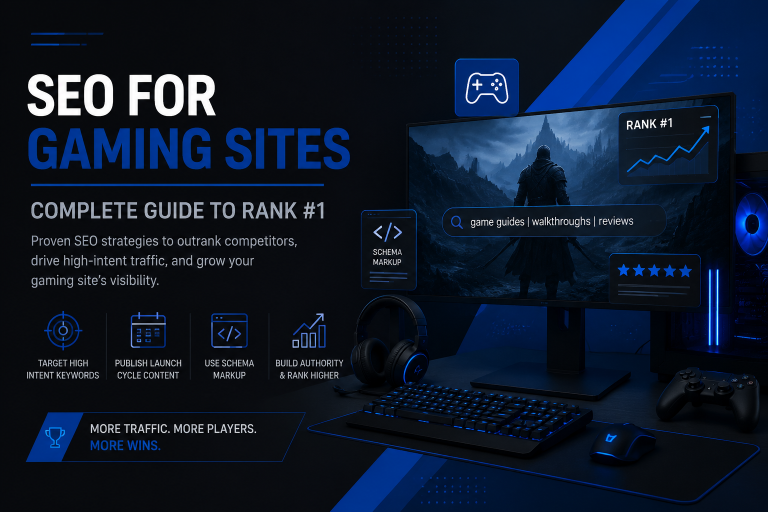
SEO for gaming sites focuses on targeting high-intent search terms like game guides, hardware specs, release dates, and reviews. Success requires matching content to player behavior, optimizing technical performance for mobile and desktop, and building authority through community engagement.
The global gaming industry is worth over $200 billion, and every minute millions of players search for tips, walkthroughs, and new titles. If your gaming website isn't visible at the exact moment of intent, you're leaving traffic and revenue on the table. But gaming SEO is not a simple copy-paste of general SEO. It demands a deep understanding of gamer psychology, rapid content lifecycles, and technical precision.
At Inteliware Growth, we've scaled digital presences for high-intent niches by building performance marketing strategies that convert. In this guide, I'll walk you through the exact strategies that help gaming sites rank on Google's first page—and stay there—while aligning with Google's E-E-A-T signals and AI overview recommendations.
What is gaming SEO?
Gaming SEO is the practice of optimizing a website that publishes video game-related content to earn organic visibility in search engines like Google. This includes game review portals, esports news sites, gaming wikis, hardware comparison blogs, and official game pages.
Unlike generic SEO, gaming SEO must cater to rapidly shifting player interests. Search intent spikes around patch notes, expansion releases, and viral clips. A gaming site's success depends on predicting those search surges and publishing authoritative, fast-loading, well-structured content exactly when players need it.
The core objective is to satisfy user intent immediately: a player looking for how to beat the final boss in Elden Ring doesn't want a generic game review. They want a step-by-step guide with embedded visuals. That's the level of precision gaming SEO demands.
Why gaming SEO matters more than ever
Organic search is the largest consistent traffic driver for most gaming sites. Social media algorithms change; paid ads become expensive. But a well-optimized article can generate traffic for years.
Consider this: over 70% of gamers use search engines to find help or discover new games. A site that ranks #1 for a set of high-intent keywords captures the lion's share of clicks—and that translates directly into ad revenue, affiliate sales, or community growth.
Moreover, Google's AI Overviews now pull structured, authoritative content directly into the search results. If your site implements schema markup and demonstrates topical expertise, you're far more likely to be featured as a trusted source. Ignoring gaming SEO means surrendering that visibility to competitors.
Understanding gamer search intent
To rank, you must first understand why gamers search. Their queries typically fall into four buckets:
- Informational (how to solve the water temple puzzle) – The player needs a clear, visual walkthrough.
- Commercial investigation (best gaming laptop under $1500) – They're comparing options before a purchase.
- Transactional (buy Diablo IV digital code) – They're ready to convert.
- Navigational (IGN Elden Ring review) – They want a specific brand's take.
Your content must be mapped precisely to these intents. A guide that mixes promo codes with a beginner's tutorial confuses both users and search engines. Always design each page to answer one primary question completely.
6 key SEO strategies for gaming sites
Here are the non-negotiable tactics we implement when scaling gaming sites. Each one addresses a specific Google signal, from content depth to technical excellence.
1. Target long-tail keywords
Broad terms like Minecraft are almost impossible to rank for without a decade-old domain. Instead, focus on specific, low-competition queries that carry clear intent.
Examples include how to beat level 5 in [Game], best settings for [Game] on low-end PC, or fix [Game] stuttering on Windows 11. These long-tail phrases often have lower search volume individually, but collectively they build a massive, engaged audience.
Use tools like Ahrefs or Google's People Also Ask to mine these queries. Then create dedicated, in-depth pages for each one. This approach builds topical authority and signals to Google that your site covers the niche exhaustively.
2. Publish launch-cycle content
Gaming search demand is event-driven. Align your publishing calendar with game patches, DLC drops, hardware releases, and seasonal events when search volume peaks.
For example, when a major expansion launches, thousands of players simultaneously search for best class [new expansion]. A site that publishes that comparison guide 24 hours before launch can capture a massive organic traffic spike. At Inteliware Growth, we build editorial calendars around confirmed launch dates and use tools like Google Trends to anticipate surges.
The key is to prepare the content skeleton in advance, then update it with live data the moment embargoes lift. Freshness is a ranking factor, and launch-cycle content signals that your site is a go-to resource during critical windows.
3. Use schema markup
Schema markup helps search engines understand the type of content you're offering and display rich snippets like ratings, platforms, and release dates directly in the SERPs. For gaming sites, three schema types are particularly powerful:
- VideoGame schema: Highlights the game's name, platform, genre, and aggregate rating.
- Review schema: Shows star ratings and reviewer name, increasing click-through rates.
- HowTo schema: Perfect for walkthroughs, with step-by-step structured data that can trigger a visual guide in results.
Implementing schema correctly can boost your organic CTR by up to 30%. Use JSON-LD format and validate it through Google's Rich Results Test. At Inteliware Growth, we treat schema as a fundamental layer of our SEO and CRO services.
4. Incorporate visuals authentically
Gamers are visually oriented. Embedding authentic gameplay clips, official trailers, and high-resolution screenshots directly into your content increases time-on-page and signals content quality to search engines.
A boss fight guide with annotated screenshots and a 30-second embedded clip showing the dodge timing will outperform a text-only version every time. Don't stuff stock images. Use your own recordings or licensed footage from publishers.
Compress images and videos properly to avoid slowing down the page. A visual-rich page that loads fast keeps users engaged and reduces bounce rate—both positive user experience signals that Google considers for rankings.
5. Optimize site speed relentlessly
Many gamers search for quick fixes or walkthroughs straight from mobile devices while they're playing. If your page takes more than 2.5 seconds to become interactive, you'll lose them.
Core Web Vitals—Largest Contentful Paint (LCP), First Input Delay (FID), and Cumulative Layout Shift (CLS)—are direct ranking factors. Use a CDN, implement lazy loading for images and videos, minify CSS/JS, and choose a performance-optimized hosting solution.
Clean mobile performance is non-negotiable. Over 60% of gaming-related searches now come from mobile devices. Test your pages using Google's PageSpeed Insights and fix every opportunity flagged. Technical speed is the foundation upon which all other SEO efforts rest.
6. Build community backlinks
Gaming communities are tight-knit. Earning backlinks from active forums, Reddit communities, and streaming creators signals genuine authority far more than mass directory links.
Participate authentically in subreddits like r/gaming or game-specific communities. Share your guides when they genuinely answer a question, not as spam. Collaborate with Twitch or YouTube creators to co-create content, then link back to your full guide.
These links are often nofollow, but they drive real traffic and build brand signals. Over time, journalists and wiki editors will cite your resource as the definitive source, earning you powerful editorial backlinks. At Inteliware Growth, we integrate community-driven link acquisition into every gaming SEO roadmap.
Technical SEO backbone of a high-ranking gaming site
Technical excellence separates an average gaming blog from a dominant one. Here are the must-have foundations:
- Mobile-first indexing: Ensure your site's mobile version has identical content and is fully responsive.
- Crawl efficiency: Use a logical URL structure, an XML sitemap, and a clean robots.txt. Avoid infinite crawl spaces caused by faceted navigation (e.g., filtering games by 10 parameters).
- Structured internal linking: Interlink guide pages, review pages, and category hubs. A strong internal link graph helps search engines discover new content and distributes authority across your domain.
- HTTPS security: Gamers are highly sensitive to malware. A secure site is a trust signal.
- Avoid heavy JavaScript reliance: Many gaming sites use heavy frameworks. Ensure critical content is server-rendered and accessible without JavaScript, so Googlebot can index it completely.
Content strategy that sustains rankings
A winning gaming content strategy balances evergreen hub pages with rapidly updated news and guides.
- Pillar pages & clusters: Create a comprehensive hub for each major game, then link out to detailed sub-guides. For example, an Elden Ring Complete Guide Hub linking to boss guides, build guides, and lore articles.
- User-generated content moderation: If you host forums or wiki sections, moderate them for quality. Low-value, thin comment pages can drag down your site's overall quality score.
- Freshness updates: Revisit older guides after major patches. Add an Updated for Patch 1.08 note and republish with the current date. Google rewards recently updated, accurate content.
Measuring gaming SEO success
You can't optimize what you don't measure. Track these KPIs monthly:
- Organic clicks & impressions (Google Search Console) – identify which queries are growing.
- Average position for target keyword clusters.
- Click-through rate (CTR) – a low CTR on a high-ranking page often means your title/meta needs tweaking.
- Engagement metrics (time on page, scroll depth, bounce rate) – especially critical for guide pages.
- Backlink growth – new referring domains, with a focus on gaming-relevant sites.
- Conversions – whether that's ad revenue, affiliate clicks, or newsletter sign-ups.
If you need help setting up proper tracking and attribution, explore our [SEO services](https://inteliwaregrowth.com/SEO) to turn raw data into revenue.
Common gaming SEO mistakes to avoid
- Keyword stuffing: Forcing game names into every sentence harms readability and triggers spam filters.
- Ignoring video SEO: Many gaming queries have video results. Optimizing your YouTube channel and embedding videos with schema can capture dual real estate.
- Slow adaptation: Publishing patch note summaries a week late misses the peak traffic entirely.
- Neglecting E-E-A-T signals: Don't hide who writes the guides. Add author bios with gaming credentials, link to their social profiles, and cite primary sources.
FAQ
How long does gaming SEO take to show results?
For a new site, expect 6–9 months to see consistent organic traffic growth, though launch-cycle content can rank within days if you hit a low-competition query exactly at peak.
Do I need a separate mobile version of my gaming site?
No. A fully responsive design that passes Core Web Vitals on mobile is the modern standard. Avoid separate m-dot sites, as they can create indexing issues.
Can I use AI-generated content for game guides?
AI can help outline content, but gamers and Google alike penalize shallow, inaccurate information. Every guide must be reviewed, fact-checked, and enhanced by a human expert with genuine gaming experience.
How do I find the best long-tail keywords for a new game?
Use the game's official forums, Reddit threads, and Google's autocomplete after typing the game's name plus how to or best. These reveal exact player pain points.
Is schema markup really worth the effort?
Absolutely. Sites with review or HowTo schema can see a 20–30% uplift in organic CTR, directly influencing rankings and traffic.
Conclusion
Gaming SEO is a dynamic discipline that rewards publishers who marry deep player understanding with technical precision. By targeting long-tail intent, syncing with launch cycles, embedding rich visuals, and building genuine community links, you can build a digital asset that grows traffic year after year.
At Inteliware Growth, we specialize in building data-driven, high-converting organic funnels for niche industries—including gaming-related platforms. Whether you run a game review portal, an esports hub, or a hardware comparison site, learn more about how we scale businesses and turn your traffic into a predictable growth engine.
Ready to level up your gaming site's SEO?
Book a free consultation with our team and discover the exact roadmap to dominate search rankings while slashing customer acquisition costs.
Contact Us
📞 +92 344 3503901
📧 sales@inteliwaregrowth.com
📍 London, United Kingdom