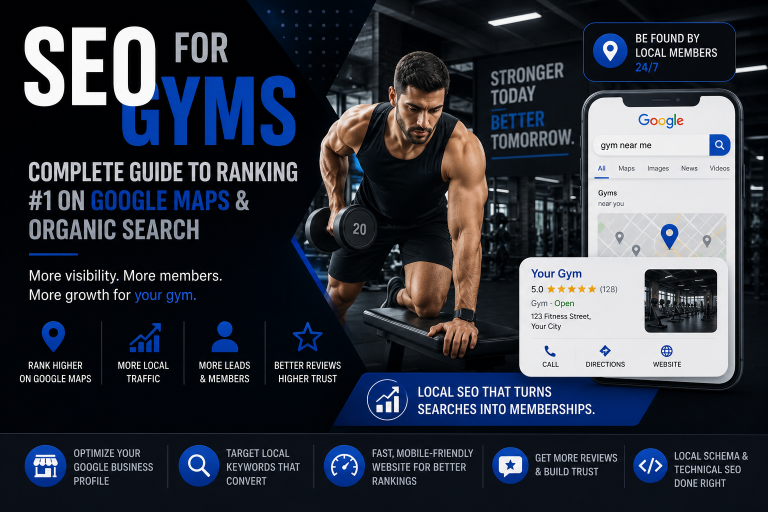
SEO for gyms is a hyper-local strategy focused on ranking your fitness center on Google Maps and organic searches when nearby users look for terms like “gym near me” or “personal training in [city]”. Success relies on optimizing your Google Business Profile, targeting local keywords, building fast mobile pages, and gathering customer reviews.
In the fitness industry, your next member is probably searching on a phone right now, standing a few blocks away. If your gym doesn’t appear in that moment, you hand the revenue to a competitor. At Inteliware Growth, we build data-driven growth frameworks for high-intent service industries. You can [View our services](https://inteliwaregrowth.com/Services) to see exactly how we approach performance marketing. This guide translates that expertise into a local SEO playbook that helps gym owners, personal trainers, and boutique studios convert nearby search traffic into paying members.
Why local SEO works 24/7 for gyms
Traditional ads interrupt. Local SEO captures demand. A prospect who types “HIIT classes near me” during lunch has already decided to work out. If your gym appears in the Google Maps 3-pack with accurate details, high ratings, and an easy booking link, a walk-in often follows within hours.
This bottom-of-funnel traffic converts far better than cold outreach. You are not trying to convince someone to start a fitness journey. You are simply being found by someone who already decided to begin one. The key is understanding and executing Google’s local ranking signals, exactly what we will break down step by step.
Google Business Profile optimization - your digital storefront
Your Google Business Profile is the single most powerful local ranking tool for any gym. A neglected profile implies a neglected facility. Optimization here is non-negotiable.
Claim and verify your listing with exact details
Start on the Google Business Profile platform and ensure your business name, address, and phone number (NAP) exactly match the footer of your website. Even “Street” versus “St.” can weaken your local signal. Set your primary category to “Gym” and add secondary ones like “Personal Trainer” or “Yoga Studio”. Meticulously populate business hours, including holiday schedules, to prevent wasted trips and member frustration.
Upload high-resolution photos that sell the experience
Avoid stock images completely. Show real classes in full swing, clean equipment, tidy locker rooms, and staff welcoming members at the front desk. Add a short video walkthrough of your facility. Profiles with 100 or more original, high-quality images typically generate double the monthly clicks of those with fewer than 20. Update your gallery weekly so it never looks stale.
Build a reputation loop with reviews and replies
Reviews are a direct local ranking factor. Ask for them after milestone moments, right after a client hits a personal best or finishes a high-energy Saturday class. Use a short, branded review link that goes straight to the review box. More importantly, reply to every single review within 24 hours. A genuine, non-templated response to a negative review shows both Google and future members that you actively listen and care.
Local keyword strategy - mapping intent to memberships
Broad terms like “fitness” do not convert locally. Your keyword strategy must combine service intent with geographic precision.
Target neighborhood-level phrases
Move beyond just the city name. If you are based in Shoreditch, optimize for “gym in Shoreditch”, “Shoreditch boxing gym”, or “personal trainer near Hoxton Square”. Integrate these phrases naturally into homepage title tags and H1 headers. When Google sees this explicit location relevance, it serves your listing for “near me” searches with far greater confidence. This granular approach isolates users who are ready to walk through your door today.
Create dedicated service pages
Your homepage cannot rank for CrossFit, yoga, spin, and HIIT at the same time. Build a separate, detailed page for each core offering. A page like “CrossFit Training [City]” filled with coaching credentials, specific pricing, schedule widgets, and focused metadata signals deep topical authority. This architecture tells search engines you are a specialist, not a generalist, and it dramatically improves conversion rates because the landing page matches the user’s exact intent.
Embed NAP consistency everywhere
Wrap your name, address, and phone number in Local Business Schema markup and place the identical information in plain text in your website footer. This anchors your entity identity on every single page, reinforcing local relevance for search engines with zero ambiguity.
Technical and on-site SEO - speed, structure, and schema
A beautiful gym site that loads slowly on mobile bleeds members every day. Technical SEO is direct revenue protection, not just a developer task.
Mandatory mobile-first experience
Your class schedule must be perfectly legible on a small screen without any pinching or zooming. Trial booking forms need large, thumb-friendly buttons that are easy to tap. Eliminate intrusive popups that cover the screen and compress all hero images. Even a one-second delay in mobile load time can drop conversions by up to 20%. Use Google PageSpeed Insights and treat every red and yellow flag as a revenue leak. As part of our Conversion Rate Optimisation service, we fix these exact friction points before a single advertising pound is spent.
Implement Local Business schema
This structured data markup tells Google your exact location, coordinates, opening hours, and price range in a machine-readable format. It can trigger rich results that display your star rating, address, and pricing directly in organic search listings. That extra visual real estate dramatically lifts your click-through rate, even if you are sitting in position two or three.
Monitor health with Google Search Console
Connect your site to Google Search Console and check it weekly. Look for indexing errors on new service pages and 404 errors that might result from a deleted schedule link. Review the actual search queries bringing you impressions. If you rank for “cheap gym [city]” but your page talks about premium luxury pricing, the mismatch kills your conversion rate. Let data dictate content adjustments, not assumptions.
Content and reviews - building an authority flywheel
Service pages capture transactional traffic. Content captures educational traffic. Both require a systematic process to become a lead generation engine.
Write simple blog posts answering real local questions
Skip the generic industry news that no potential member cares about. Instead, create content like “Best Running Routes Around [Local Park] for Cardio Training” or “Healthy Lunch Spots Near [Gym Location]”. These posts capture locals who want a lifestyle partner and attract valuable geo-relevant backlinks from community blog. Keep paragraphs short, use bullet points where helpful, and include an internal link back to a free pass or consultation page in every single article. Check our blog for examples of how we structure high-performing content.
Systemize review generation with smart automation
Set up a post-visit email that fires 24 hours after a completed personal training session or introductory class. If the user clicks a positive star rating, redirect them straight to leave a Google review. If the feedback is neutral or negative, route them to a private internal form. This allows you to resolve the issue offline and prevent a public one-star rating that drags down your average score.
Build local citations on trusted directories
Ensure your gym is listed accurately on fitness aggregators like Mindbody and Class Pass, as well as strict regional business directories and local chamber of commerce pages. NAP consistency is critical here. An old phone number still floating on a dusty directory listing confuses Google’s knowledge graph and directly hurts your map pack performance.
How Inteliware Growth turns local search into gym revenue
Most agencies deliver a spreadsheet of traffic numbers and call it a day. That is vanity. We are a UK-based performance marketing agency obsessed with measurable ROI. Our 5-step roadmap for gyms mirrors the rigorous frameworks we use for high-stakes industries like immigration law firms and app startups. You can read real outcomes on our Case studies page.
We start with an Audit that deep dives into your competitor backlink profile and your current conversion friction points. Then we build a Strategy with real membership acquisition cost forecasts, not just traffic projections. During the Execution phase we launch conversion-optimized landing pages for specific programs like HIIT or yoga, backed by precise ad creative. Advanced Tracking gives you a live dashboard where you see exactly which keyword or channel generated a trial sign-up, right down to the pound. Finally we Scale your budget based purely on winning data and cut underperforming spend instantly. If a channel does not convert, it gets paused. If a keyword brings in members, its budget increases. This is how performance marketing builds profitable gyms.
Contact Us
📞 +92 344 3503901
📧 sales@inteliwaregrowth.com
📍 London, United Kingdom
Book Your Free Consultation
Frequently Asked Questions
How long does gym SEO take to show results?
Local map movement often begins within 3 to 4 months for an aggressively optimized profile. Competitive organic terms can take 6 to 9 months, while low-competition neighborhood long-tail phrases may rank in weeks.
Do I need a website if I have a Google Business Profile?
Yes. A GBP linked to a strong, locally optimized site ranks far higher than a standalone profile. Your website validates your entity and provides the depth of content Google needs to establish relevance.
Which is better for a gym, Google Ads or SEO?
They work best together. Ads deliver immediate visibility while SEO builds a free, compounding asset. A smart approach uses both to lower your long-term cost per member.
How do I get into the Google Maps 3-pack?
You must dominate what you can control. Maximize review volume and reply speed for prominence, and tightly match your GBP categories and on-page content to search queries for relevance.
Can I do gym SEO myself?
You can handle the basics like claiming your GBP and fixing NAP. Advanced keyword strategy, Schema markup, and earning quality local backlinks typically require specialist tools and experience, which is where a dedicated agency adds the most value.