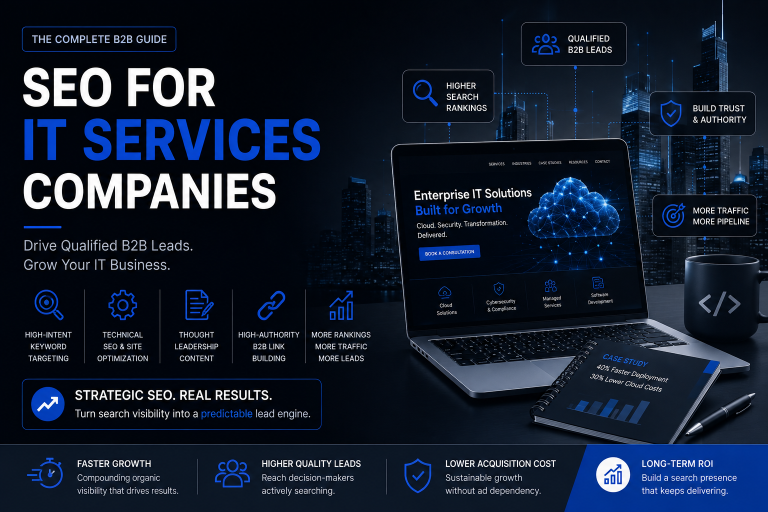
SEO for IT services companies focuses on targeting high-intent B2B keywords, optimizing technical site health, and demonstrating deep domain authority. Success requires shifting away from generic tech terms to specific solutions like cloud migration services or custom enterprise software development to attract qualified business leads.
In an industry where decision-makers spend weeks researching before contacting a vendor, your website must do more than look professional. It must show up for the exact problems your IT firm solves. This guide breaks down the exact SEO framework we use at Inteliware Growth to help tech service providers capture demand, build trust, and close more contracts through organic search.
Why IT services need SEO
Most IT buyers start with a search engine. They don’t ask for IT support; they search for SOC 2 compliance consulting for SaaS startups or managed Kubernetes cluster migration. Generic SEO tactics fail here. You need a strategy that maps to the buying committee’s language, addresses long sales cycles, and proves your firm can deliver on technical promises.
A well-executed SEO programme for an IT services company delivers three things consistently:
- Predictable lead flow from decision-makers actively evaluating solutions
- Lower customer acquisition cost compared to paid ads alone
- Compounding authority that makes future sales conversations easier
At Inteliware Growth, we’ve seen IT service firms double their organic pipeline within six months by applying the strategies below. Explore our case studies to see real client results.
Core SEO strategies
A complete SEO plan for IT companies rests on five pillars. Execute them together to build lasting organic visibility.
Intent-driven keyword mapping
The biggest mistake IT companies make is chasing high-volume, vague keywords like IT services or software development. These terms attract hobbyists, students, and irrelevant traffic, not the CFO or CTO holding a budget.
Instead, build your keyword map around three layers:
Service-line keywords
Target the specific solutions you deliver. Use modifiers that signal commercial intent:
- enterprise SaaS integration services
- legacy system modernisation consultant
- outsourced DevOps for fintech
Industry-vertical keywords
Pair your services with the niche industries you understand best:
- HIPAA-compliant app development for healthcare
- IT support for 50+ employee law firms
- cloud migration for manufacturing ERP
Problem-aware phrases
Many buyers search for symptoms, not solutions. Capture these with content that diagnoses and solves:
- why is our CI/CD pipeline slowing down deployment
- how to reduce cloud costs without scaling back
- signs your app architecture won’t support growth
Map each keyword to a dedicated service page, case study, or long-form guide. This stops keyword cannibalisation and signals deep relevance to Google.
Technical optimization
Technical SEO is where most IT firms have a natural advantage, yet often miss the mark. Your site might look fast to you, but crawling and indexing issues can kill rankings silently.
Focus on these non-negotiables:
Core Web Vitals and mobile performance
Your buyers open your site on phones during meetings. A Largest Contentful Paint above 2.5 seconds can drop you off page one. Google’s Core Web Vitals guidelines explain exactly which metrics matter. Compress images, defer non-critical JavaScript, and use a CDN.
Clean URL architecture and site structure
Organise pages by service family and industry. A logical hierarchy like /services/cloud-migration/aws/ helps both users and search engines understand your expertise.
Schema markup
Implement Organization and Service schema. For IT companies, also add SoftwareApplication or TechArticle schema where relevant. Structured data helps you win rich results and can improve how Google understands your service offerings.
Indexing hygiene
Audit regularly for orphan pages, redirect chains, and accidentally no-indexed critical pages. One misplaced robots.txt directive can hide your best service page from search entirely.
Thought leadership content
IT buyers don’t purchase on a whim. They evaluate vendors over weeks, comparing technical depth and reliability. Thought leadership content bridges the gap between a click and a contract.
Build E-E-A-T (Experience, Expertise, Authoritativeness, and Trust) by publishing:
- Technical whitepapers: Deep dives into architecture decisions, security frameworks, or benchmarking data. Gate one or two to generate leads.
- Original case studies: Present real results like how we reduced API latency by 40% for a travel booking platform. Include challenges, the approach, and hard numbers.
- Process and methodology guides: Demonstrate how you approach a migration, an audit, or a tool selection. This gives procurement teams confidence in your rigour.
- Industry commentary: React to changes in regulations, major outages, or new cloud pricing. Timely, expert analysis earns backlinks and shows you operate at the forefront.
Each piece of content should link to a relevant service page and include a clear next step, whether that’s downloading a full report or booking a scoping call. Our blog contains examples of how we structure technical content for maximum lead generation.
B2B link building
Backlinks remain a top ranking factor, especially in competitive B2B tech spaces. But guest posting on generic blogs won’t move the needle. You need links that reinforce your domain’s technical authority.
Digital PR with data
Conduct small research studies, such as surveying IT leaders on cloud cost trends. Pitch the findings to tech publications, analyst blogs, and industry newsletters. Journalists love proprietary data.
Contributions to trusted tech platforms
Write tutorials for sites like DevOps.com, DZone, or InfoQ. Focus on solving a specific problem with a step-by-step guide, and link naturally to a related resource on your site.
Software and service directories
Claim and optimise profiles on Clutch, G2, GoodFirms, and niche directories like the AWS Partner Network or Microsoft Solution Provider listings. These send referral traffic and send strong trust signals to Google.
Partner and integration backlinks
If you resell or integrate with tools like Salesforce, HubSpot, or ServiceNow, earn links from their partner ecosystems by producing joint webinars or case studies.
Local and regional targeting
Even if your IT firm serves clients globally, specific regions often generate the highest-value contracts. Tech hubs like London, New York, Berlin, and Bangalore have concentrated demand and concentrated competition.
Google Business Profile for IT services
Optimise your profile with your primary service categories, a detailed business description using service keywords, and high-quality images of your team or office. Publish regular updates about completed projects or new certifications.
Location-specific landing pages
Don’t just stuff city names into generic pages. Create genuinely useful pages that discuss regional nuances: data sovereignty requirements, local tech ecosystem maturity, or in-person implementation availability.
Local citations and reviews
Build citations on local chamber of commerce sites, tech association directories, and B2B review platforms. Actively collect Google reviews from satisfied clients; these influence local pack rankings and conversion rates.
Regional event and meetup content
If your team speaks at or sponsors London Tech Week or a local AWS meetup, document it with a recap post. Tag location and event names. This feeds local relevance and can attract links from event pages.
Measuring SEO success
Vanity metrics like total traffic won’t pay the bills. Tie every SEO effort to revenue outcomes.
Track these key performance indicators:
- Keyword positions for high-intent service terms: Monitor top 10 rankings for your money pages.
- Organic goal completions: Form fills, demo requests, whitepaper downloads, and phone calls originating from organic search.
- Assisted conversions: See how many deals touched an organic page before closing.
- Pipeline value by source: Tag leads in your CRM by first-touch channel and measure closed-won revenue.
Use Looker Studio custom dashboards (similar to our real-time reporting framework at Inteliware Growth) to give your leadership team visibility into SEO’s contribution without drowning in spreadsheets. Learn more about our approach on our full services page.
The Inteliware Growth approach
We aren’t an agency that dabbles in everything. Our entire business is built on driving measurable growth for high-intent service industries, including IT services firms that need qualified B2B leads, not just traffic. Our five-step scaling framework translates directly to SEO success:
- Audit: We perform a technical and content gap analysis against your top three competitors, identifying exactly which keywords and pages drive their pipeline.
- Strategy: We build a custom roadmap with KPI forecasting, content calendars, and link acquisition targets.
- Execution: From technical fixes to publishing specialist content, our team handles every detail.
- Tracking: We implement attribution that shows which organic pages influence deals, not just last-click conversions.
- Scale: Once the data proves what’s working, we double down on winning clusters.
Ready to turn your IT services website into a lead engine?
📞 Call us at +92 344 3503901
📧 Email sales@inteliwaregrowth.com
📍 Our team operates from London, United Kingdom, serving IT firms globally.
FAQs
How long does it take to see results from SEO for an IT company?
Expect meaningful ranking and lead improvements within 4 to 8 months. Competitive niches may take 12+ months.
Should IT services companies focus on national SEO or local SEO?
Use both if you serve remote clients and have strong regional demand. National SEO captures wide-funnel searches, while local SEO targets ready-to-hire prospects near key tech hubs.
What’s the most important ranking factor for B2B tech sites?
Relevance and authority. Match content precisely to buyer queries and earn links from respected tech publications.
Can we do SEO without a blog?
Yes, but a blog is the fastest way to publish thought leadership and capture long-tail buyer questions at scale.
How do we compete with larger IT consultancies in search?
Specialise in niche service-industry combinations they ignore, create deeper content, and build links through original data. For a detailed breakdown, read Google’s guide on creating helpful, people-first content.
Your IT services SEO blueprint starts here
SEO for IT services companies isn’t about chasing algorithm tricks; it’s about building a digital footprint that mirrors your firm’s technical depth and reliability. When you align intent-driven keywords, bulletproof technical foundations, authoritative content, trusted backlinks, and local signals, you create a system that attracts exactly the clients you want.
At Inteliware Growth, we’ve engineered growth for niche service providers across industries, from taxi companies and immigration lawyers to app startups, cleaning companies, and doctors & clinics. The same data-obsessed rigour we bring to paid campaigns powers our SEO strategies.