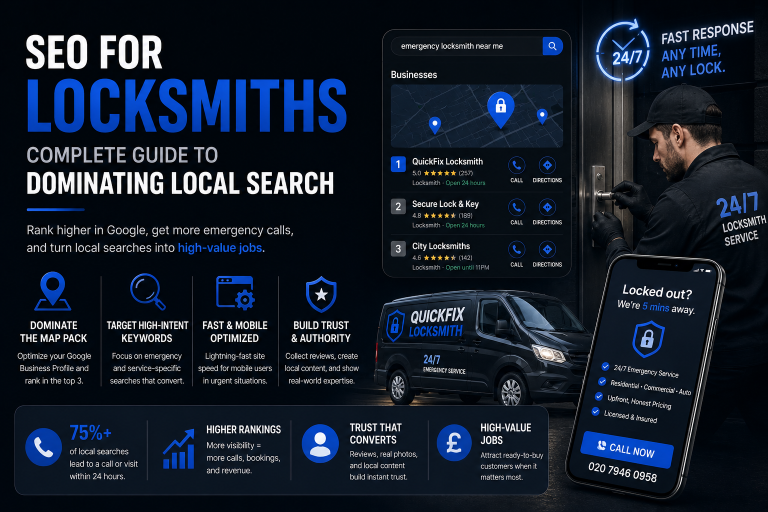
Locksmith SEO is a high-intent local marketing strategy focused on ranking your business in Google’s Map Pack and organic search results. Because lockouts and security emergencies happen fast, success relies on optimizing your Google Business Profile, targeting emergency and mobile keywords, and ensuring rapid mobile site performance.
A potential customer loses their keys late at night, grabs their phone, and searches emergency locksmith near me. If your business doesn’t appear at the top of that screen, you’ve lost a high-value, immediate-revenue job to a competitor who did the local SEO work. This guide walks you through exactly how to get there and stay there, with a transparent, no-spam approach that Google rewards.
The emergency revenue engine
Over three-quarters of people who perform a local search on their smartphone visit a business within a day, and a significant portion of those searches result in a purchase. For locksmiths, that purchase is often a premium emergency call-out. Search volume for locksmith near me spikes on weekends and late at night, precisely when traditional marketing sleeps. Organic local search never clocks out.
Google’s local algorithm favours three signals: proximity, relevance, and prominence. Your strategy must satisfy all three simultaneously. The businesses that appear in the local 3-pack understand this. It’s also not just about the Map Pack. Organic blue links still capture serious traffic for research-based queries like how much to rekey a house or best keyless entry systems for business. A comprehensive SEO approach positions you as both the immediate solution and a trusted authority.
Local map pack optimization
The Map Pack is the trio of business listings that sits at the very top of a local search. For locksmiths, it’s often the only thing a stressed caller clicks. Dominating this space takes a meticulous, honest strategy.
Claim your profile and verify every detail
Your Google Business Profile (GBP) is the control centre. If you haven’t claimed and verified it, do that first. Use the exact business name on your storefront, with no added keywords or city names. Your address must be a real, staffed location Google can confirm. Fill in every field: primary category (Locksmith), secondary categories (e.g., Security System Supplier, Key Duplication Service), accurate hours including holidays, and a local phone number matching your website.
Add high-resolution photos weekly. A listing with recent images of your team, van, completed jobs, and shopfront tells Google you’re an active, legitimate entity. Use Google Posts to publish updates, safety tips, or offers. Freshness signals matter.
Reviews: Your revenue lifeline
Reviews are the strongest local ranking signal after proximity, and they provide the social proof that turns a panicked searcher into a caller. After every successful job, send a polite text or email with a direct link to your review form. Never incentivise, but make it effortless.
Respond to every review. A quick message like, Thank you, Sarah! Glad we could help with your late-night lockout in Hackney, shows Google you’re engaged. For negative reviews, stay professional and move the conversation offline. A well-handled complaint can build more trust than a wall of perfect scores.
Avoid spam, no exceptions
Locksmith SEO has been plagued by spam: fake virtual offices, keyword-stuffed names like Emergency 24/7 London Locksmith Cheap Fast, and residential addresses. Google’s algorithm and manual reviews now detect these patterns ruthlessly. A suspension wipes out your leads overnight and can take months to reverse. Stick to your real, single location. Your brand name stays clean.
Website & keyword strategy
Your GBP gets you found, but your website closes the deal and powers organic rankings for hundreds of long-tail searches the Map Pack doesn’t cover.
Target high-intent, long-tail keywords
Generic terms like locksmith London are competitive. The real conversions lie in intent-rich, urgent phrases. Build pages around specific services and emergencies, such as:
- emergency car lockout [city]
- rekey locks for new home [neighbourhood]
- 24 hour commercial locksmith near me
- install deadbolt cost [city]
- broken key extraction same day
Use keyword tools and Google’s autocomplete to find exact phrases people type during a crisis. Map each cluster to a dedicated page.
Build dedicated service pages
Each core service deserves its own clean URL: /residential-locksmith/, /commercial-locksmith/, /auto-locksmith/, and /emergency-locksmith/. Detail exactly what the service includes, coverage area, typical response times, and real examples. Embed genuine customer testimonials specific to that service.
If you serve multiple towns, build a unique location landing page for each. Mention local landmarks, community security concerns, and link to Google Maps directions. This hyper-local content proves authenticity and helps you rank for locksmith in [area] searches. Never copy-paste and just swap the city name.
Add local business schema markup
Schema markup is machine-readable code that clarifies your business information. Implement LocalBusiness schema (subtype: Locksmith) on your homepage and every service/location page. Include name, address, phone, hours, price range, and geo-coordinates. Validate it with Google’s Rich Results Test. Proper schema can generate review stars and sitelinks in organic results, boosting click-through rates.
Technical & mobile performance
A locksmith’s website is visited by someone standing in the dark, on a phone, with a dying battery. If it loads slowly or isn’t instantly usable, they bounce and call a competitor. Technical SEO for locksmiths must prioritise ruthless speed and mobile-first design.
Speed up pages for the locked-out user
Page speed is a ranking factor and a direct conversion lever. Run your site through Google’s PageSpeed Insights and focus on Core Web Vitals. Compress all images to WebP, implement lazy loading, minify code, and use a CDN. Eliminate render-blocking resources. Choose a fast managed host. A site that loads in under two seconds on 4G will consistently outrank and out-convert a sluggish one.
Design for mobile first, always
Your most critical element, the click-to-call button, must be a large, sticky, thumb-friendly button in the header. Phone numbers should always be tap-to-dial links. Keep the menu simple: Emergency Services, All Services, Contact. No intrusive pop-ups that hide the phone number, no autoplay video. The whole mobile experience must radiate reliability and immediacy. Minimal taps from lockout to rescue.
Build local links the right way
Earn natural backlinks from trustworthy local sources. Join your local Chamber of Commerce, locksmith trade bodies like the Master Locksmiths Association, and reputable directories such as TrustATrader or Checkatrade. Sponsor a youth sports team or host a free community security workshop, and you’ll often get a link from the club or local news. Never buy links or use PBNs. Google’s link spam update is unforgiving. White-hat relationship building demonstrates real-world involvement and strengthens local authority.
SEO + paid ads: Full-funnel visibility
SEO builds a sustainable, long-term pipeline, while paid search ads deliver instant presence. Together they are a powerful combination in competitive metro areas. A Google Ads campaign targeting emergency locksmith near me can place you right at the top of the search results, above even the Map Pack, while your GBP and organic listing hold multiple spots below. This multi-pronged visibility increases trust and the likelihood of a call.
Remarketing data from paid campaigns can also inform your content strategy. If users searching smart lock installation respond well to ads, create an in-depth blog post or service page on smart home security to capture that organic traffic. The synergy lowers overall cost per acquisition.
How Inteliware Growth drives locksmith leads
At Inteliware Growth, we apply the same data-driven frameworks that power growth for immigration law firms, healthcare clinics, and other high-intent service verticals. Locksmith SEO sits squarely in our sweet spot: hyper-local, emergency-responsive, and conversion-focused.
Our specialized frameworks have also delivered consistent leads for Taxi Companies and other time-sensitive service businesses where every missed call costs real money.
Our 5-step roadmap is adapted precisely for your business. We audit your GBP health, website technical state, keyword gaps, and competitor landscape. We build a custom SEO roadmap covering on-page optimisation, local link building, review generation workflows, and conversion rate improvements. Every action is tied to transparent real-time dashboards so you see exactly how organic traffic turns into phone calls and revenue. Because we understand the urgency of lockouts, every recommendation prioritises speed, mobile conversion, and airtight local reputation management.
Ready to turn local searches into dispatched vans? Book your free consultation today and let’s build a locksmith SEO engine that works while you sleep.
Contact Us
📞 +92 344 3503901
📧 sales@inteliwaregrowth.com
📍 London, United Kingdom
View All Services
Frequently asked questions about SEO for locksmiths
How long does locksmith SEO take to show results?
Typically 3 to 6 months for Map Pack movement, and 6 to 12 months for competitive organic terms. SEO is a long-term investment that compounds over time.
Can I rank without any Google reviews?
Yes, but it is extremely difficult. Reviews heavily influence local ranking and click-through rate, so a steady flow of authentic feedback is essential.
Is paid advertising better than SEO for locksmiths?
Neither is better on its own. Paid ads deliver instant visibility while SEO builds sustainable, cost-effective traffic. A combined strategy usually yields the strongest returns.
Do I need different pages for every city I serve?
Only if you have a physical, staffed location in that city. Otherwise, rely on your GBP service area settings and natural content mentions to avoid being flagged for spam.
What’s the biggest mistake locksmiths make with local SEO?
Keyword stuffing the business name and using a virtual office without permanent signage, which often leads to immediate suspension. Ignoring mobile page speed is a close second, as it kills emergency conversions.