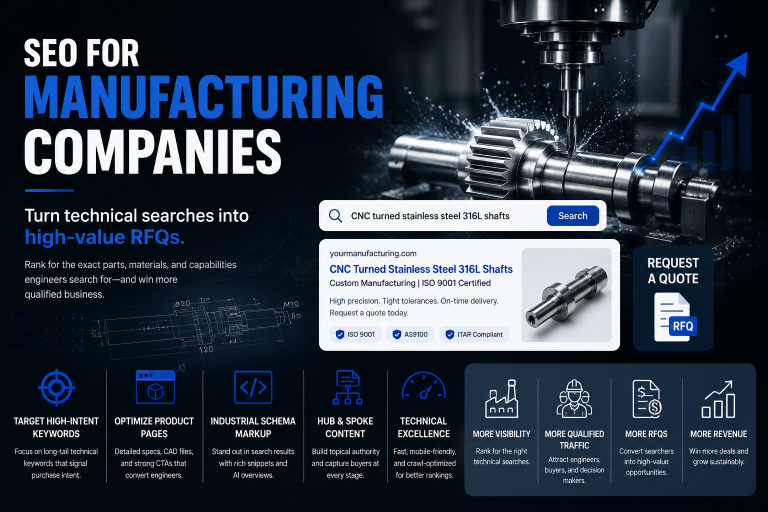
SEO for manufacturing companies is the process of optimizing an industrial website so it ranks higher on search engines when engineers, procurement officers, and B2B buyers search for specific parts, materials, or production capabilities. Effective manufacturing SEO drives high-value Request for Quotes (RFQs) by targeting long-tail technical keywords and improving digital visibility.
When a sourcing manager types “CNC turned stainless steel 316L shafts with 8μm Ra finish” into Google, they aren’t browsing. They’re buying. Your factory’s website either answers that exact query instantly, or you lose the order to a competitor whose product page loads first. That’s the commercial reality manufacturing SEO addresses. In a sector where a single purchase order can be worth six figures, showing up on page one for the right technical terms isn’t just marketing; it’s revenue engineering.
Why manufacturing SEO is different
Standard B2B SEO advice rarely fits industrial businesses. You’re not selling impulse-buy SaaS subscriptions. You’re dealing with part numbers, ISO certifications, material grades, 3D CAD models, and complex buying committees. Search engines, and the AI overviews they now show, need structured, precise signals to trust your site over a generalist distributor. That means your SEO strategy must speak the language of engineers, not just marketers. Below, we break down the core strategies that consistently move the needle for machine shops, custom fabricators, and industrial OEMs.
Core manufacturing SEO strategies
Building a manufacturing site that ranks requires a tactical mix of keyword precision, content depth, and technical cleanliness. These five strategies form the backbone of every successful industrial SEO campaign we’ve run.
Target long-tail technical keywords
Broad terms like “machinist” or “metal fabrication” are vanity metrics. The money lies in highly specific, low-volume search phrases that signal readiness to buy. Focus on exact product specs, material grades, tolerance capabilities, or certifications. A buyer who searches “ISO 9001 certified aluminum CNC machining” already knows what they need; they’re now vetting suppliers. Build your keyword map around:
- Material + process + geometry (e.g., “PEEK injection molding small gears”)
- Industry standard + service (e.g., “AS9100 sheet metal forming”)
- Capacity + equipment (e.g., “5-axis milling 600mm x 400mm titanium”)
- Part number or OEM reference (when allowed)
Use keyword research tools to dig into Reddit threads, engineering forums, and technical PDFs. The language engineers use in specifications documents is the language they’ll type into the search bar.
Optimize product pages
Every distinct product, part family, or manufacturing capability deserves its own content-rich page, not a thin catalog entry. A well-optimised product page includes:
- H1 with the primary technical keyword (e.g., “Custom Polyurethane Injection Molded Seals”)
- Specification tables listing dimensions, materials, tolerances, and testing standards
- Downloadable 2D drawings or 3D CAD files (with alt text that includes dimensions and material)
- Application examples showing real-world use cases
- RFQ call-to-action above the fold, ideally with a short form
These pages not only rank for long-tail searches but also serve as landing pages for PPC campaigns, providing a cohesive user experience that shortens the sales cycle.
Implement industrial schema markup
Structured data is what turns a plain blue link into a rich result that shows specifications, pricing availability, and reviews directly on the search page. For manufacturers, three schema types are non-negotiable:
- Product schema – Mark up every product page with name, description, SKU, material, and manufacturing-specific properties.
- Organization schema – Include your NAICS code, address, certifications, and sameAs links to ThomasNet or industry associations.
- FAQ schema – Structure common technical questions and answers so Google can pull them into AI overviews and featured snippets.
When a procurement officer searches “does acetal meet FDA requirements” and your FAQ page surfaces in the AI snapshot, you’ve just positioned your company as the authoritative answer before a single ad dollar is spent.
Create hub-and-spoke content
Early-stage research traffic is gold. Buyers spend weeks comparing materials, analysing failure modes, and reading design guides before ever submitting an RFQ. Capture that attention with a hub-and-spoke model: a comprehensive pillar page (e.g., “The Engineer’s Guide to Precision CNC Machining”) that links out to several spoke articles covering specific topics like “5-axis vs. 3-axis: When to Upgrade,” “Understanding GD&T Callouts,” or “Material Selection for High-Temperature Applications.”
Each spoke targets a cluster of long-tail informational keywords and links back to the pillar, signalling to Google that your site is a deep topical resource. Over time, this architecture builds the E-E-A-T (Experience, Expertise, Authoritativeness, Trustworthiness) signals that search engines crave, especially for YMYL-adjacent industrial safety or aerospace topics.
Fix technical site health
Manufacturing websites often suffer from heavy CAD files, thousands of product variants, and legacy platforms. If a product page takes five seconds to load on a shop floor tablet, the engineer goes back to the search results and clicks the next supplier. Core technical fixes include:
- Image compression and next-gen formats (WebP for product photos, SVG for technical diagrams)
- Lazy loading for off-screen CAD previews
- Pagination and faceted navigation configured so search engines don’t crawl infinite parameter combinations
- Mobile responsiveness – over 40% of industrial B2B searches now happen on mobile devices
- XML sitemaps that prioritise product and capability pages while excluding thin parameter URLs
Conduct quarterly technical audits. A site that loads in under two seconds and renders flawlessly on a procurement manager’s phone is a site that gets quoted.
Advanced SEO tactics for manufacturers
Once the foundational pieces are in place, advanced tactics separate market leaders from the rest of the page-two results. These strategies compound over time to build a near-impregnable search position for high-value industrial queries.
Turn RFQ forms into conversion machines
Driving traffic is half the battle. Converting that traffic into leads requires frictionless inquiry paths. Embed short RFQ forms directly on product pages, pre-populated with the part number the user was viewing. Add trust signals near the form: ISO certificates, ITAR registration, average response time, and real quotes from plant managers. Track form abandonment with event tags and use those insights to shorten fields or clarify questions. A 2% improvement in RFQ completion can mean thousands in new pipeline value.
Leverage local SEO
Many sub-contractors serve a regional 200-mile radius. Ensure your Google Business Profile is fully completed with precise categories (e.g., “CNC Machining Shop,” “Metal Fabricator”), current photos of your shop floor, and a Q&A section answering common turnaround questions. Encourage satisfied OEM clients to leave detailed reviews that mention specific processes. Locally optimised pages like “Precision stamping services in the West Midlands” can capture buyers who need fast turnaround and face-to-face collaboration.
Build industry backlinks
In manufacturing, relevance beats volume for links. Earn backlinks from ThomasNet, IndustryNet, trade association member directories, material supplier Case studies, and guest articles in publications like Machine Design or Engineering.com. When a major material vendor links to your case study about using their polymer in a medical device, that link carries immense topic authority. Avoid generic link-building; every link should make sense to a mechanical engineer who stumbles upon it.
Create technical videos
Short technical videos (machine run-time clips, material comparison demonstrations, CAD walkthroughs) keep users on page longer and often rank independently on YouTube. Embed a 60-second video on your “Inconel 718 5-axis milling” capability page. Use descriptive filenames and transcripts filled with keyword-rich spoken content. Search engines increasingly surface video results for “how to” and “what is” queries, giving you two listings on page one for the price of one.
Prevent duplicate content
If you sell through distribution partners who also host your product specs, duplicate content is inevitable. Use self-referencing canonicals on your own product pages, and syndicate with care by having distributors add a canonical tag pointing back to your original page. For large catalogs generated from PIM systems, programmatic canonicals prevent thin content indexing while keeping your site clean.
Our SEO framework for manufacturers
At Inteliware Growth, we don’t do vanity SEO. We apply the same data-driven, ROI-focused methodology that has scaled Taxi Companies, immigration law firms, app startups, cleaning businesses, and medical clinics to industrial manufacturers. Our 5-step framework translates seamlessly:
- Audit – We deep-dive your existing web traffic, competitor keyword gaps, technical health, and how many RFQs currently come through organic search. We analyze which product pages underperform despite high margins.
- Strategy – We map every manufacturing capability to a keyword universe, prioritise product pages that can capture RFQs within 90 days, and build a custom content calendar around engineering pain points. KPIs include organic RFQs, quote-to-search ratio, and page-one keyword positions for technical terms.
- Execution – Our team creates technical product copy, implements schema markup, builds hub-and-spoke content, and optimises load speeds. We also manage Google Ads campaigns targeting the same high-intent keywords, creating a unified search presence.
- Tracking – Real-time dashboards show exactly how many quotes each organic landing page generates. Advanced attribution ties a closed $40,000 order back to the specific long-tail search that started the journey.
- Scale – Once a core product group proves profitable in search, we expand the blueprint across additional product lines, geographic markets, and languages. Budget follows proven data, not guesswork.
Take a look at [our services](https://inteliwaregrowth.com/[services](https://inteliwaregrowth.com/services/)) for a complete breakdown of what we offer. When you're ready to see real results, dive into our Case studies to discover how we turn complex B2B search traffic into qualified quotes.
Turn searches into RFQs
The factories that dominate search tomorrow are the ones acting on technical SEO today. If your product pages aren’t built to answer the exact specifications buyers type, you’re invisible at the moment of purchase intent. We can change that.
Contact Us
📞 +92 344 3503901
📧 sales@inteliwaregrowth.com
📍 London, United Kingdom
Book a Free Consultation – available whenever you’re ready. Let’s audit your manufacturing site and build a roadmap that fills your pipeline with qualified RFQs, not just traffic.
Frequently Asked Questions
How long does SEO take for a manufacturing company?
Meaningful movement on technical long-tail keywords typically takes 3–6 months. New, well-optimized product pages can generate RFQs even sooner.
What keywords should a machine shop target first?
Focus on high-margin processes paired with exact materials and certifications. “ISO 13485 CNC swiss machining PEEK” will convert far better than broad terms like “precision machining.”
Is schema markup really that important for industrial websites?
Yes. It tells Google exactly what you manufacture, which can earn rich results and AI overview placements that boost click-through rates by 20–30%.
Can a small manufacturer compete with large distributors in search?
Absolutely. Owning ultra-specific technical niches, like “custom titanium waveguide flanges WR-28,” lets smaller specialists capture high-intent traffic that large distributors ignore.
Do I need to hire an agency, or can I do manufacturing SEO in-house?
In-house teams can handle basics, but an experienced agency accelerates results with advanced schema, content architecture, and precise conversion tracking, often paying for itself in a single captured RFQ.