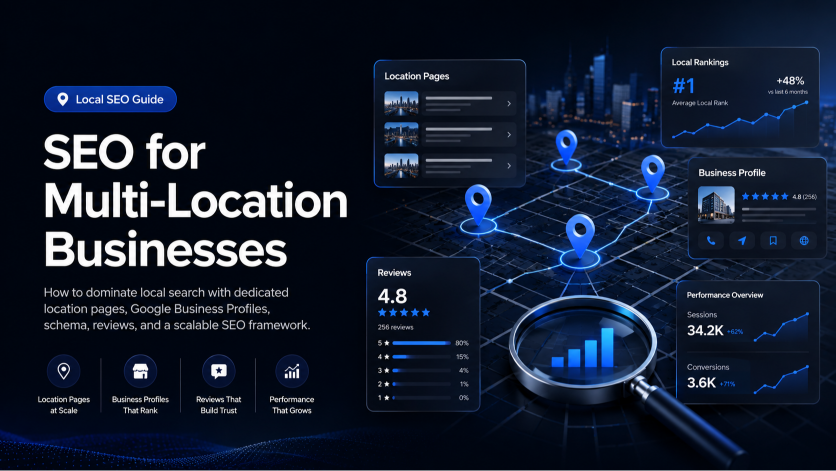
SEO for multi-location businesses means optimizing your online presence so each branch ranks well for nearby customers. Key steps include setting up individual Google Business Profiles for every branch, building dedicated web pages for each area, and keeping your business details the same everywhere online.
Scaling a business across multiple locations is a milestone, but it brings a complex challenge. How do you ensure customers find the specific branch near them, not a competitor down the street? One website alone is not enough. You need a granular strategy that treats every address as a unique entity while maintaining brand authority. At Inteliware Growth, we specialise in performance-driven local strategies for high-intent industries like taxi companies and clinics. Here is how to master multi-location SEO.
Core optimization steps
Mastering multi-location SEO requires a systematic approach. You must move beyond generic marketing and focus on the technical and on-page signals Google uses to determine local relevance. Moz reveals that proximity, relevance, and prominence drive the Map Pack. These pillars are non-negotiable.
Google Business Profiles
A single Google Business Profile (GBP) is not enough for multiple branches. You must claim a unique profile for every physical location. Each profile must be verified and optimized with distinct data, including local phone numbers, specific hours, and precise addresses. Google help page provides clear steps for adding and verifying locations. Avoid using a central call centre number or head office address unless you are purely virtual. For service-area businesses like taxi firms, define the exact service zones for each fleet base. Google prioritises proximity, so each profile must be locally relevant.
Website structure
Your site architecture tells Google how your business is organized. A flat structure where all locations are on one page weakens local relevance. Build a clean, logical URL structure with separate pages for each city. This parent-child structure consolidates authority. When you write blog posts or run ads linking to a specific city page, the URL helps Google understand the relationship between your site and the physical world. It also improves user experience by taking customers directly to the local information they need.
Local content
Copying the same text on every city page and only swapping the city name is a doorway page strategy that Google penalises. Each location page must have unique text. For an immigration law firm, the London page should discuss London-specific courts or community ties, while the Manchester page should do the same for Manchester. Include local photos rather than stock images, staff bios of the team at that branch, and local FAQs. For a cleaning company, mention the specific neighbourhoods served and link to local resources. This demonstrates genuine physical presence and community involvement.
NAP consistency
NAP stands for Name, Address, and Phone number. This data must be identical across the internet, including your website, GBP, Yelp, Facebook, and industry directories. Even minor discrepancies hurt. If your address is Suite 2 on Google but Unit 2 on Yelp, search engines may doubt your business validity. BrightLocal guide explains how to audit and fix mismatched listings. Standardise your business name everywhere, for example Ltd versus Limited. Consistency helps Google confidently display your business in search results and builds trust.
Schema markup
Schema markup is code that provides search engines with explicit information about your business. For multi-location SEO, add LocalBusiness Schema code to every location page, including exact geo-coordinates, branch address, and local phone number. Schema.org docs outlines all required properties. This technical step allows Google to index your data perfectly. When Google understands your data structure, you have a higher chance of appearing in the Map Pack or being cited by Google AI Overview for local queries.
Customer reviews
Reviews are the lifeblood of local SEO, but gathering reviews for your head office does not help satellite branches. You must gather and answer reviews for each specific branch. If a customer visits your Birmingham clinic, direct them to review that specific Birmingham GBP, not the generic brand. Respond to all reviews, positive and negative, to show engagement. This reinforces experience, expertise, authoritativeness, and trustworthiness. A high volume of positive, localized reviews tells Google that this branch is a trusted entity in that neighbourhood.
The Inteliware Growth framework
Writing good content is half the battle. To truly scale, you need to integrate SEO with performance marketing. At Inteliware Growth, we use a 5-step roadmap to turn local SEO into revenue, not just traffic.
1. Audit
Before creating content, we dive into competitor data. For taxi companies, we analyse who ranks for airport transfers in a specific city and why. We evaluate audience intent. Are they looking for a ride now or pricing information? We also audit existing funnels. A common issue for cleaning companies is high traffic on city pages but low conversions because the user cannot find a local phone number quickly. Our case studies show how these audits uncover hidden revenue opportunities.
2. Strategy
You cannot manage what you do not measure. We build a custom roadmap that separates KPIs per location. It is not about total website traffic. It is about the click-to-call rates for Manchester versus Leeds. For app-based startups expanding geographically, we forecast channel performance. We predict how much budget should go to local SEO versus Google Ads Management in specific territories.
3. Execution
We launch custom landing pages designed for conversion. For immigration lawyers, we build pages that handle sensitive search intent and build trust instantly. Every city page loads fast, is mobile-optimised, and features a clear call to action. For doctors and clinics, this is often a Book an Appointment button that goes directly to the local office calendar.
4. Tracking
Google Analytics can mislead local businesses if not configured correctly. We implement advanced attribution models. For multi-location businesses, it is vital to know if a phone call came from the header button on the London page or the footer button on the services page. We use real-time dashboards to show clients exactly how local SEO contributes to their bottom line.
5. Scale
Once we identify which locations or keywords generate leads, we scale aggressively. We might add paid social advertising to amplify local content that already ranks well. If a blog post about immigration rules in London attracts potential clients, we retarget those users on Meta platforms. This synergy between SEO and paid ads reduces customer acquisition cost for our clients.
Common mistakes to avoid
As you implement your strategy, avoid these frequent errors.
Ignoring near me micro-moments
Users often search on mobile while standing on a street. Optimize local pages for voice search and near me queries. Ensure schema includes geo-coordinates so Google can measure proximity instantly.
The fake location trap
Some businesses try to rank for cities where they have no physical office, using virtual offices or P.O. boxes. This violates Google guidelines. Google guidelines clearly prohibit fake listings. If you are a service-based business like a cleaning company, specify your service areas on your GBP rather than creating fake listings.
Neglecting internal linking
Your About Us page and Blog should link down to specific location pages. This pushes authority from high-traffic pages to location pages. For example, a case study about a successful taxi campaign should link to the specific city page where the service was performed.
Our industry expertise
At Inteliware Growth, we understand that different industries require unique local SEO strategies. Here is how we apply multi-location principles across our specialised sectors.
Taxi companies
We optimize local landing pages for instant booking keywords. The goal is to convert search intent into ride requests within seconds. We ensure the phone number is click-to-call on mobile and local area codes are visible.
Immigration lawyers
This is a high-stakes industry. We use local content to establish trust and expertise. We publish local case studies and ensure every lawyer bio is attached to their specific office page.
Cleaning companies
We focus on lead generation. We build city-specific pages targeting residential and commercial cleaning. We integrate instant quote forms and local trust badges, such as Trusted by 200 families in Croydon.
Doctors and clinics
We integrate appointment booking systems directly into location pages. We use LocalBusiness schema with the MedicalClinic type to appear in rich snippets for health queries.
Conclusion
Mastering SEO for multi-location businesses is about building a clear, distinct, and trustworthy web presence for every physical branch. Treat each location as its own entity with dedicated pages, schemas, and reviews, and you create a network of authority that Google cannot ignore. The goal is to solve the user problem immediately. If they need a taxi in Leeds, they find the Leeds page. If they need a doctor in London, they find the London page. By implementing these strategies, you satisfy search engines and serve customers better.
Ready to scale your multi-location business with a data-driven SEO and performance marketing strategy? The team at Inteliware Growth is ready to help. We specialise in turning local searches into high-value customers.
Frequently asked questions
How many Google Business Profiles do I need?
You need one separate GBP listing for every physical location or service area. You cannot use one listing for multiple branches.
Can I copy and paste my website content for different city pages?
No. This is duplicate content and gets penalised. Each page must have unique content relevant to that specific location.
What matters most for local SEO?
Proximity, relevance, and prominence. These cover distance, service match, and reputation.
How long does multi-location SEO take to work?
You can expect movement within three to six months after optimising GBPs and location pages, depending on competition. Paid ads can supplement growth immediately.
Do I need a separate phone number for each location?
Yes, ideally. A unique local phone number reinforces local relevance and helps with call tracking.
Ready to dominate your local market?
Struggling to connect the dots between your website and physical locations? We build high-converting local SEO frameworks for high-intent industries.
Contact Us
📞 +92 344 3503901
📧 sales@inteliwaregrowth.com
📍 London, United Kingdom