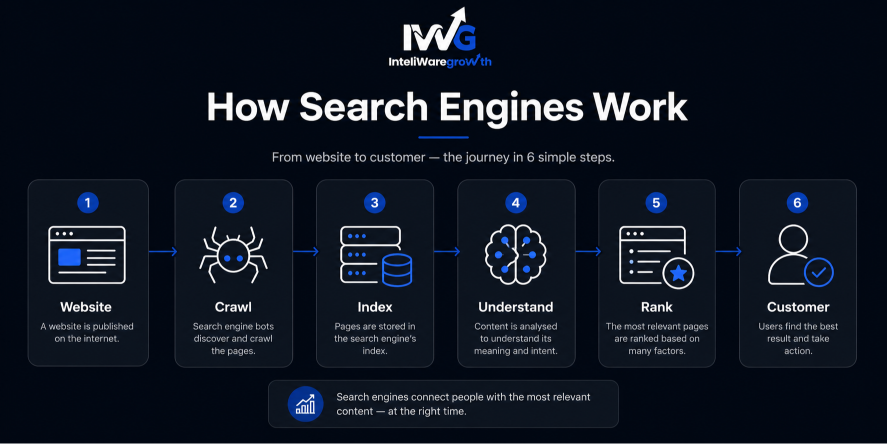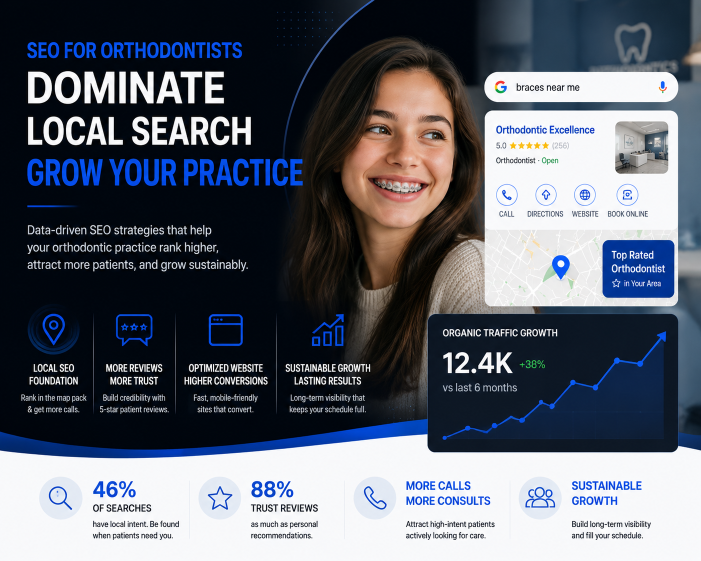
SEO for orthodontists is the process of optimizing your website and local digital profile so your practice ranks high on Google when people search for care like "braces near me" or "Invisalign". It helps local patients find your clinic easily without paying for every single click.
However, turning that definition into a consistent stream of new patients takes a deliberate strategy. The orthodontic practices that win the local market combine strong Google Business Profile signals, patient-first content, and technically sound websites. At Inteliware Growth, we build data-driven growth frameworks for doctors and clinics that do exactly that. This guide walks you through the local, content, technical, and reputation strategies you need to rank higher and grow sustainably.
Why orthodontic SEO captures higher-intent patients
Orthodontic care is rarely an impulse buy. A parent researching braces or an adult exploring clear aligners will search, compare reviews, and look at before-and-after photos before ever picking up the phone. Someone typing “best Invisalign provider in [city]” is signaling buying intent that no social media scroll can match.
SEO meets that intent at the exact moment of need. Unlike paid ads that stop delivering the moment you pause a budget, a well-optimized web presence generates leads for years. Ranking in the local 3-pack also builds instant trust—patients perceive a top organic listing as an endorsement from Google itself. And once your foundation is built, the cost per patient acquisition usually drops well below what you’d pay for high-competition PPC clicks.
Local SEO: foundation of patient acquisition
Because orthodontic patients typically choose a practice within a tight geographic radius, local SEO is the non-negotiable cornerstone of your marketing. Every local signal must reinforce that you are the most relevant, trusted option nearby.
Google Business Profile: your 24/7 front desk
Your Google Business Profile (GBP) often drives more calls and direction requests than your actual website. Claim your profile and treat it as a live asset.
- Set your primary category to “Orthodontist” specifically—not just “Dentist.”
- Completely fill in your hours, phone number, appointment link, and a description that naturally mentions your city and core treatments.
- Upload fresh, high-quality photos weekly. Team images, office tours, and real patient smiles build trust instantly.
- Use Google Posts to share treatment tips, special offers, and practice news. Active profiles rank noticeably higher, as highlighted in Google’s own guidance on improving local rankings.
Map rankings and the local 3-pack
For searches like “braces near me,” the map pack with three business listings takes the vast majority of clicks. Google determines 3-pack placement based on proximity, relevance, and prominence. While you can’t move your physical location, you can aggressively strengthen relevance through precise category selection and localized website content, and prominence through review velocity and backlinks from local media or health directories.
Citations and NAP consistency
NAP stands for Name, Address, and Phone number. This information must appear identically on every directory—Yelp, Healthgrades, WebMD, and any local chamber of commerce listings. Even a minor mismatch like “Suite B” versus “#B” weakens Google’s confidence in your practice. Audit your citations regularly, claim all profiles, and prioritize high-authority health directories over spammy generic sites.
Website content that converts clicks into consultations
Once your local presence is solid, your website must immediately answer the visitor’s question and lead them toward an appointment. Every page should serve a distinct purpose.
Service pages: unique and in-depth
A single “Services” page that lists every treatment is a missed ranking opportunity. Build individual pages for each core offering.
- Clear aligners (Invisalign, Spark): Explain the process, candidacy requirements, typical timelines, and cost considerations. Embed an FAQ section that answers questions about pain, eating, and cleaning aligners.
- Metal and ceramic braces: Detail the differences, expected discomfort levels, food restrictions, and care routines. Use before-and-after images with real patient consent.
- Early interceptive care: Outline the signs a child may need an orthodontic evaluation, the ideal age for a first visit, and the long-term benefits of phase-one treatment.
Each service page needs a unique meta title, clear headings, and a contextual internal link to a related blog post. This depth signals topical authority far better than a thin, generic page. If you need inspiration, our Case studies show how we’ve structured content for clinics to drive measurable lead growth.
Local keywords placed naturally
Include your city and neighborhood terms where they sound human, not stuffed. Your page title might be “Top-Rated Orthodontist in [City] | [Practice Name].” Within the body, mention landmarks and adjacent suburbs to reinforce geographic relevance. If you have multiple locations, create truly distinct landing pages for each area, ensuring the content isn’t duplicated.
Patient education through blogging
A blog captures the long-tail questions parents and teens ask before committing to treatment. Write clear, short posts answering “How long do braces hurt after tightening?”, “What foods can you eat with braces the first week?”, or “Invisalign vs. braces for teens.” These answer-targeted articles often win featured snippets and voice search results, bringing in high-intent traffic without additional ad spend. For deeper insights into aligning content with patient intent, explore our blog.
Technical & mobile factors: invisible ranking engines
A beautifully written website means nothing if it loads slowly or breaks on a smartphone. Technical SEO ensures Google can efficiently crawl your site and users stick around.
Speed and performance
Page speed is a confirmed ranking factor, and a delay of even two seconds kills conversions. Compress large before-and-after images using next-gen formats like WebP, invest in quality managed hosting to improve server response time, and routinely audit and remove any unnecessary plugins or tracking scripts. Google’s PageSpeed Insights tool can help you diagnose specific issues. Lean, fast pages keep both Google and visitors happy.
Mobile-friendly design
The majority of “orthodontist near me” searches happen on phones. Your site must be fully responsive, with tap-friendly buttons and a prominent click-to-call phone number. Streamline your navigation so that booking a consultation is never more than one thumb-tap away. Test every service page and contact form on multiple real devices to catch any friction.
Secure browsing (SSL certificate)
An active SSL certificate (HTTPS) is a baseline requirement. It encrypts any information a patient submits through a form and prevents the “Not Secure” warning in Chrome that instantly erodes trust. For any health-related site, Google also treats HTTPS as a lightweight but necessary ranking signal.
Reputation & trust: the human ranking factor
Google’s E-E-A-T (Experience, Expertise, Authoritativeness, Trustworthiness) guidelines matter enormously for orthodontic practices. In fact, Google’s Search Quality Rater Guidelines explicitly emphasize authority for medical queries. Real-world reputation directly shapes your rankings.
Patient reviews: Your strongest local signal
A 4.9-star rating with hundreds of detailed reviews can outrank a competitor with a more polished website but only a handful of ratings. Make review generation a systematic part of your front-desk workflow: ask happy patients or parents for a review shortly after a positive appointment. Respond to every review professionally—thank positive ones warmly and address any negative feedback with empathy and an offer to resolve the issue offline. This activity signals to Google that your practice is engaged and credible.
Showcase credentials and real transformations
Dedicated doctor bio pages should highlight education, board certifications, continuing education, and professional memberships like the AAO. Before-and-after galleries work even harder when they include brief case descriptions and are marked up with structured data. Any local awards, press features, or community involvement further cement your authority and differentiate you from chains.
How Inteliware Growth accelerates orthodontic patient acquisition
Inteliware Growth is a UK-based performance marketing agency focused on high-intent service industries. We don’t apply generic marketing templates. For orthodontic practices, we fuse technical SEO, patient-focused content, and conversion optimization into one growth framework. Explore our dedicated Doctors & Clinics solutions to see how we tailor this specifically for patient acquisition.
Our 5-step growth framework
- Audit: We perform a deep dive into your GBP health, competitor local profiles, citation accuracy, and website technical state so no gap goes undiscovered.
- Strategy: We build a custom roadmap with clear KPIs—forecasting organic traffic for treatment keywords, local pack improvements, and lead conversion goals.
- Execution: We launch localized landing pages, educational blog series, and conversion-focused ad creative that all share a consistent, authoritative brand voice.
- Tracking: Advanced attribution modeling and real-time dashboards show you exactly which organic pages are producing phone calls and booked consultations.
- Scale: Once the winning keywords and content types are identified, we expand aggressively based purely on profitable, data-backed signals. Our [View all services](https://inteliwaregrowth.com/Services) page gives a complete overview of the channels we deploy.
Ready to own your local market?
Stop depending entirely on paid ads to fill your chairs. A strategic SEO foundation delivers consistent, high-trust patient leads month after month.
Contact Us
📞 +92 344 3503901
📧 sales@inteliwaregrowth.com
📍 London, United Kingdom
Book Your Free Consultation
Frequently Asked Questions
How long does orthodontic SEO take to show results?
You can expect initial ranking improvements within 3 to 4 months. Highly competitive city markets often need 6 to 9 months to reach the local 3-pack.
Is SEO better than Google Ads for orthodontists?
They work best together. Ads bring immediate visibility, while SEO builds a lasting, cost-effective patient channel that grows stronger over time.
What are the best keywords for an orthodontic website?
Focus on terms like “orthodontist near me,” “braces [city],” and “Invisalign provider [city],” plus long-tail phrases such as “how much do braces cost” or “adult braces options.”
Do I really need a separate page for each treatment?
Yes. Separate pages for braces, clear aligners, and early interceptive care let you target specific keywords and show Google deeper expertise on each topic.
How important are backlinks for an orthodontic practice?
Very important when they come from quality sources. Links from local news sites, dental associations, and reputable directories build real authority. Avoid spammy links.
Can I manage orthodontic SEO on my own?
You can handle basics like GBP updates, reviews, and blogging. However, technical audits, site speed fixes, and competitive content strategy usually benefit from a specialist partner.